
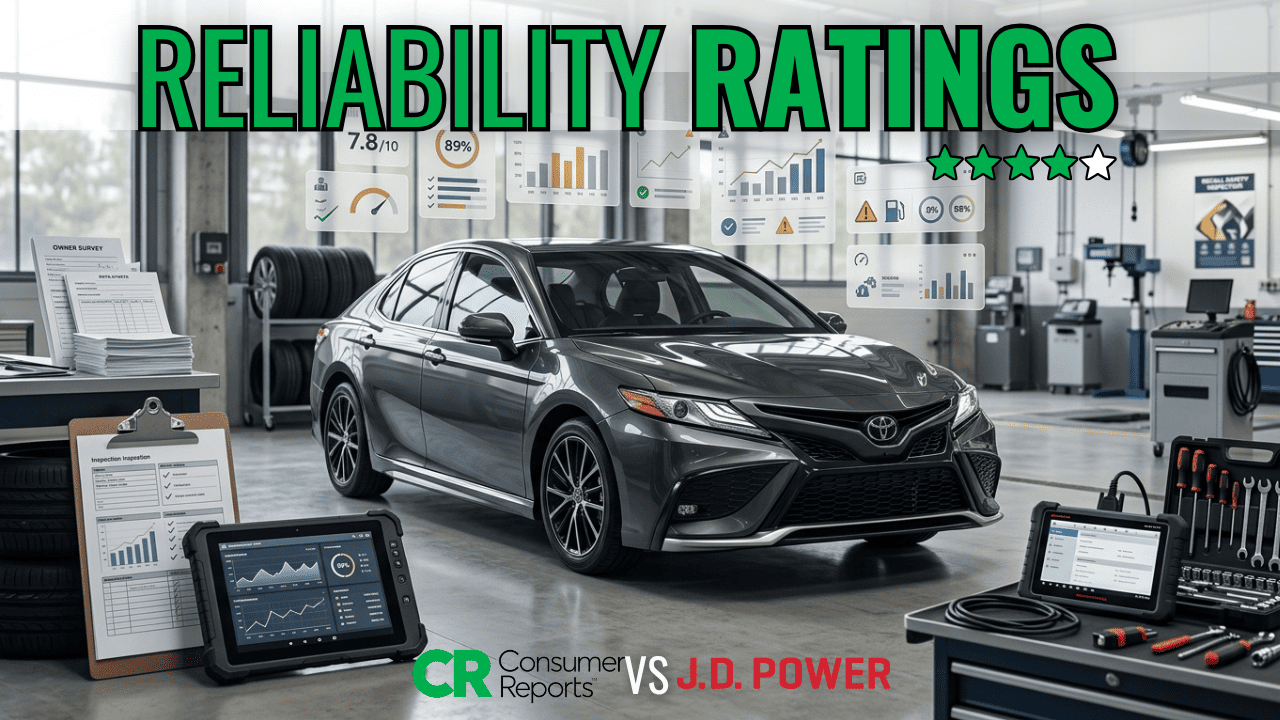
Search almost any car’s reliability and you’ll find conflicting answers. Consumer Reports, J.D. Power, repair data, and owner experiences can disagree without any of them necessarily being wrong.
The reason is simple: there is no universal automotive reliability score. Different sources measure owner-reported problems, dependability, repair costs, breakdowns, recalls, or complaints.
So don’t ask only which rating should I trust? Ask what does this rating actually measure? Once you understand that distinction, conflicting reliability data becomes far more useful.
Reliability, Dependability and Longevity Are Not the Same Thing
Before comparing ratings, separate three concepts often treated as interchangeable. Reliability is how consistently a vehicle operates without faults; dependability measures problems over a defined ownership period; longevity asks whether it can remain usable and economical after very high mileage and many years.
A trouble-free three-year-old car has demonstrated early dependability—not 200,000-mile durability. That’s why J.D. Power scores, Consumer Reports predictions, and high-mileage evidence answer different questions.

Consumer Reports: The Best Starting Point for Most U.S. Buyers
For U.S. shoppers, Consumer Reports is one of the strongest starting points. Its Annual Auto Surveys include roughly 380,000 vehicles, with owners reporting problems across major mechanical, electrical, battery, infotainment, and trim areas. Crucially, CR gives greater weight to more serious problems rather than simply counting complaints.
CR also publishes model-year reliability histories, which are particularly valuable for used-car buyers. There is, however, an important distinction between historical reliability and predicted reliability.
For a 2026 vehicle, Consumer Reports may predict reliability using the model’s recent history. If the vehicle has been redesigned or data is limited, CR may incorporate adjacent model years, related models or brand history.
That is statistically reasonable. But a prediction is still not the same thing as observing that exact vehicle for five years.
Best use: identifying model-year reliability patterns.
Main limitation: new vehicles contain more prediction and less direct evidence.

J.D. Power: Excellent for Defined Ownership Periods
J.D. Power‘s Vehicle Dependability Study measures problems after three years of ownership. The 2026 U.S. study surveyed 33,268 original owners of 2023 vehicles, reporting results as problems per 100 vehicles (PP100)—lower is better.
PP100 needs context. An infotainment glitch and transmission failure both count as problems despite very different consequences. The study therefore measures more than mechanical reliability; software, displays, connectivity, and driver-assistance systems also matter.
Also distinguish the Vehicle Dependability Study from J.D. Power’s Initial Quality Study. They answer different questions.
Best use: comparing three-year dependability.
Main limitation: three years cannot prove 10- or 15-year durability.
RepairPal: What Happens When Reliability Becomes a Repair Bill?
RepairPal measures reliability differently, focusing on repair cost, frequency, and severity. That’s useful because two cars can suffer the same number of failures while creating very different ownership costs—a $250 sensor and a $5,000 transmission aren’t equivalent problems.
RepairPal therefore helps answer an important question: when this vehicle fails, how painful is the repair likely to be?
Best use: understanding repair frequency, severity, and cost.
Main limitation: its dataset and model-year coverage shouldn’t be treated as a current new-car reliability forecast.
NHTSA: Not a Reliability Rating—and That’s Why It Matters
NHTSA tracks recalls, owner complaints, defect investigations, and manufacturer communications—not conventional reliability scores. Raw counts can mislead because they ignore severity, fleet size, and the number of vehicles affected.
Its real value is pattern detection. Repeated complaints supported by investigations, manufacturer information, or recalls provide much stronger evidence than complaint totals alone. For used cars, NHTSA’s VIN lookup is also essential for checking open safety recalls.
Best use: identifying safety defects, recurring failure patterns, and open recalls.
Main limitation: recall and complaint counts are not reliability scores.

ADAC: A Completely Different View of Reliability
Germany’s ADAC Pannenstatistik measures actual roadside-assistance events rather than owner-reported problems. That creates an important distinction: Consumer Reports asks what went wrong; ADAC effectively shows which failures left vehicles needing roadside help.
This makes ADAC valuable for identifying stranding risk, but it doesn’t capture every defect. More importantly for U.S. shoppers, European versions may use different engines, transmissions, and other specifications.
Best use: identifying roadside-breakdown patterns in European-market vehicles.
Main limitation: it measures breakdowns rather than overall reliability, and European results may not apply directly to U.S.-spec cars.
What Car?: Reliability Through Cost and Downtime
For UK readers, What Car?‘s Reliability Survey adds another useful dimension. It considers not only reported faults but also repair cost and how long the vehicle remains off the road.
That matters because reliability isn’t simply failure frequency. One electronic failure that leaves a car waiting weeks for parts may be more disruptive than several inexpensive same-day repairs.
Best use: evaluating UK-market reliability with attention to repair cost and downtime.
Main limitation: results reflect UK specifications, powertrains, and ownership conditions, which may differ from other markets.
Can U.S. Buyers Use European Reliability Data?
Yes—but only when the vehicles are mechanically comparable. That means they share the same generation and substantially the same engine, transmission, hybrid system, drivetrain, and other reliability-critical hardware.
For example, imagine ADAC reports frequent breakdowns in a European SUV fitted with a 2.0-liter diesel and dual-clutch transmission, while the U.S. version uses a 2.5-liter gasoline engine and conventional automatic. The cars may look identical, but the systems causing those failures don’t even exist in the American version. Applying that reliability record directly would be misleading.
The opposite can also happen. If the U.S. and European versions use the same generation, engine family, transmission, and hybrid system, overseas evidence becomes much more relevant—even if equipment and trim differ.
Owner Forums and Reddit: Excellent Clues, Poor Statistics
Owner forums and communities can reveal emerging transmission, electrical, water-leak, or component problems before large reliability surveys have enough data to detect a pattern. Their greatest value is showing you what deserves further investigation.
The limitation is selection bias: owners with problems are far more likely to post than owners whose cars work normally, and complaint counts mean little without knowing how many vehicles are on the road. Treat owner communities as an early-warning system, not a reliability database.
Why Reliability Rankings Sometimes Contradict Each Other
Now the contradictions make sense. Imagine a car with an excellent engine and transmission that rarely breaks down, but suffers frequent infotainment bugs, expensive repairs, and long waits for electronic parts.
ADAC might rate it well because it rarely strands drivers. J.D. Power could penalize its technology problems, RepairPal its repair costs, What Car? its downtime, and Consumer Reports might show strong mechanical reliability alongside weaker electronics.
None necessarily has to be wrong. They’re measuring different dimensions of the same vehicle. That’s why TopCarList doesn’t treat reliability as a single number.
Why Model Year Matters More Than Brand Reputation
A reliable brand doesn’t guarantee every model year will be reliable. Engines, transmissions, electronics, suppliers, and production revisions change, with redesign years deserving particular scrutiny because they introduce the most new variables. Research the specific generation and model year, not just the badge. Our Toyota RAV4 Years to Avoid, Honda CR-V Years to Avoid, and XV70 Toyota Camry year-by-year analysis show how meaningful those year-to-year differences can be.
The TopCarList Car Reliability Ratings Hierarchy
Instead of asking which single reliability source is “best,” use them together. So, for a used vehicle, I would research in roughly this order:
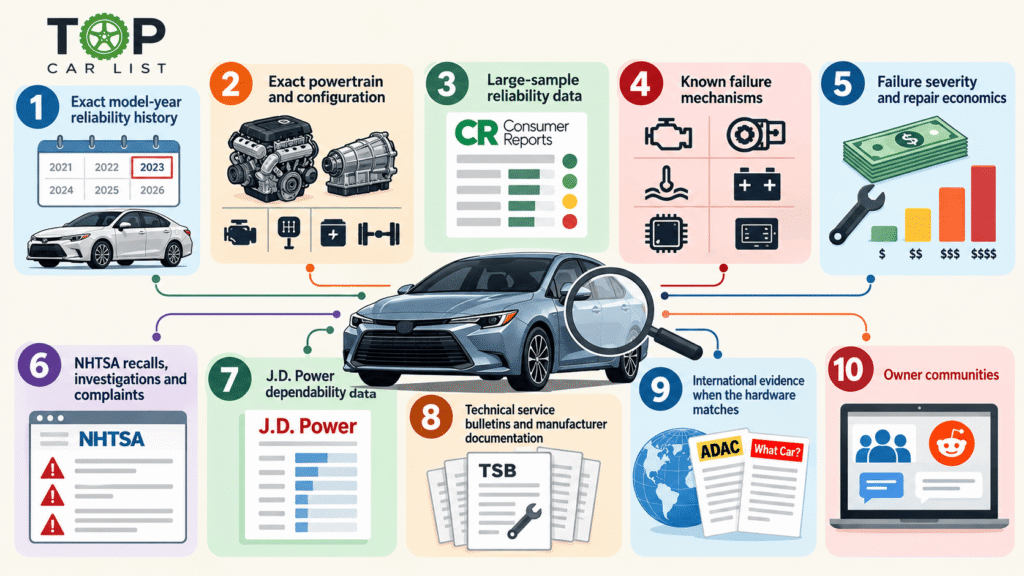
Most importantly, look for convergence.
If Consumer Reports identifies below-average reliability, repair data shows unusually expensive failures, NHTSA contains a recognisable complaint pattern, technical information identifies the affected component, and owners repeatedly describe the same failure, the combined evidence is far stronger than any individual score.
The reverse is equally important. A handful of angry forum posts should carry much less weight when large datasets show no corresponding pattern.
Conclusion: Stop Looking for One Perfect Score
No single reliability score tells the whole story. Use Consumer Reports for historical owner-reported trends, J.D. Power for structured dependability data, RepairPal for repair costs and severity, and NHTSA for recalls, investigations, and complaints.
Then narrow the research to your exact model year and powertrain, identify recurring failures, and find out what they actually cost to fix. A reliability score should tell you where to investigate next, not what car to buy. Our 10-year ownership cost guide shows how those repair risks fit into the larger ownership-cost equation.
Frequently Asked Questions
What is the most trustworthy car reliability rating?
There is no single definitive source. For U.S. buyers, Consumer Reports is one of the strongest starting points because of its large model-year owner dataset, but it should still be combined with repair information, NHTSA records and model-specific technical research.
Is J.D. Power reliable?
Yes, when used for what the study actually measures. The Vehicle Dependability Study evaluates problems experienced by owners after three years. That’s useful evidence of early dependability, but it isn’t proof of 10- or 15-year durability.
Is ADAC more accurate than Consumer Reports?
They shouldn’t be ranked that way because they measure different outcomes. Consumer Reports surveys owner-reported problems, while ADAC primarily records roadside breakdown events. A vehicle can therefore perform well in one dataset and less well in the other without either result being incorrect.
Can I use European reliability ratings when buying a U.S. car?
Yes, if the relevant hardware matches. Verify the generation, engine, transmission, drivetrain and hybrid or electrical system first. Overseas data from a different powertrain may have little relevance to the U.S. version.
Does having lots of recalls mean a car is unreliable?
Not necessarily. Recall counts don’t account for severity, affected population or fleet size. Investigate what the recalls involve and whether they apply to the particular VIN.
Are Reddit and owner forums useful for reliability research?
Yes—for finding potential failure patterns. They are much less useful for estimating failure rates because owners experiencing problems are disproportionately likely to post about them.
- Chinese Cars Are Winning the Technology Race—But Will They Last?

- 2024 Toyota Camry Reliability: Is It Toyota’s Smartest Buy?

- 2023 Toyota Camry Reliability: Is Paying More Really Worth It?

- 10 Most Reliable Used Cars in 2026: Specific Years to Buy

- 2022 Toyota Camry Reliability: Is It the Best Used Camry?

- Car Reliability Ratings Explained: Which Ones Can You Actually Trust?
*Disclaimer: This website provides automotive content for informational purposes only and should not be considered professional advice. While we strive for accuracy, we do not guarantee the reliability or suitability of any vehicle or product mentioned—always conduct your own research before making purchasing decisions. Additionally, some links on this site are affiliate links, meaning we may earn a commission if you make a purchase, at no extra cost to you.