
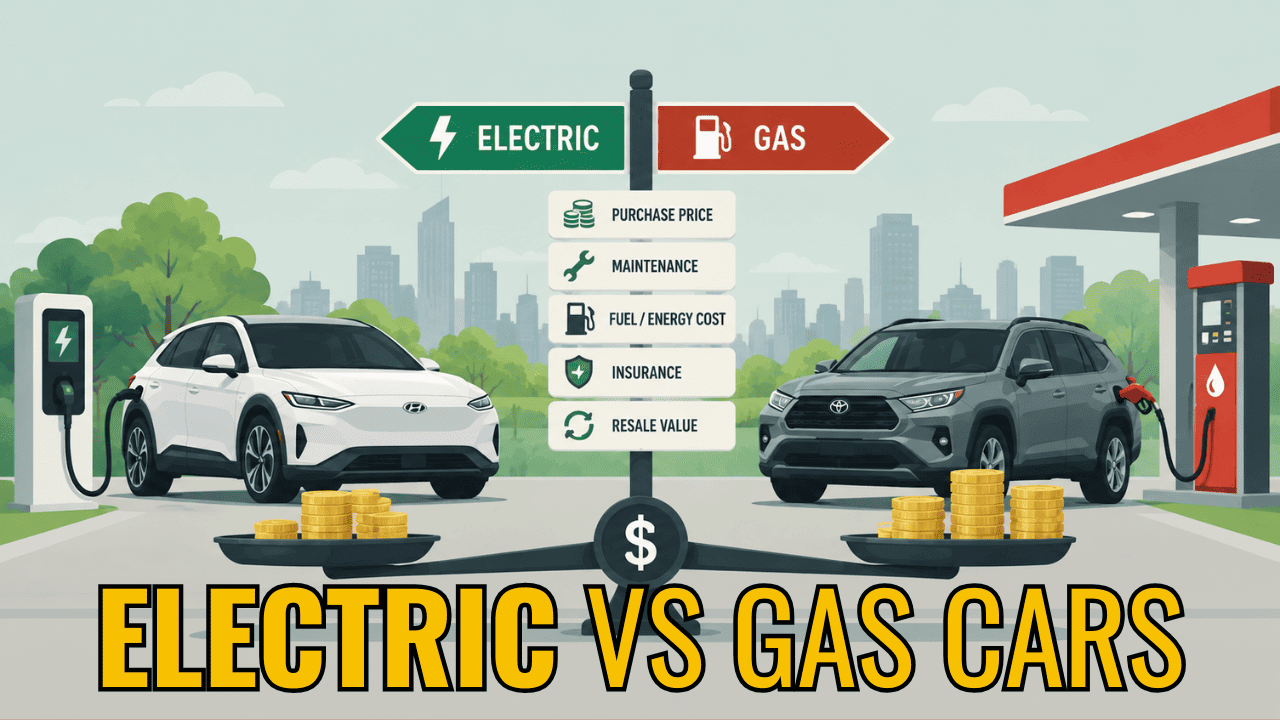
Electric cars are cheaper to fuel. They generally require less routine maintenance. Neither fact proves that an EV is cheaper to own.
The larger financial question is whether those savings compensate for differences in purchase price, financing, insurance, depreciation, charging costs and resale value. In 2026, that calculation has become particularly important because the U.S. federal new and previously owned clean-vehicle purchase credits ended for vehicles acquired after September 30, 2025.
So rather than another list of EV and gasoline-car pros and cons, let’s answer the question that matters:
When does an electric car actually cost less to own?
First, Calculate Energy Cost Per Mile
This is where EVs usually win.
Suppose a gasoline car returns 30 mpg and gasoline costs $3.25 per gallon:
$3.25 ÷ 30 = 10.8 cents per mile
Now take an EV consuming 30 kWh per 100 miles and assume home electricity costs $0.17/kWh:
30 × $0.17 ÷ 100 = 5.1 cents per mile
At 12,000 miles per year:
| Vehicle | Energy cost per mile | Approx. annual energy cost |
|---|---|---|
| 30-mpg gas car | 10.8¢ | $1,300 |
| EV at 30 kWh/100 mi | 5.1¢ | $612 |
The EV saves approximately $688 per year, or $3,440 over five years if energy prices and consumption remain unchanged.
That’s meaningful.
But it isn’t enough to tell us which vehicle is cheaper.
Purchase Price Can Erase Years of Energy Savings
Imagine two otherwise suitable vehicles:
Gas vehicle: $30,000
EV: $35,000
If the EV saves $688 annually in energy, recovering that $5,000 purchase-price difference through energy alone takes about 7.3 years.
And that simple calculation is actually generous to the EV because it ignores any additional financing cost on the extra $5,000.
Reverse the situation—perhaps because a heavily depreciated used EV costs less than its gasoline alternative—and there may be no premium to recover at all.
This is why statements such as “EVs save money because electricity is cheaper than gasoline” are incomplete.
The correct comparison starts with what each vehicle costs you to acquire.
Depreciation May Matter More Than Gasoline
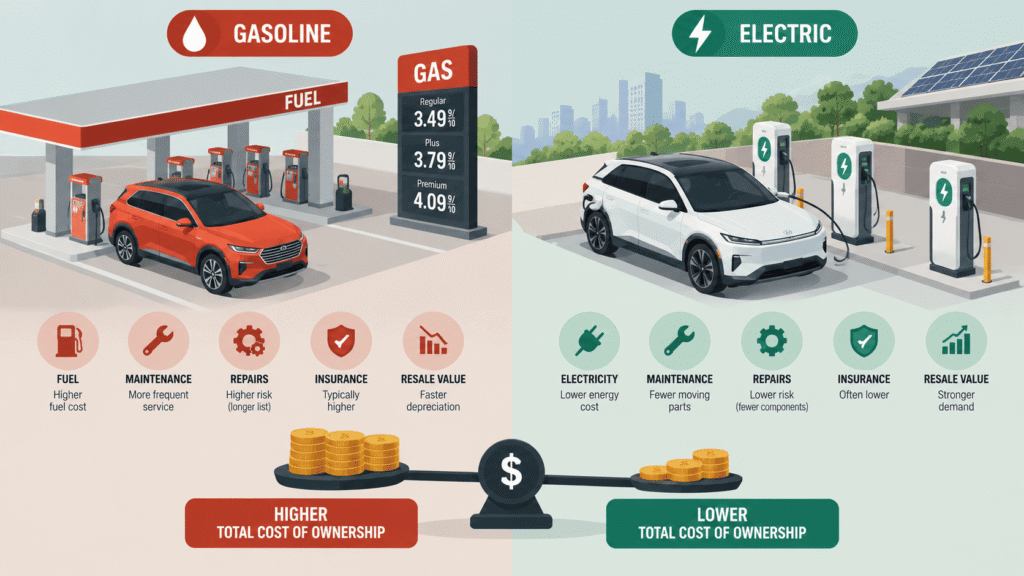
This is the expense buyers routinely underestimate.
AAA’s 2025 Your Driving Costs study found depreciation to be the largest component of new-vehicle ownership cost, averaging $4,334 per year across the vehicles it studied.
That is several times larger than the $688 annual energy saving in our example.
EV depreciation therefore deserves particular attention.
A 2026 University of Michigan study analyzing approximately 260,000 used-vehicle listings found that BEVs depreciated more rapidly than other powertrains during their first several years, before subsequently following more similar depreciation patterns.
That hurts the original buyer.
But it creates a fascinating opportunity for the second owner.
The same study compared new vehicles with three-year-old used vehicles across multiple U.S. cities, vehicle classes and charging scenarios. Over seven years, buying a three-year-old used midsize SUV instead of a new one produced approximately:
- $3,000 TCO savings for an ICE vehicle
- $1,000 for an HEV or PHEV
- $13,000 for a BEV
In the researchers’ used-vehicle analysis, BEVs had the lowest total cost of ownership among the powertrains examined.
That’s an important distinction.
Rapid depreciation can make a new EV financially unattractive while making the same EV unusually attractive used.
EV Maintenance Really Is Lower—But Don’t Exaggerate It
An EV eliminates oil changes, spark plugs, exhaust components and many engine-related service items.
The U.S. Department of Energy has estimated scheduled maintenance at approximately 6.1 cents per mile for a battery EV versus 10.1 cents for a conventional internal-combustion vehicle.
Regenerative braking can also reduce friction-brake wear.
But an EV is not maintenance-free.
It still has tires, suspension, wheel bearings, air-conditioning equipment, coolant systems on many models, cabin filters and numerous electronic and mechanical components. Heavy weight and high torque can also make tire replacement a meaningful expense depending on the vehicle and how it is driven.
The right conclusion isn’t that EV maintenance costs nothing.
It’s that routine powertrain maintenance is structurally simpler and generally cheaper.
Home Charging Changes the Equation
An EV’s cost advantage depends heavily on where you obtain electricity.
The U.S. Department of Energy recommends calculating EV energy cost from two numbers:
electricity price per kWh × vehicle kWh consumed per mile
That’s why “EVs cost X dollars to charge” is almost meaningless without knowing the electricity rate.
Home charging is particularly important because the vehicle can often recharge during the hours it would otherwise be parked. Some utilities also offer time-of-use rates that make off-peak charging cheaper.
Public DC fast charging changes the calculation.
Rates vary considerably by network and location, and repeated reliance on commercial fast charging can substantially reduce the fuel-cost advantage that made the EV financially attractive in the first place.
Someone with inexpensive overnight home electricity therefore has a fundamentally different ownership equation from an apartment resident who depends on public chargers.
No reliable home or workplace charging? Don’t assume the EV will be the cheaper choice.
A Level 2 Charger Is Part of the Purchase Price
Another commonly omitted cost is getting electricity into the car.
Some owners don’t need dedicated charging equipment at all. The Department of Energy notes that Level 1 charging from an appropriate household circuit can meet the daily range requirements of some drivers.
Others need 240-volt Level 2 charging.
The charger itself is only part of the expense. Installation difficulty depends on the distance from the electrical panel, available panel capacity, wiring requirements, permitting and whether electrical upgrades are necessary.
If switching to an EV requires substantial electrical work, add that cost to the EV side of the calculation.
If the house already has suitable charging infrastructure, don’t add it again when replacing one EV with another.
Insurance Can Give Some Savings Back
Never assume identical insurance costs simply because two vehicles occupy the same market segment.
Insurance depends on the specific model, driver, location, repair costs, claims experience and coverage. An EV’s lower energy and maintenance costs can therefore coexist with a higher insurance premium.
The only useful number is the quote for the actual vehicles you’re considering.
Get those quotes before buying, not afterward.
A difference of $50 per month is $3,000 over five years—enough to materially change a close EV-versus-gas calculation.
What About Battery Replacement?
Treating a complete battery replacement as routine EV maintenance produces an equally misleading calculation.
Modern EV batteries are designed for long service, but degradation is real, individual models differ, and an out-of-warranty pack failure can be expensive.
For a new EV, battery warranty terms therefore matter.
For a used EV, the more important questions are remaining warranty, battery state of health and usable range today.
This is another reason a deeply depreciated used EV can be either an excellent purchase or a poor one. The lower price is valuable only if the battery and vehicle condition justify it.
The Break-Even Calculation
For a simple first comparison:
Annual gas cost = annual miles ÷ MPG × gasoline price
Annual EV electricity cost = annual miles × kWh/100 miles ÷ 100 × electricity price
Then calculate:
Annual energy saving = gas cost − EV electricity cost
And:
Simple break-even period = additional EV purchase cost ÷ annual energy saving
But don’t stop there.
For a meaningful ownership comparison, add:
Purchase price + financing + energy + insurance + maintenance + charging installation + taxes/fees − resale value
That is much closer to the real cost of owning the vehicle.
Who Is Financially Favored?
| Your situation | Likely advantage |
|---|---|
| Cheap home charging + high annual mileage | EV |
| Used EV after heavy early depreciation | Potentially strong EV case |
| Mostly expensive public fast charging | Gas advantage increases |
| Low annual mileage + substantial EV price premium | Gas often harder to beat |
| Already have home charging installed | EV economics improve |
| Expensive charger/electrical upgrade required | EV break-even takes longer |
| Keep cars only 2–3 years | Depreciation becomes critical |
| Keep cars for many years | Operating savings matter more |
| Frequent remote long-distance travel | Gas may have practical value beyond TCO |
The Most Interesting Buy in 2026 May Be a Used EV
This is where today’s market becomes counterintuitive. New EV buyers can suffer from rapid early depreciation. Used EV buyers can benefit from exactly the same phenomenon.
The University of Michigan’s 2026 analysis found used BEVs had the lowest total cost of ownership across its studied powertrains, with the researchers specifically identifying depreciation as a major reason.
That doesn’t mean every used EV is a bargain though, battery condition, charging speed, range, repair history, insurance and model-specific reliability still matter enormously. But a three-year-old EV whose first owner absorbed a large portion of its depreciation deserves a very different financial analysis from the same vehicle when new.
For value-focused buyers, that may be one of the most important changes in the EV market.
Final Verdict: Electric or Gas?
There is no financially correct powertrain independent of the buyer.
An EV has its strongest case when you can buy it without a large price premium, charge cheaply at home, drive substantial annual mileage and keep it long enough for lower operating costs to accumulate.
A gasoline car becomes harder to beat when the comparable EV costs substantially more, annual mileage is low, home charging is unavailable or expensive public charging will dominate.
And used vehicles complicate the conventional wisdom further. Rapid early EV depreciation is bad news for new-car resale value but can create unusually attractive prices for second owners.
So don’t ask whether EVs are cheaper than gas cars.
Ask:
What will these two specific cars cost me over the number of years I actually intend to own them?
Once purchase price, financing, depreciation, energy, maintenance, insurance and resale are included, the answer can be very different from what the fuel bill alone suggests.
For readers deciding between electric, hybrid and plug-in hybrid powertrains based on how they actually drive, our Hybrid vs. Electric Cars: How to Choose Between Them guide tackles that separate question.
- Chinese Cars Are Winning the Technology Race—But Will They Last?
- 2024 Toyota Camry Reliability: Is It Toyota’s Smartest Buy?
- 2023 Toyota Camry Reliability: Is Paying More Really Worth It?
- 10 Most Reliable Used Cars in 2026: Specific Years to Buy
- 2022 Toyota Camry Reliability: Is It the Best Used Camry?

- Car Reliability Ratings Explained: Which Ones Can You Actually Trust?
*Disclaimer: This website provides automotive content for informational purposes only and should not be considered professional advice. While we strive for accuracy, we do not guarantee the reliability or suitability of any vehicle or product mentioned—always conduct your own research before making purchasing decisions. Additionally, some links on this site are affiliate links, meaning we may earn a commission if you make a purchase, at no extra cost to you.