
The biggest changes coming to electric vehicles may not be the ones receiving the most publicity. Solid-state batteries continue to dominate headlines, but between 2026 and 2031, less glamorous advances in electrode manufacturing, silicon anodes, battery management, pack architecture, high-voltage electronics and alternative chemistries could affect ordinary EVs sooner.
So rather than speculate about flying cars or 1,000-mile EVs, here is what current engineering and scientific evidence tells us is actually coming.
1. Dry Electrodes Could Change How Batteries Are Built
One of the most consequential battery advances of 2026 isn’t a new chemistry at all. It’s a different way of manufacturing electrodes. The potential benefits include simpler manufacturing and the ability to build thicker, high-loading electrodes.
A February 2026 Nature Energy study demonstrated dry-processed electrodes with more than 99% active material by weight and areal loading above 5 mAh/cm². What’s unusual is that the researchers achieved this through electrode architecture rather than inventing a new cathode chemistry or exotic electrolyte.
What this could mean by 2031: incremental improvements in energy density accompanied by potentially more efficient battery manufacturing. It may matter to mass-market EVs sooner than some much more famous battery breakthroughs.
2. Silicon Anodes Are Getting More Interesting Than the “Better Range” Headlines Suggest
Graphite has dominated commercial lithium-ion anodes, but silicon can theoretically store far more lithium per unit mass. The interesting development isn’t simply “more silicon.” Researchers are becoming better at controlling what happens at the microscopic interface between silicon and the electrolyte.
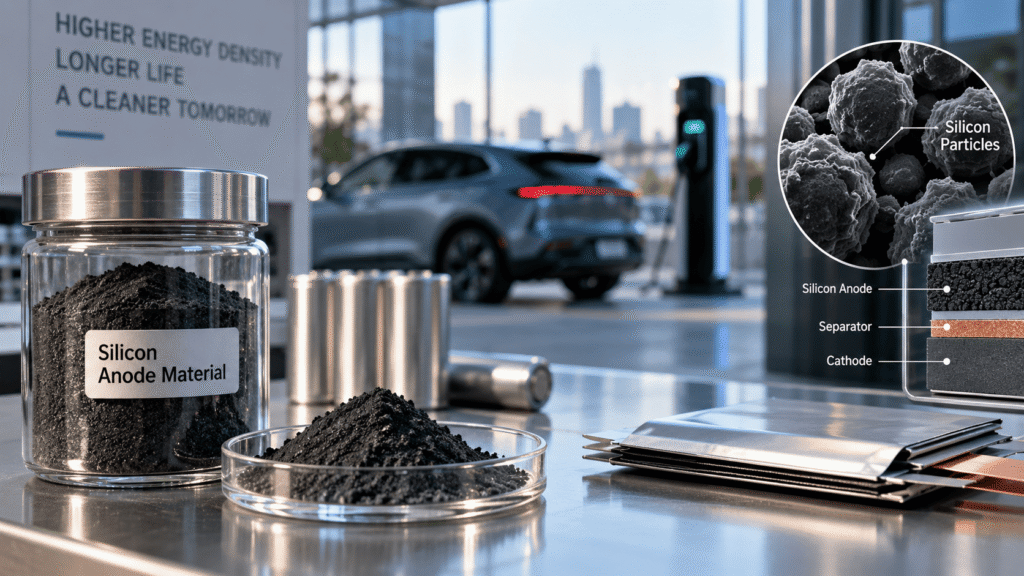
In May 2026, researchers reported a catalytic interface that encouraged formation of a compact, lithium-fluoride-rich SEI on silicon-based anodes. Their pouch cells reached approximately 85.3% charge in six minutes while delivering about 240 Wh/kg under that charging condition. Ah-scale laminated cells retained about 72% of their initial capacity after 500 cycles under six-minute charging.
Those numbers are remarkable, but they require context: this is peer-reviewed experimental battery research, not evidence that your next EV will routinely charge to 85% in six minutes. The important breakthrough is the mechanism. Engineers are learning how to control interfacial chemistry so that silicon can tolerate extreme charging without destroying itself as quickly.
What this could mean by 2031: progressively higher silicon content in commercial anodes, supporting higher energy density and faster charging without waiting for an entirely new battery chemistry.
3. Solid-State Batteries Are Real—but the Timeline Is Usually Oversold
Solid-state batteries replace the conventional liquid electrolyte with a solid electrolyte. The IEA’s 2026 assessment distinguishes semi-solid, almost-solid and true all-solid-state batteries. The versions promising the largest benefits remain at prototype or small-scale testing stages, and all-solid-state manufacturing is still more complicated and expensive than conventional lithium-ion production.
The IEA therefore expects solid-state batteries to remain largely confined to premium applications into the first half of the 2030s. That doesn’t mean solid state has failed. It means the transition is likely to be evolutionary.
What this could mean by 2031: the first serious commercial applications may arrive, particularly in expensive vehicles where additional range or performance can justify the cost. But conventional lithium-ion batteries will probably still power most mainstream EVs.
4. Sodium-Ion Batteries Could Solve a Different Problem
Sodium-ion technology is often described as a cheaper replacement for lithium-ion batteries. That’s incomplete. Its most interesting advantage may be temperature performance.
According to the IEA’s 2026 assessment, the latest sodium-ion cells can retain around 90% of nominal capacity at temperatures as low as −40°C. That’s particularly significant because cold-weather performance remains one of the weaknesses of many lithium-ion EVs.
There is a major tradeoff. The IEA reports current leading sodium-ion cells at up to roughly 175 Wh/kg, versus about 205 Wh/kg for advanced LFP and 265 Wh/kg for NMC. Lower energy density means more battery mass and volume for the same range.
That makes sodium-ion poorly suited to the simplistic prediction that it will replace lithium-ion everywhere. It may instead excel in smaller short-range EVs, commercial vehicles, stationary storage and potentially mixed-chemistry packs combining sodium-ion and lithium-ion cells to exploit their different strengths.
What this could mean by 2031: cheaper or cold-weather-oriented EVs using sodium-ion, while lithium-ion remains dominant where range and packaging efficiency matter most.
5. The Weakest Cell May Matter More Than the Average Cell
This is one of the least discussed EV reliability problems—and one of the most important findings published in 2026. An EV battery contains hundreds or thousands of individual cells. They don’t age identically.
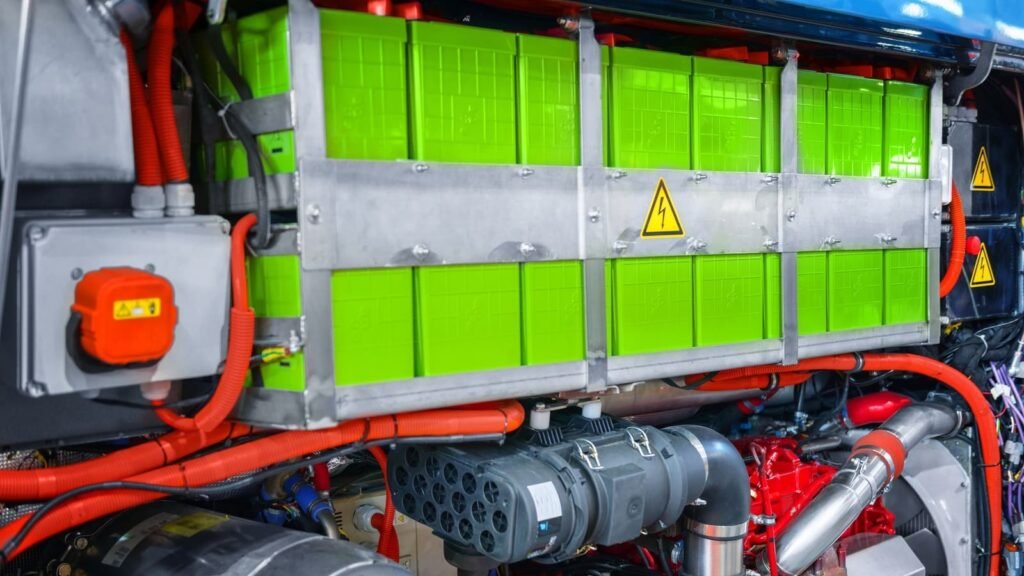
Researchers analyzing real-world operating data from 116 electric passenger cars and 17 electric buses, with some vehicles accumulating as much as 300,000 km, quantified what happens when cells inside a pack gradually diverge.
For the passenger cars studied, cell-to-cell inconsistency shortened pack lifetime by an average 17.7% relative to the average lifetime of the constituent cells and reduced power capability by 12.9%. Only about 80.7% of the available battery energy resources were ultimately utilized over the operational lifetime.
That’s profound because it changes how we should think about battery longevity. The future isn’t simply about manufacturing cells that last longer. Manufacturers also need cells that age more consistently, along with battery-management systems capable of detecting and managing divergence.
What this could mean by 2031: more sophisticated BMS algorithms, tighter cell-manufacturing tolerances and much better battery-health diagnostics. For used-EV buyers, detailed pack-health information could eventually become as important as mileage is today.
6. Cell-to-Pack and Cell-to-Chassis Designs Will Remove More “Packaging”
Traditional EV batteries group cells into modules, then modules into a pack. Every layer requires housings, connectors and structural material that doesn’t store energy. Cell-to-pack designs remove the module layer. Cell-to-chassis concepts go further by integrating the battery more directly into the vehicle structure.
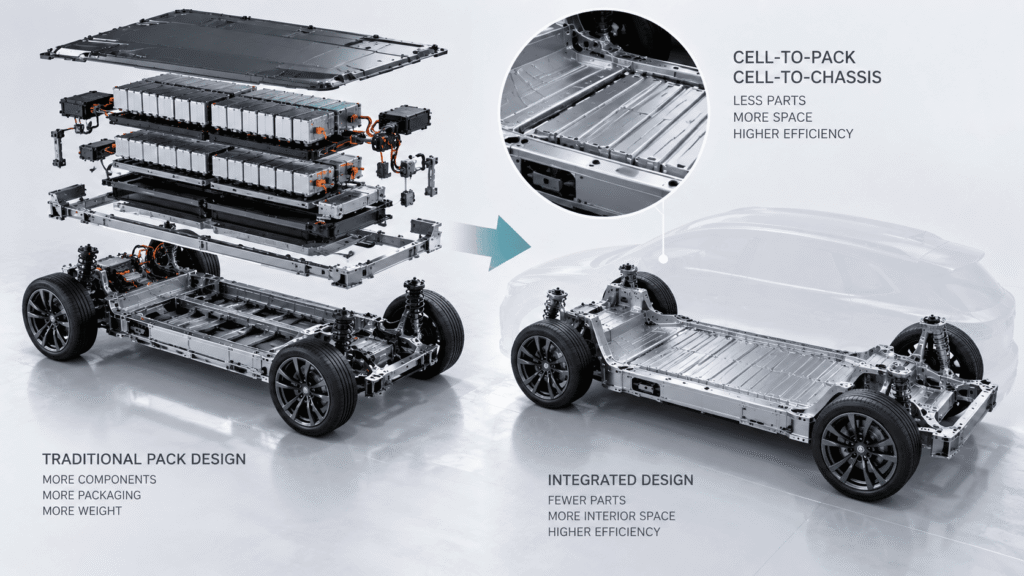
The IEA notes that these architectures are already helping manufacturers increase system-level energy density, particularly with lower-energy-density LFP cells. But integration creates an underappreciated tradeoff: serviceability.
A highly integrated battery can use space brilliantly while making damaged or degraded components harder to replace individually. The engineering objective therefore isn’t merely maximum energy density; manufacturers also have to balance structural integration, crash repair, recycling and eventual pack servicing.
What this could mean by 2031: EV range improvements won’t come only from better chemistry. Engineers will extract more usable energy from the same physical space by removing redundant structure—but buyers should pay increasing attention to repairability.
7. 800- and 1,000-Volt EVs Change Charging Physics—but They Don’t Eliminate Battery Limits
Ultra-fast charging is often reduced to one number: charger kilowatts. The physics is more interesting. For a given power, doubling voltage halves current. Because resistive heating rises with the square of current, the IEA calculates that doubling voltage can reduce those resistive losses by 75%.
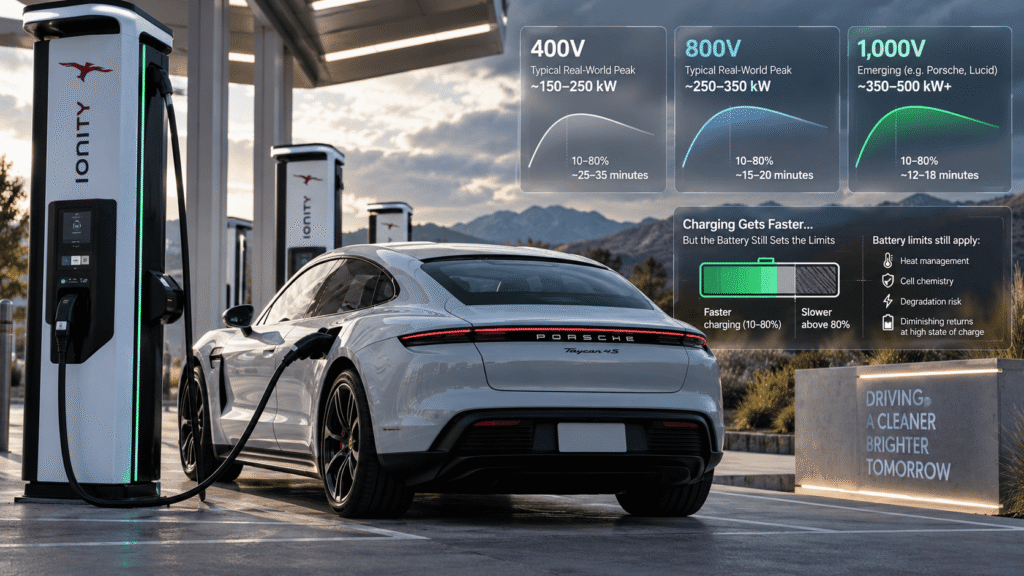
Higher pack voltage reduces current and heat in cables and power electronics; it does not make the battery cells charg faster. Cell chemistry, lithium transport, temperature and cooling still determine how much charging current the battery can safely accept.
That’s one reason EVs are moving beyond traditional 400-volt architectures toward 800 V and above. The first production 1,000-volt passenger EV platforms appeared in 2025, and more high-voltage vehicles followed. That is why advances such as the silicon-interface research discussed earlier matter just as much as 800- or 1,000-volt hardware.
What this could mean by 2031: sub-15-minute charging should become considerably more common in capable EVs, but headline peak kW will remain a poor way to judge charging performance. The useful metric is how much energy the vehicle can sustain across the charging curve.
8. Your EV Could Become Part of Your House—and Eventually the Grid
An EV battery is enormous compared with most household energy-storage systems. The U.S. Department of Energy notes that light-duty EV batteries commonly hold roughly 15–100 kWh, enough to make bidirectional vehicles useful as building-scale energy-storage devices.
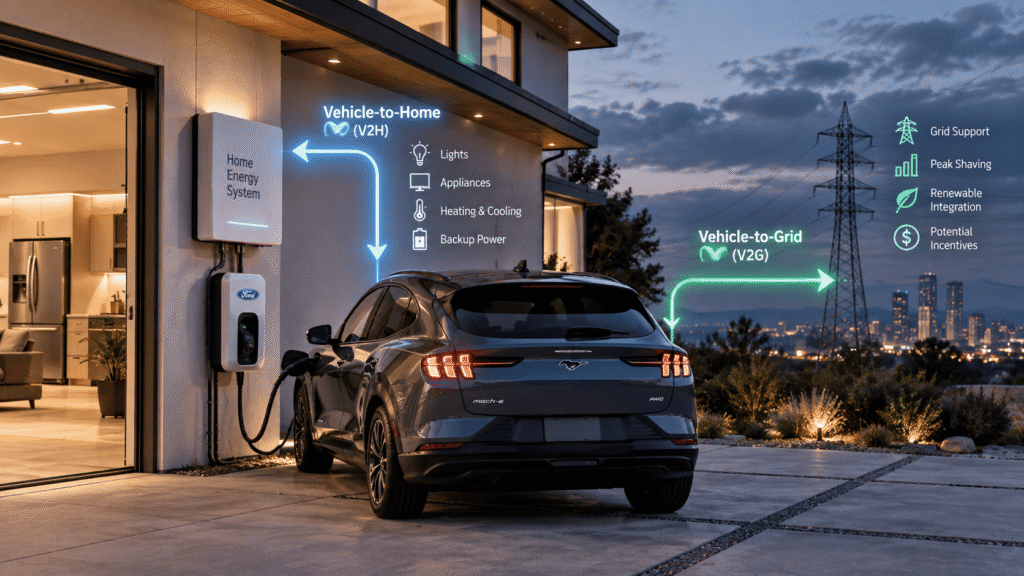
An EV can supply electricity during an outage or shift energy consumption away from expensive peak periods. Vehicle-to-grid systems go further, allowing aggregated vehicles to participate in demand response and other grid services.
The difficult part isn’t proving that electricity can flow backward. That’s already established, the challenge is standardization, compatible vehicles and chargers, utility rules, installation costs, battery-warranty implications and coordinating thousands of mobile batteries whose owners still expect them to be charged when they need to drive.
What this could mean by 2031: bidirectional capability may increasingly become a purchasing consideration rather than an engineering curiosity, particularly for homeowners with solar power or regions vulnerable to outages.
What Will Actually Change EVs by 2031?
The evidence suggests that the next five years might not be defined by one miraculous battery, instead we could expect it to be defined by stacked improvements. This also explains why shoppers shouldn’t evaluate an EV solely by EPA range.
Battery chemistry, charging curve, thermal management, pack repairability, degradation, voltage architecture and battery-health diagnostics will increasingly determine whether two EVs with similar advertised range provide very different ownership experiences.
For buyers deciding whether an EV already makes sense today, our Hybrid vs. Electric Cars guide addresses the practical choice rather than the future technology.
Final Verdict
By 2031, the typical EV may not look radically different from one sold today. Underneath it, however, substantial changes are likely. Perhaps the most important development will be less visible: battery engineering is moving from optimizing individual cells toward optimizing the entire system.
The 2026 finding that cell inconsistency alone can shorten real-world pack life by nearly 18% illustrates why. The next generation of EVs won’t become dramatically better simply because one laboratory discovers a cell with spectacular energy density. They will improve when chemistry, electrodes, manufacturing consistency, cooling, power electronics, pack architecture and battery-management software work together.
That is less dramatic than the promise of a revolutionary battery. It is also much closer to how the next generation of electric vehicles will actually arrive.
- Chinese Cars Are Winning the Technology Race—But Will They Last?
- 2024 Toyota Camry Reliability: Is It Toyota’s Smartest Buy?
- 2023 Toyota Camry Reliability: Is Paying More Really Worth It?
- 10 Most Reliable Used Cars in 2026: Specific Years to Buy
- 2022 Toyota Camry Reliability: Is It the Best Used Camry?

- Car Reliability Ratings Explained: Which Ones Can You Actually Trust?
*Disclaimer: This website provides automotive content for informational purposes only and should not be considered professional advice. While we strive for accuracy, we do not guarantee the reliability or suitability of any vehicle or product mentioned—always conduct your own research before making purchasing decisions. Additionally, some links on this site are affiliate links, meaning we may earn a commission if you make a purchase, at no extra cost to you.