
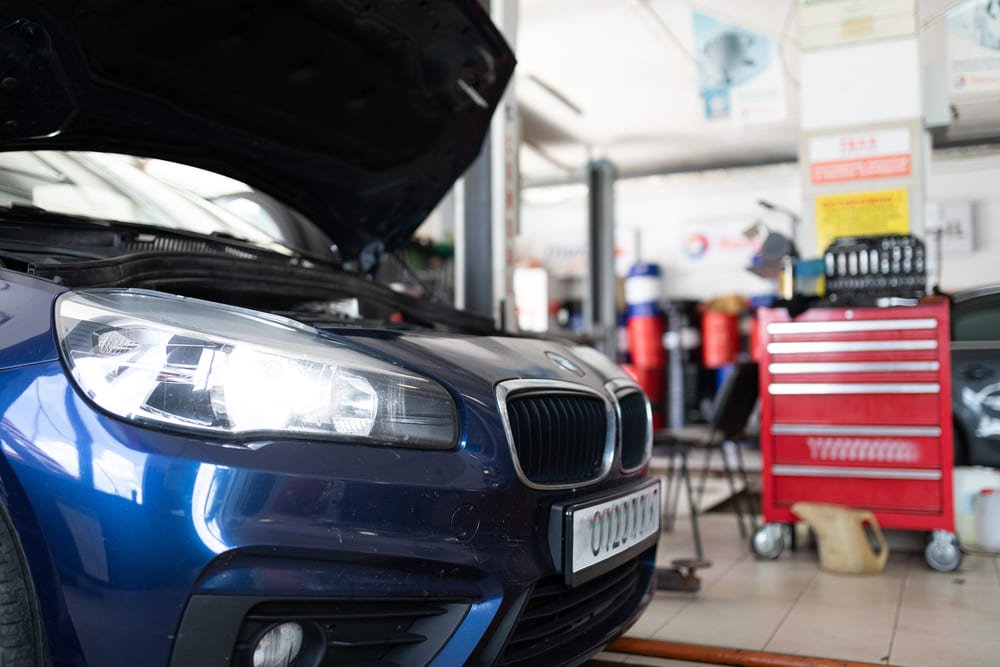
German cars have a reputation for expensive maintenance, while Japanese cars are associated with almost the opposite. There is evidence behind that difference: Consumer Reports‘ long-term cost analysis places several European luxury brands—including Audi, BMW, Mercedes-Benz, and Porsche—among the more expensive manufacturers as vehicles age. RepairPal illustrates the gap more simply, estimating roughly $968 in average annual repair and maintenance costs for BMW versus $441 for Toyota.
But that doesn’t mean German engineers build bad cars and Japanese engineers build good ones. Maintenance cost and reliability are not the same metric.
Ownership cost also reflects the hardware installed, consumable prices, packaging density, labor time, parts cost, and service complexity. A tightly packaged performance car with adaptive suspension and large brakes can therefore cost substantially more to maintain than a simpler mainstream vehicle even if neither suffers an unusual number of failures.
Reliability determines how often the car needs attention. Engineering complexity helps determine how expensive that attention becomes.
Maintenance Cost Isn’t the Same as Reliability
Consider two hypothetical cars. Car A needs four $400 repairs, while Car B needs only two repairs at $1,600 each. Car B has failed half as often, yet its total repair bill is twice as high. That’s why high ownership cost shouldn’t automatically be interpreted as poor reliability. A more useful framework is:
ownership service cost = scheduled maintenance + repair frequency + repair complexity + parts and labor cost
German premium vehicles often differ from mainstream Japanese cars across several of these variables simultaneously. Reliability determines how often something goes wrong; engineering complexity and parts pricing help determine how painful it is when it does.
Why German Cars Often Cost More
Part of the difference begins with what you’re comparing. BMW, Mercedes-Benz, Audi, and Porsche sell many premium and performance vehicles, while Toyota, Honda, Mazda, and Subaru operate much more heavily in the mainstream market.
A performance-oriented German car may use larger brakes, wider tires, turbocharged engines, more elaborate cooling systems, adaptive dampers, electronic differentials, or air suspension. None of those systems needs to fail for ownership to become expensive. Larger tires and brakes cost more to replace, powerful engines may require more oil and specialized fluids, and sophisticated suspension hardware is expensive when normal wear eventually catches up with it.
So some German cars cost more to maintain simply because they contain more expensive things to maintain.
That’s a cost-of-complexity issue—not necessarily a reliability problem.
The Hidden Cost of Packaging
There is another factor that receives far less attention: serviceability. Imagine the same $50 seal on two engines. One is accessible immediately; reaching the other requires removing intake hardware, cooling components, structural bracing, or adjacent systems. The part costs the same. The repair doesn’t.
Modern premium vehicles increasingly package turbochargers, emissions equipment, AWD hardware, cooling circuits, and electronics into remarkably dense spaces. That packaging can improve aerodynamics, crash structure, cabin space, and performance density, but the engineering tradeoff is sometimes greater service labor.
This creates an important ownership distinction: component reliability determines whether the repair happens; serviceability determines how difficult the repair becomes. Or more simply: parts fail. Packaging determines how expensive some failures become.
Why Japanese Cars Often Cost Less
Japanese vehicles no longer possess some universal simplicity advantage. Toyota and Honda build sophisticated hybrids, turbocharged engines, complex ADAS, and deeply integrated electronics; Lexus adds air suspension and high-output luxury powertrains. Modern Japanese engineering can be extremely complex.
The advantage for mainstream models is partly economic. Millions of Corollas, Camrys, Civics, Accords, RAV4s, and CR-Vs on North American roads create a huge service ecosystem: more technician experience, aftermarket competition, used and remanufactured parts, diagnostic knowledge, and independent-shop familiarity.
Scale doesn’t merely reduce the cost of building a vehicle. It can reduce the cost of keeping one alive.
Vehicle class matters just as much. Comparing a Corolla with a BMW 5 Series and attributing the maintenance gap entirely to Japan versus Germany confuses nationality with engineering purpose. One was designed primarily as affordable transportation; the other as a premium performance sedan.
Their maintenance costs should be different—even if both are perfectly reliable.
Japanese Doesn’t Automatically Mean Cheap
The nationality shortcut breaks down quickly once comparable vehicles are examined. A Lexus LS with sophisticated suspension, large wheels, extensive electronics, and a powerful drivetrain won’t suddenly have Corolla ownership costs because both come from Toyota Motor Corporation.
Performance models expose the same flaw. Large brakes, specialized tires, AWD hardware, adaptive chassis systems, and high-output powertrains cost more to maintain regardless of the manufacturer’s passport.
German cars aren’t inherently expensive to maintain, and Japanese cars aren’t inherently inexpensive. The more useful question is what hardware you’re actually buying. Configuration matters more than nationality.
The Used Luxury-Car Depreciation Trap
This becomes especially important when shopping used. Imagine an $80,000 German luxury SUV depreciates to $20,000.The new owner understandably thinks:
I’m buying a $20,000 vehicle.
Which is the purchase price of a mainstream used car, however, mechanically, it remains an $80,000 machine.
You’re still maintaining the suspension, brakes, cooling systems, drivetrain, and electronics engineered for its original performance and luxury targets. Depreciation doesn’t shrink the brake rotors, remove the air suspension, simplify the adaptive dampers, or make a tightly packaged turbocharged engine easier to service.
Vehicle value depreciates. Maintenance architecture doesn’t.
That’s why a heavily depreciated German luxury vehicle can be outstanding value for one owner and financially painful for another. The purchase price tells you what the vehicle is worth today. It doesn’t tell you what kind of machine you’re agreeing to maintain.
Don’t Assume German Cars Require the Dealer
Another outdated assumption is that German cars inevitably require dealership servicing. Modern BMWs, Mercedes-Benz, Audi, and Porsche cars certainly demand capable diagnostic equipment and platform-specific knowledge, but strong independent specialist networks exist across the U.S.
A good BMW or Mercedes specialist can diagnose and repair problems far beyond what a general repair shop encounters regularly—and often knows which combinations of engine, transmission, chassis hardware, and model year age well in the real world.
For anyone considering an older German luxury car, one of the smartest decisions can therefore happen before buying it: find the specialist first. Ask which powertrains they see repeatedly, what failures become expensive, which configurations they would avoid, and how readily parts are available.
That workshop knowledge can reveal ownership risks a generic reliability score cannot.
What Should You Compare Before Buying?
Instead of asking whether German or Japanese cars are cheaper to maintain, compare the actual hardware.
| Check | Why It Matters |
|---|---|
| Exact powertrain | Determines fluids, service procedures and mechanical complexity |
| Suspension | Air/adaptive systems create different long-term costs |
| Wheel and brake package | Larger performance hardware increases consumable costs |
| Drivetrain | AWD adds components compared with simpler 2WD layouts |
| Parts availability | Affects both cost and downtime |
| Service access | Labor can dominate otherwise inexpensive repairs |
| Local specialist support | Particularly valuable with older premium vehicles |
| Maintenance records | Often more informative than nationality |
That is also why two examples of the same model can produce surprisingly different ownership experiences.
The expensive wheel package, adaptive suspension and high-output engine that made one configuration desirable when new may be exactly what makes another configuration preferable used.
German vs. Japanese Maintenance: Which Is Cheaper?
On average, Japanese cars are cheaper to maintain—particularly when mainstream Japanese vehicles are compared with German premium brands. Consumer Reports’ long-term data supports that broad difference, especially as vehicles age beyond their early warranty years.
But nationality isn’t the mechanism. German vehicles often combine expensive components, performance-oriented consumables, dense packaging, and sophisticated chassis and comfort systems. Mainstream Japanese models frequently benefit from mature platforms, enormous production volumes, broad parts availability, and extensive independent-repair knowledge.
That doesn’t make the German vehicle poorly engineered. Sometimes the engineering that makes the car exceptional is precisely what makes it expensive to maintain.
Reliability helps determine how often repairs occur. Complexity, component cost, and serviceability determine how painful those repairs become.
So don’t ask only whether the car is German or Japanese. Ask the question that actually matters:
‘What hardware am I agreeing to maintain?‘
If you want to continue exploring how engineering philosophy affects long-term ownership, read our Korean vs. Japanese Cars: Are They Equally Reliable? analysis, where we examine whether Korea’s rapid engineering progress has translated into the same long-term reliability and high-mileage evidence established by leading Japanese manufacturers.
For more engineering analysis, reliability research, and practical buyer guides, explore the latest articles on TopCarList.
- Chinese Cars Are Winning the Technology Race—But Will They Last?

- 2024 Toyota Camry Reliability: Is It Toyota’s Smartest Buy?

- 2023 Toyota Camry Reliability: Is Paying More Really Worth It?

- 10 Most Reliable Used Cars in 2026: Specific Years to Buy

- 2022 Toyota Camry Reliability: Is It the Best Used Camry?

- Car Reliability Ratings Explained: Which Ones Can You Actually Trust?
*Disclaimer: This website provides automotive content for informational purposes only and should not be considered professional advice. While we strive for accuracy, we do not guarantee the reliability or suitability of any vehicle or product mentioned—always conduct your own research before making purchasing decisions. Additionally, some links on this site are affiliate links, meaning we may earn a commission if you make a purchase, at no extra cost to you.