Thursday, April 2, 2026
spot_img
Home Blog Page 3

Best Car Interior Cleaning Kits: Make Your Cabin Look New

Most drivers clean the outside of their cars far more often than the inside — even though the interior is where you actually live. Dust builds up on the dashboard, leather starts drying out, fabrics trap smells, and fingerprints smudge screens you look at every single day.

If your cabin looks tired, smells old, or simply doesn’t feel as fresh as it used to, the right interior cleaning kit can change that in one afternoon.

But not all kits are created equal. The best ones clean deep, protect surfaces, refresh leather, and leave the entire interior looking factory-new — without a professional detailer’s price.

Below are the cleaning kits that really deliver in 2025 — fast, strong, and safe for leather, vinyl, plastics, and modern touchscreens.

Before diving in, pair this with our:
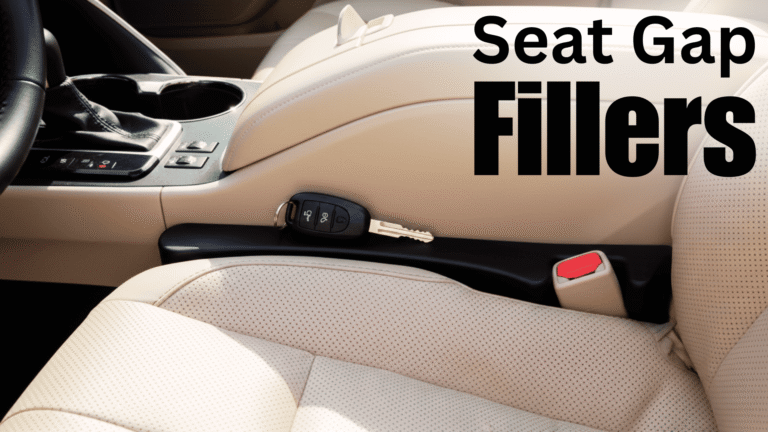
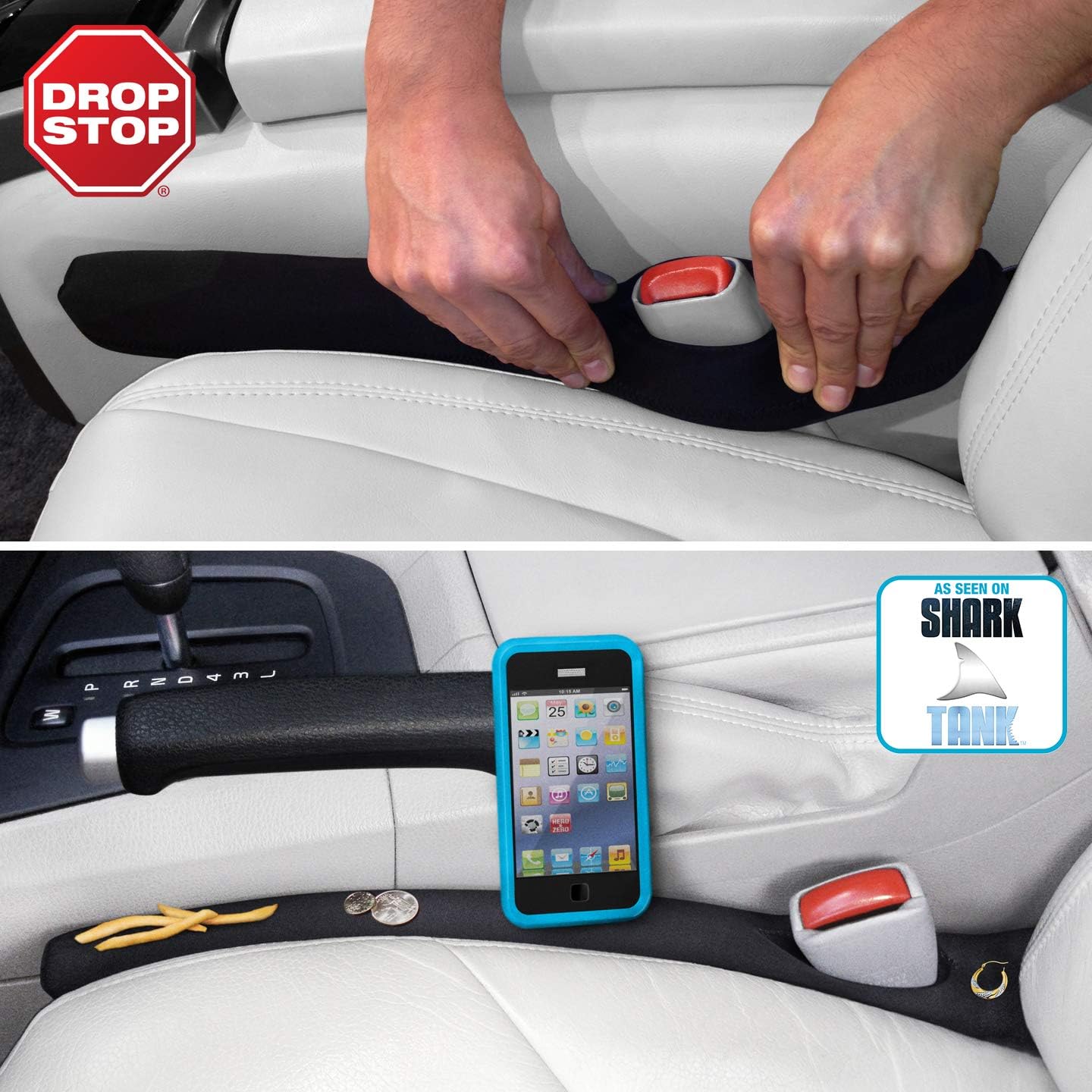
Best Seat Gap Fillers for Leather Seats
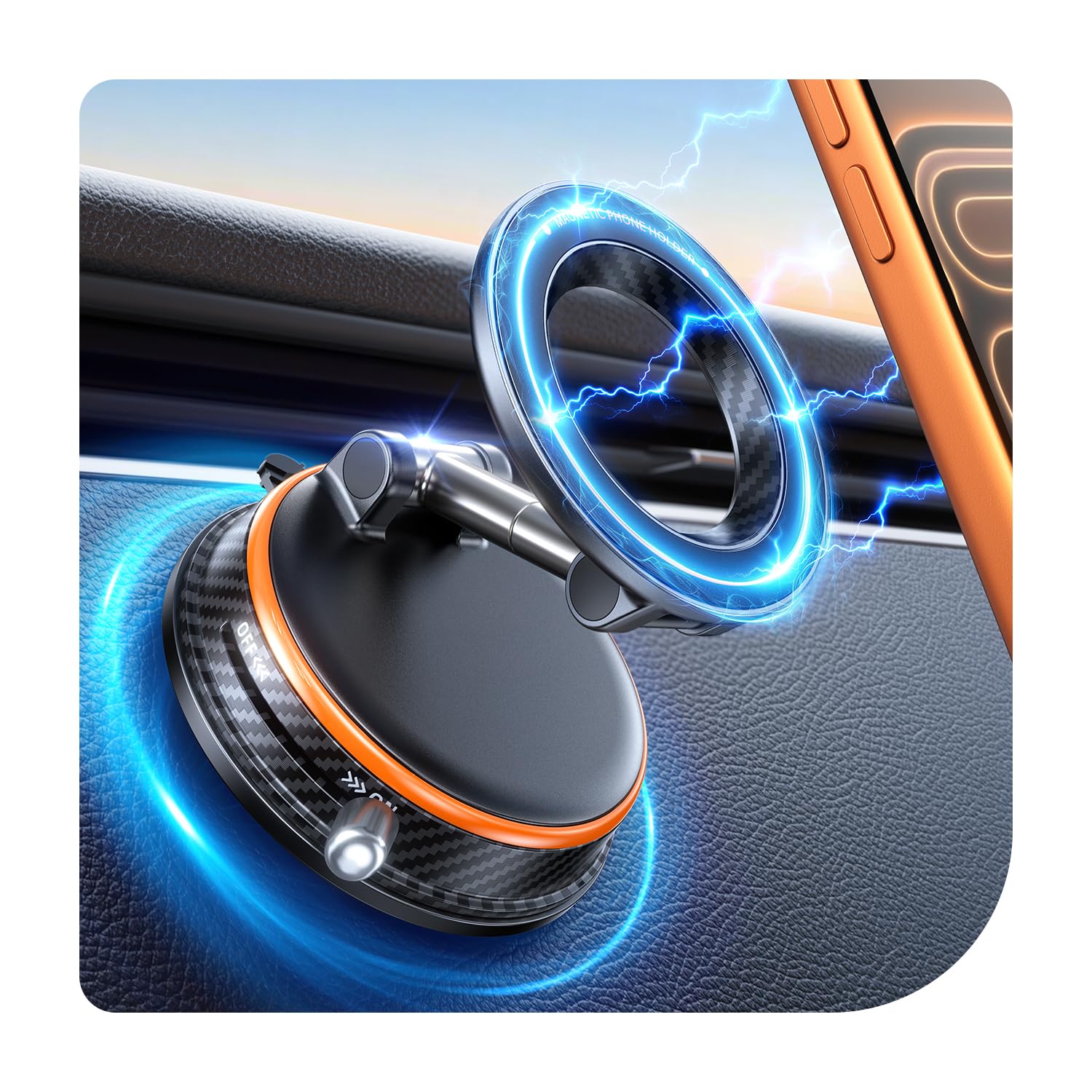
Best Magnetic Phone Mounts for Thick Cases
…to upgrade your cabin completely.

Top Car Interior Cleaning Kits for 2025

ProductWhy It MattersScore

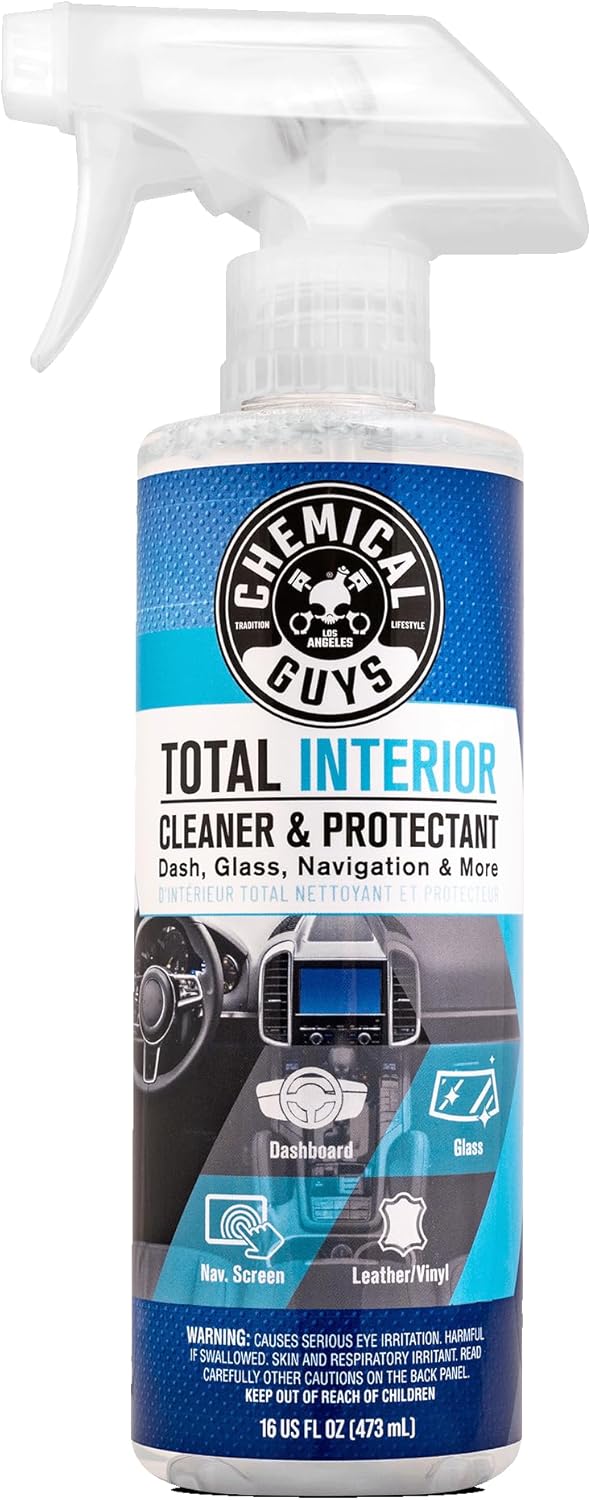
Chemical Guys Total Interior Cleaner + Protectant
Best all-in-one cleaner; safe for leather, screens & dashboard95/100

Lexol Leather Cleaner & Conditioner Kit
Best leather-safe formula for restoring color & softness87/100
Meguiar’s r’s Quik Interior Detailer + Wipes KitFastest way to refresh daily smudges & dust86/100
CAR GUYS Super CleanerThe strongest deep-clean formula for fabrics & stains90/100
303 Interior Cleaner + UV Protectant KitBest for touchscreens & sensitive gloss trims93/100
Stoner Car Care 8-Piece Interior KitExcellent mix of tools + cleaners for full interior detail89/100

Armor All Premi
er Interior Kit
Best beginner kit for simple, quick cleaning88/100

How We Chose These Kits

You want products that actually work on the surfaces in your car and that are easy to use in cold, wet conditions. We prioritized: surface versatility (safe for leather, vinyl, plastic, glass), protection (UV blockers and conditioners), cleaning power (stain removal and residue-free finishes), ease of use (spray, applicator, included towels), value (what you get for the price), scent (not overpowering), and real-world reliability (brand reputation and customer feedback). Each pick highlights a different strength so you can match a product to your needs quickly.


Chemical Guys Total Interior Cleaner — The “Do Everything” Kit

Best for: Drivers who want one bottle that works on everything
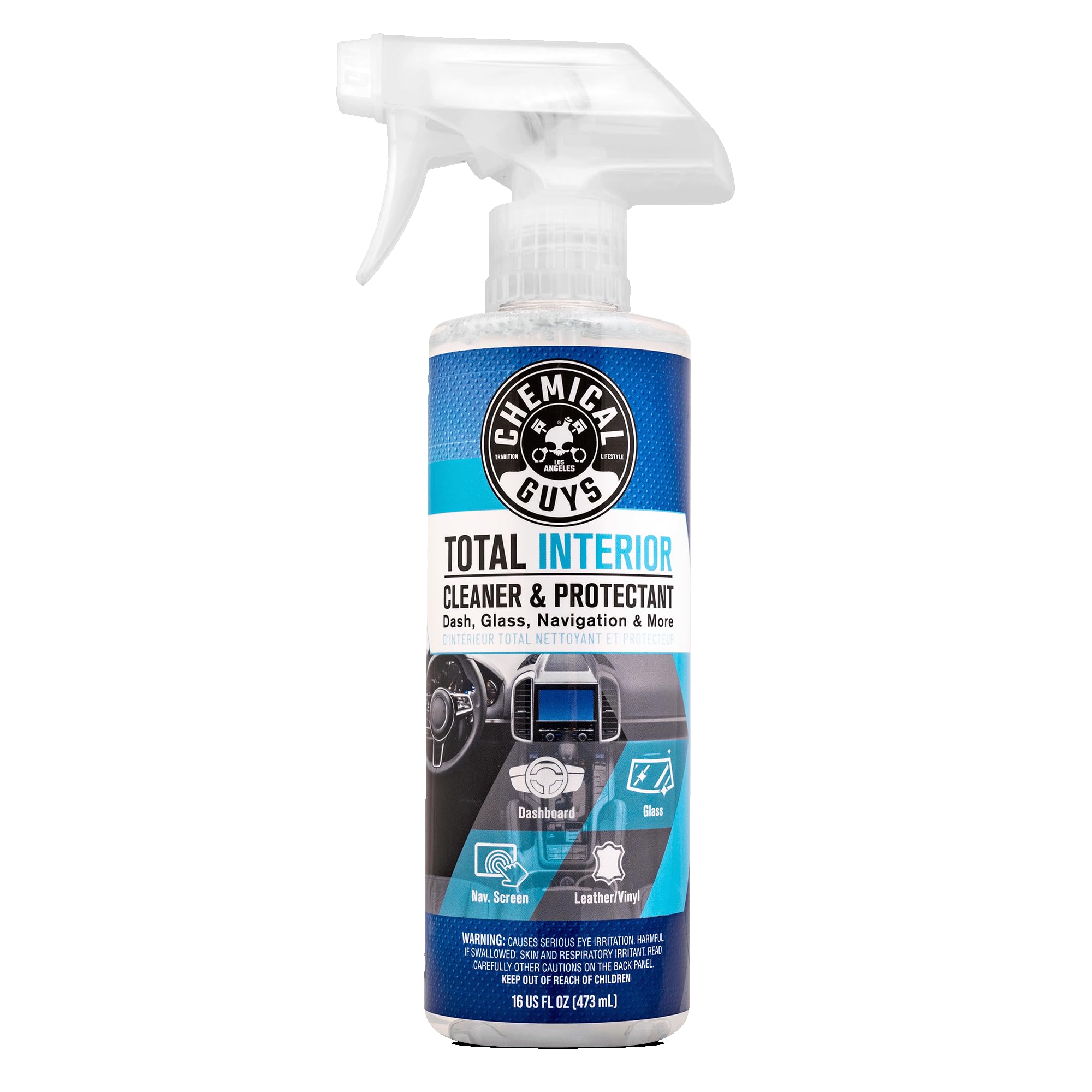
Chemical Guys Total Interior, 16 oz


Chemical Guys Total Interior, 16 oz

All-in-one interior cleaner that cleans and protects leather, vinyl, plastic, rubber and glass with a streak-free finish; 16 fl oz, Fresh scent.

This is an easy fix that really gets the job done when winter makes your floor mats a total mess of salt and mud. This spray bottle is just what you need. Just spray it on the dashboard, door panels, screens, or leather and vinyl surfaces, then wipe it down with a microfiber cloth. It picks up dirt without any greasy residue, leaving everything looking clean and natural, not shiny or overdone.

The formula includes UV protection so you’re not just cleaning — you’re helping keep plastics and dash pieces from fading over time. For quick weekly touch-ups, post-road-trip cleanings, or before guests pile in for holiday drives, it’s an easy go-to I’d recommend keeping in the trunk or garage.

Versatility

Designed for leather, vinyl, plastic, rubber and glass, it’s handy in cars, trucks, RVs and even around the house on desks or chairs. You can use it for quick daily wipe-downs or deeper clean sessions after muddy commutes or winter road trips.

Key Benefits

  • Cleans and protects multiple interior surfaces
  • Built-in UV protection to reduce fading
  • Streak-free, natural-looking finish
  • Light, non-overpowering fresh scent
  • Fast spray-and-wipe application for quick touch-ups
  • It leaves a factory matte finish, not a greasy shine.

This cleaner works on leather, dashboards, glass, screens, steering wheels, plastics — literally the entire cabin. It’s one of the safest and most versatile formulas on the market.


Lexol Leather Kit

The Gold Standard for Leather

Lexol Leather Care Kit


Lexol Leather Care Kit

Two-step leather kit with cleaner and conditioner that lifts dirt and penetrates pores to protect against cracking; safe for car interiors, furniture, shoes and bags; includes applicator sponges.

You’ll notice how straightforward this two-step system is once you try it. The cleaner loosens grime without being harsh, then the conditioner soaks in to restore suppleness and help prevent winter cracking from dry heat and road salt. It’s compact enough to keep in the trunk for seasonal touch-ups or to bring inside for handheld items like bags and boots. If you want a reliable leather refresh that’s easy to control and won’t leave a greasy film, this is a sensible kit to keep around.

Versatility

You can use it for weekly seat maintenance, restoring sun-faded leather after long winter drives, or giving a quick refresh to handbags, boots and luggage. It’s handy for prepping the cabin before guests or for deeper conditioning sessions when temperatures drop and leather dries out.

Key Benefits

  • Two-step cleaner + conditioner system for thorough care
  • Conditioner penetrates to nourish and help prevent cracking
  • Wipes away cleanly with no greasy or tacky residue
  • Safe for multiple leather items—seats, furniture, shoes and bags
  • Includes two applicator sponges so you can keep products separate

If your car has leather seats (especially older or dry ones), Lexol is unmatched. It conditions deeply, restores suppleness, and helps prevent cracking — something no all-purpose cleaner can do safely. In short it makes old leather feel alive again.


Meguiar’s Quik Interior Detailer

The 5-Minute Refresh

Meguiar's Quik Interior Detailer - 24 Oz


Meguiar’s Quik Interior Detailer – 24 Oz

Quickly and easily cleans interior surfaces—plastics, vinyl, leather, rubber, metal and LCD/navigation screens—with a gentle formula that lifts dirt and restores a natural finish.

It works on leather, vinyl, plastic, rubber, metal and even screens, so it’s great for quick weekly touch-ups, cleaning up spills after errands, or getting the cabin ready before guests. If you want a single, dependable interior cleaner to stash in the trunk, this is a practical pick (just be mindful some people mention the bottle can tip and leak).

When your car’s full of salt, slush, and muddy shoes, just spray a little onto a microfiber cloth or right on the surfaces and wipe it down. It’ll get rid of all that dust and dirt without making things greasy. Plus, the sun-blocking stuff helps keep your dashboard and trim from fading and cracking.

Versatility

Great for daily wipe-downs, clearing winter salt and slush from floors and door sills, spot-treating spills, and refreshing the cabin before a ride. Safe for dashboards, door panels, leather seats, rubber trim and navigation screens.

Key Benefits

  • Safe on multiple surfaces including leather, vinyl, plastic, rubber and screens
  • Gentle, high-lubricity formula lifts dirt without a greasy finish
  • Sun-blocking agents help protect against fading and cracking
  • Convenient 24 oz spray bottle for quick touch-ups
  • Leaves a natural look with a mild, unobtrusive scent

If you don’t have time for a full interior detail, this is your best friend. Spray, wipe, done. Removes fingerprints, dust, light grime, and leaves a clean scent.


CAR GUYS Super Cleaner

The Stain Assassin

CAR GUYS Super Cleaner


CAR GUYS Super Cleaner

18 oz multi-surface interior cleaner for leather, fabric, carpet and vinyl; includes a microfiber towel for spot cleaning and quick detail touch-ups.

This cleaner is awesome for weekly touch-ups or cleaning up those spills after a busy holiday. It’s also perfect for giving your car a quick spruce-up before company comes over. Plus, it comes with a towel that makes it super easy to start using right away. If you want a reliable all-in-one cleaner to keep in your trunk, this one’s a great choice, especially if you have kids, pets, fabric seats, coffee accidents, or those pesky mystery stains.

To use it just spray a little on your microfiber towel or right onto the vinyl leather or fabric. Give it a quick scrub and then wipe it down. It gets rid of dirt without leaving any greasy stuff behind and has a nice mild scent so your cabin won’t smell like chemicals.

Versatility

Use it for daily wipe-downs, spot-treating coffee or mud stains after errands, and deeper clean-ups before road trips or holiday visits. It handles dashboards, door panels, seats, carpets and even tough scuffs on darker interiors.

Key Benefits

  • True multi-surface formula — works on leather, vinyl, fabric, carpet and plastic
  • Included microfiber towel makes spot jobs faster
  • Effective at lifting stains, scuff marks and everyday grime
  • Leaves minimal residue and a mild scent
  • Available in convenient 18 oz kit (also offered in gallon size if you need more)

This deep-clean formula will solve most cabin nightmares. One bottle handles fabric, vinyl, plastics, carpet, rubber, and trim. It’s the “power tool” of interior detailing chemicals.


303 Interior Cleaner + UV Protectant

Best for Modern Cars

303 Automotive Protectant Spray


303 Automotive Protectant Spray

Spray protectant that helps prevent fading and cracking, repels dust, lint and staining; superior UV protection; restores lost color on interior & exterior surfaces. 16 fl. oz.

This spray really deserves a spot in your car cleaning kit. Just spray it on your dashboards, door panels, rubber seals, and plastic trim after a good clean, and it’ll give everything a nice matte look that keeps surfaces looking fresh instead of greasy. It’s super useful for keeping things tidy—just wipe it down every couple of weeks to make sure dust and road salt don’t get comfy. Plus, it’s perfect for getting your cabin ready before a road trip or after that long summer in the sun.

If you’re looking for something that works well and protects against UV damage while bringing faded surfaces back to life, this is definitely a go-to product.

Versatility

Use it for routine cabin touch-ups, restoring faded door panels after winter sun exposure, or protecting rubber seals from drying out when temperatures drop. It’s also useful beyond the car—boats, patio furniture and other outdoor gear benefit from the same UV protection and color restoration.

Key Benefits

  • Superior UV protection to help prevent fading and cracking
  • Dries to a non-greasy, matte finish—no oily residue
  • Repels dust, lint and common staining for longer-lasting cleanliness
  • Works on many surfaces: vinyl, plastic, rubber and more
  • Restores lost color and helps maintain a like-new appearance

Touchscreens plus shiny black trim and glossy finishes can really attract scratches. That’s why 303 is made just for these surfaces. It wipes away smudges easily without leaving streaks and gives your dashboard some UV protection too. If you have a newer car with a big infotainment screen this cleaner is definitely your best bet.


Stoner Car Care 8-Piece Kit

Tools Matter

Stoner Car Care 8-Piece Interior Kit


Stoner Car Care 8-Piece Interior Kit

Complete interior detailing kit with Power Clean, Leather Cleaner & Conditioner, Trim Shine and Trim Clean, Carpet & Upholstery Cleaner, Invisible Glass Premium Glass Cleaner, plus two microfiber cloths.

You’ll love this all-in-one car care set that takes care of the usual messy spots. Power Clean makes it easy to wipe away dust and fingerprints on the hard surfaces. The leather cleaner keeps your seats looking great, the trim products bring your plastics back to life, and the glass cleaner is ammonia-free, so it’s safe for tinted windows. It’s perfect for quick weekly clean-ups or for tackling a thorough clean after those snowy or muddy drives.

If you’re looking for a single kit that keeps you from fumbling with different bottles, this is a smart and practical choice.

Versatility

Use it for everyday cabin cleanups, seasonal deep cleans after winter road salt exposure, or before guests and trips when you want the interior looking its best. The glass cleaner works beyond the car on appliances or windows, and trim/leather products are useful on boats or outdoor gear too.

Key Benefits

  • All-in-one kit covers leather, trim, carpet, hard surfaces and glass
  • Leather cleaner conditions as it cleans to help preserve seats
  • Invisible Glass formula has no ammonia—safer for tinted windows
  • Trim Shine rejuvenates plastics and dashboards for a refreshed look
  • Includes two microfiber cloths so you can start detailing right away

This kit includes everything:
Brushes, wipes, sprays, cloths — making it perfect for people who want a complete setup without buying tools separately. Think of it as the “starter kit for serious detailers.


Armor All Premier Kit

Beginner-Friendly & Affordable

Armor All Premier Car Care Kit


Armor All Premier Car Care Kit

All-in-one 8-piece kit for interior and exterior care: wash & wax, glass cleaner, multi-purpose cleaner, protectant, tire shine, wheel cleaner, wash pad and air freshener.

This kit helps you keep things simple so you don’t have to mess around with a bunch of different products. You can use the all-in-one cleaner and protectant on your dashboard and door panels, the glass cleaner gives you streak-free windows, and the wash-and-wax with microfiber pad makes washing the outside fast while still leaving it shining.

The tire shine and wheel cleaner work great to clean off dirty rims after those slushy drives, and the air freshener keeps your car from smelling like road salt. It’s a handy all-in-one option to stash in your trunk for those quick weekly clean-ups, post-trip refreshes, or those times when friends hop in for holiday rides.

Versatility

Works across interior plastics, vinyl and glass and covers exterior tasks from a gentle wash to tire shine. It’s useful for daily wipe-downs, seasonal deep cleans after winter trips, and prepping the car before weekend visitors or holiday drives.

Key Benefits

  • Complete 8-piece set for interior and exterior needs
  • Wash-and-wax gives a quicker clean with added shine
  • Multi-purpose cleaner and protectant refresh interiors
  • Glass cleaner improves visibility with minimal streaking
  • Tire shine and wheel cleaner handle winter grime
  • Air freshener helps neutralize lingering odors

If you want a cheap, easy way to keep your interior clean without thinking too hard, this is the kit. Spray, wipe, done. No complexity. No risk.


Best Kits by Category

CategoryBest Choice
Best all-in-one cleanerChemical Guys Total
Best for leatherLexol Leather Kit
 Best for screens & UV Protection303 Interior Cleaner
 Best Quick Touch-UpsMeguiar’s Quik Interior Detailer
 Best Stain RemoverCAR Guys Super
 Best Value KitArmor All Kit
 Best Complete Detail KitStoner 8-Piece Kit

FAQs

1. What Should You Look For When Buying A Winter Car Interior Cleaning Kit?

You should prioritize kits and products that are labeled safe for the specific surfaces in your car, so look for multi-surface compatibility (leather, vinyl, plastic, rubber, glass) if you want one-step convenience, or choose dedicated items for delicate materials. In winter you’ll also want a product with UV protection and non-greasy formulations to prevent surfaces from drying, cracking, or attracting road salt residue; examples include all-in-one options like Chemical Guys Total Interior Cleaner & Protectant ($11.97) for everyday maintenance, 303 Protectant ($15.99) for superior UV protection, and Lexol’s two-step kit ($20.93) if your focus is leather care. Consider kit completeness (cleaner, protectant, microfiber towels, applicators), ease of use, scent sensitivity, and whether the kit includes ammonia-free glass cleaner for tinted windows; bigger bundled kits such as Armor All Premier ($39.50) or Stoner’s 8-piece kit ($43.99) give more coverage but check for any leaking packaging when buying online. Finally, read the directions for temperature and storage recommendations so liquids don’t freeze while you transport or store them in winter.

2. Are These Kits Safe For Leather, Screens, And Tinted Windows?

You can safely use many modern kits on a wide range of surfaces if you follow the label and technique: use a leather-specific cleaner/conditioner like Lexol for aniline or natural leather rather than a general protectant, clean screens and touch displays by spraying product onto a microfiber cloth first (rather than spraying directly) and then wiping, and avoid ammonia-based glass cleaners on tint—choose an ammonia-free glass product such as the Invisible Glass options found in several kits. Always test in an inconspicuous spot before full application to check for color change or residue, avoid products that say not to use on unfinished leathers or suede, and use minimal product to prevent sticky buildup; 303 warns against use on some delicate materials, and many reviewers recommend applying sprays to cloths rather than spraying electronics directly.

3. How Do You Use A Kit To Get The Best Results And Prevent Damage In Winter?

You’ll get the best results by following a simple sequence: vacuum and remove loose debris first, pre-treat stains with a dedicated stain remover (Car Guys Super Cleaner $19.99 is effective for upholstery stains), apply your chosen interior cleaner—spraying onto a microfiber towel instead of directly onto surfaces for electronics—work textured areas with a soft brush, then wipe dry and finish with a protectant to repel dust and salt; for leather use the Lexol two-step cleaner and conditioner ($20.93) and allow time to absorb before you sit on seats. Use a clean, low‑lint microfiber for each step to avoid transferring soils, buff excess protectant to a matte finish to avoid glare, wear nitrile gloves if you’re sensitive to chemicals, and store your kits inside above freezing to prevent bottles and pumps from failing. Remember to use products sparingly—too much protectant or oil-based dressing will attract dirt and look greasy—so a few light passes with a quality product (examples: Meguiar’s Quik Interior Detailer $9.74 for fast touch-ups, 303 Protectant $15.99 for longer UV defense) will keep your interior spotless without unintended residue.

4. What’s the best all-purpose interior cleaner for 2025?

Chemical Guys Total Interior is the top pick because it safely cleans every surface — leather, screens, dashboards, door panels.

5. What’s the safest cleaner for leather seats?

Use Lexol. It conditions leather fibers properly without leaving residue.

6. What kit is best for deep cleaning seats and carpet?

CAR GUYS Super Cleaner handles tough stains on fabric seats, headliners, and carpets.

7. Can these cleaners damage touchscreens?

303 Interior Cleaner is designed specifically for screens and glossy trim — safe and streak-free.

8. How often should I clean my car interior?

Weekly wipe-downs, monthly mild cleaning, and deep cleaning every 2–3 months.

Wrapping Up

Choosing the right kit can help you get winter maintenance done quicker and avoid damage down the line. If you’re looking for a simple spray that cleans and protects a bunch of surfaces, Chemical Guys Total Interior is a solid pick.

For a budget-friendly package that covers the basics inside and out, Armor All’s kit offers great value. Go for CarGuys Super when you need to tackle tough stains, grab Meguiar’s Quik for quick touch-ups, use Lexol’s two-step kit for leather care, and reach for 303 Protectant when you want UV protection with a nice matte finish. If you’d rather have a range of specialty products, check out the Stoner Detail Kit, which includes different cleaners and microfiber towels to handle every surface right.

And if you’re doing a complete refresh, be sure to also take a look at:
Best Seat Gap Fillers for Leather Seats
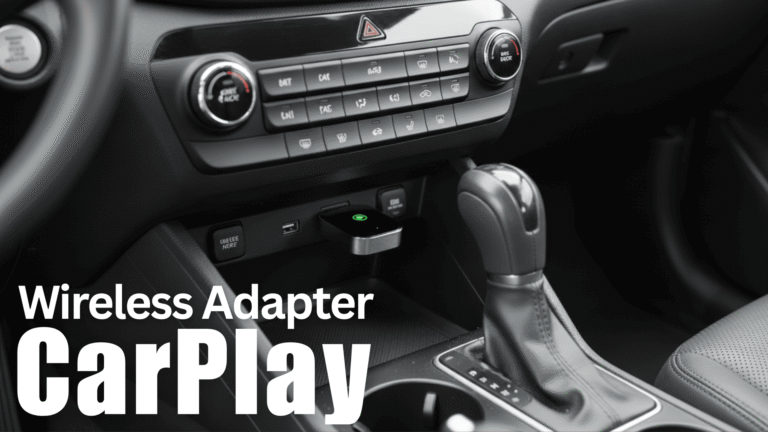
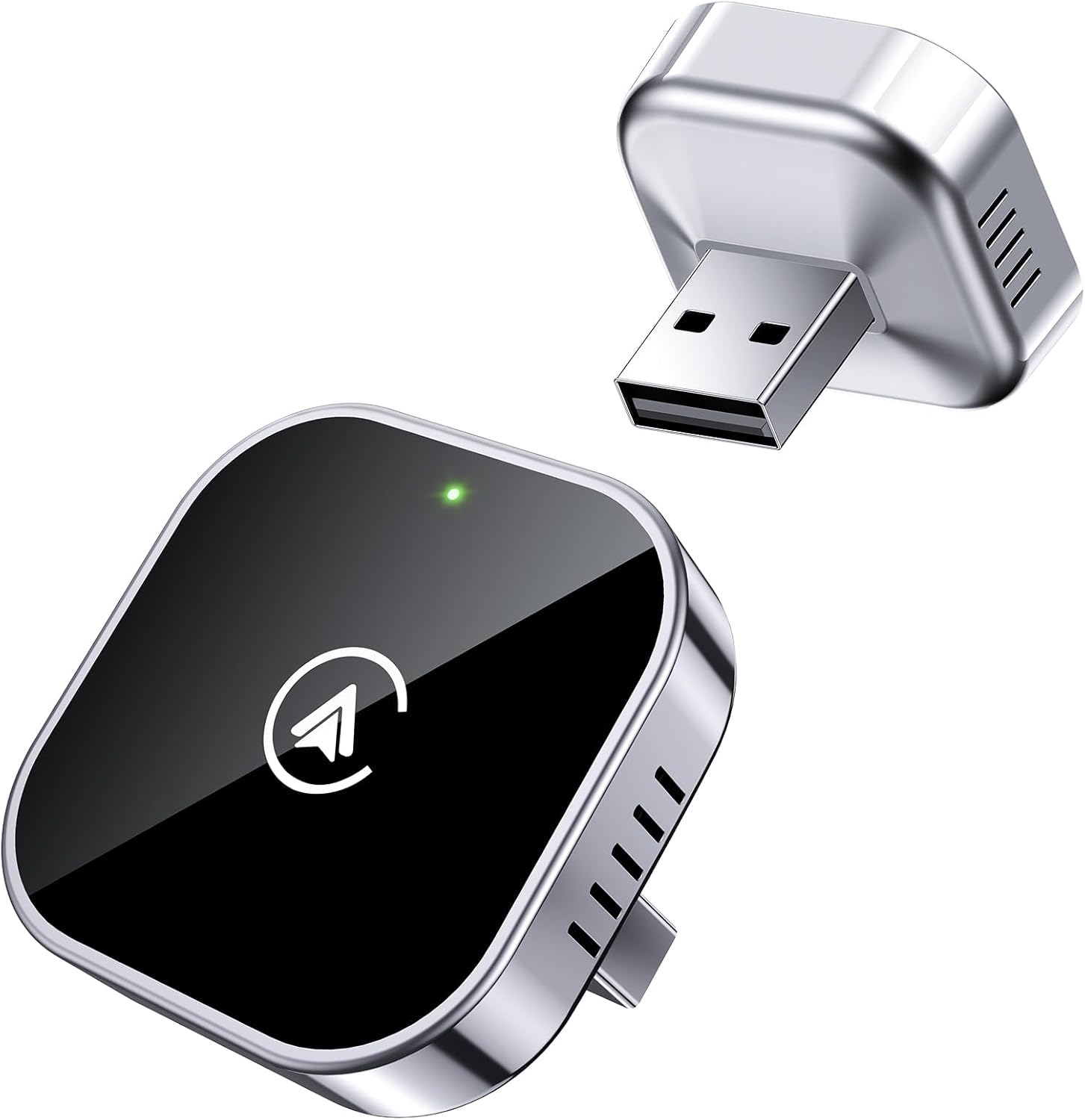
Best Wireless CarPlay Adapters for Older Cars

Finally, here’s a quick rundown of what each product does best for different cleaning tasks.

For leather seats: choose Lexol or Chemical Guys
For screens & new cars: get 303
For stains: get CAR GUYS
For fast maintenance: Meguiar’s
For full cockpit restoration: Griot’s or Stoner

Just choose the option that fits your cleaning style—whether you’re into quick fixes or deeper detailing—and you’ll spend less time scrubbing and more time enjoying a cozy, well-protected interior.

Product Image Rating Main Highlights Suitable Surfaces Dimensions & Weight Price
Chemical Guys Total Interior Cleaner & Protectant
Product Image
4.6/5 (44,395+ reviews)
  • Cleans & protects various surfaces
  • Includes UV protection
  • Non-greasy finish
  • Streak-free cleaning
  • Leather
  • Vinyl
  • Plastic
  • Rubber
  • Glass
  • Metal
2.8 x 2.8 x 7.9 inches; 1.1 pounds 11.97
Armor All Premier Car Care Kit
Product Image
4.5/5 (14,601+ reviews)
  • 8-piece kit for complete interior & exterior care
  • Includes car wax and wash
  • Multi-purpose cleaner
  • FreshFX air freshener
  • Interior plastics
  • Exterior glass
  • Wheels & tires
  • Leather
13.39 x 12.94 x 7.44 inches; 9.22 pounds 39.50
CAR GUYS Super Cleaner
Product Image
4.5/5 (N/A)
  • Effective on various materials
  • Stain remover for multiple surfaces
  • Includes microfiber towel
  • Non-toxic formula
  • Leather
  • Upholstery
  • Fabric
  • Plastic
  • Vinyl
3 x 9 x 10 inches; 1.13 pounds 19.99
Meguiar’s Quik Interior Detailer Cleaner
Product Image
4.5/5 (N/A)
  • Quick and easy spray application
  • Cleans a variety of surfaces
  • Sun-blocking agents
  • Non-greasy finish
  • Plastics
  • Vinyl
  • Leather
  • Rubber
  • Metal
  • LCD screens
1.8 x 4 x 10 inches; 1.83 pounds 9.74
Lexol Leather Conditioner and Cleaner Kit
Product Image
4.5/5 (15,966+ reviews)
  • Two-step cleaning & conditioning system
  • Non-toxic ingredients
  • Includes applicator sponges
  • Revitalizes and protects leather
  • Leather
  • Handbags
  • Furniture
6.42 x 3.23 x 8.8 inches; 2.79 pounds 20.93
303 Products Automotive Protectant Spray
Product Image
4.7/5 (15,677+ reviews)
  • Superior UV protection
  • Repels dust & staining
  • Non-greasy texture
  • Long-lasting formula
  • Vinyl
  • Plastic
  • Rubber
  • Metal
3.9 x 1.8 x 11 inches; 1.2 pounds 15.99
Stoner Car Care Interior Detailing Kit
Product Image
4.6/5 (29+ reviews)
  • 8-piece kit for comprehensive interior cleaning
  • Includes gloves and microfiber cloths
  • Easy application
  • Eco-friendly formula
  • Carpets
  • Upholstery
  • Leather
  • Windows
12 x 9.5 x 9.5 inches; 9.64 pounds 43.99

*Disclaimer: This website provides automotive content for informational purposes only and should not be considered professional advice. While we strive for accuracy, we do not guarantee the reliability or suitability of any vehicle or product mentioned—always conduct your own research before making purchasing decisions. Additionally, some links on this site are affiliate links, meaning we may earn a commission if you make a purchase, at no extra cost to you.

**When you click on links we might get a small commission on purchases that qualify.
Which XV70 Camry Year Should You Buy? A Tested Guide

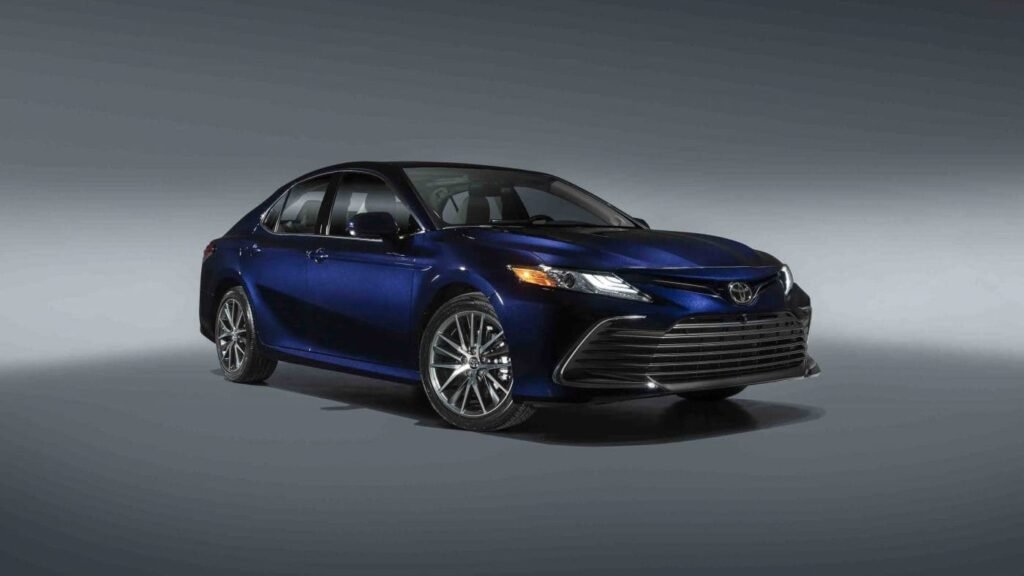
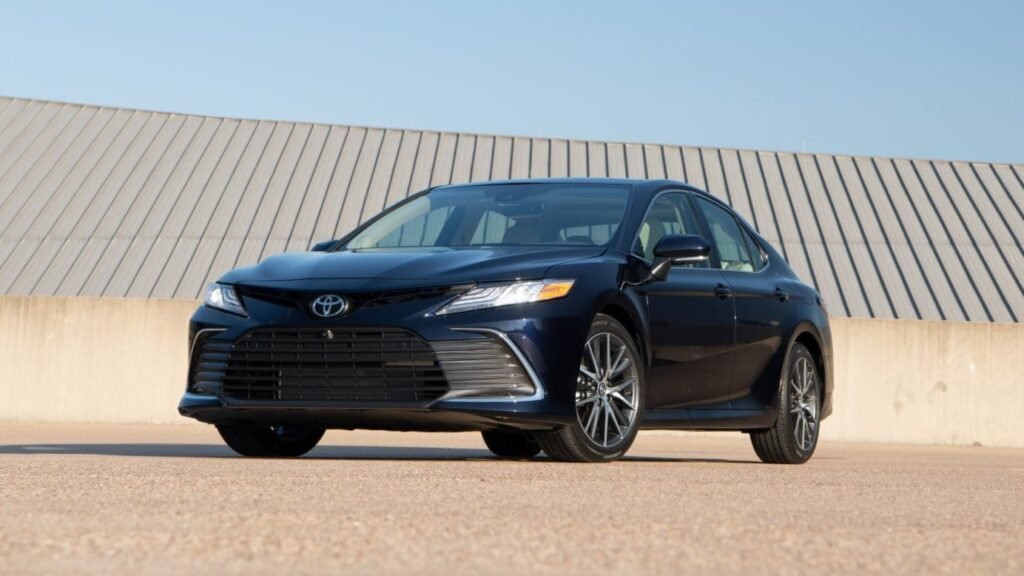
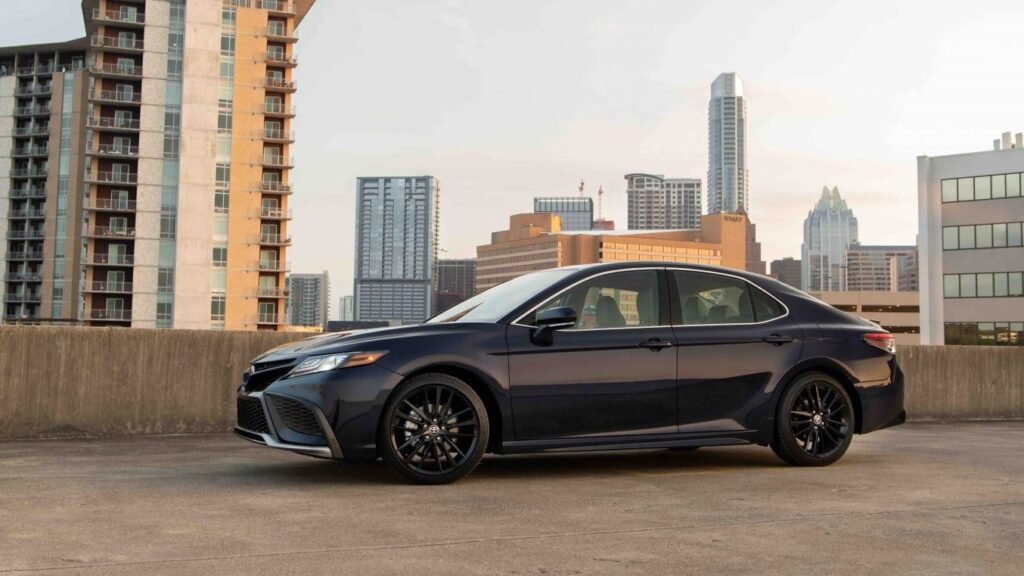
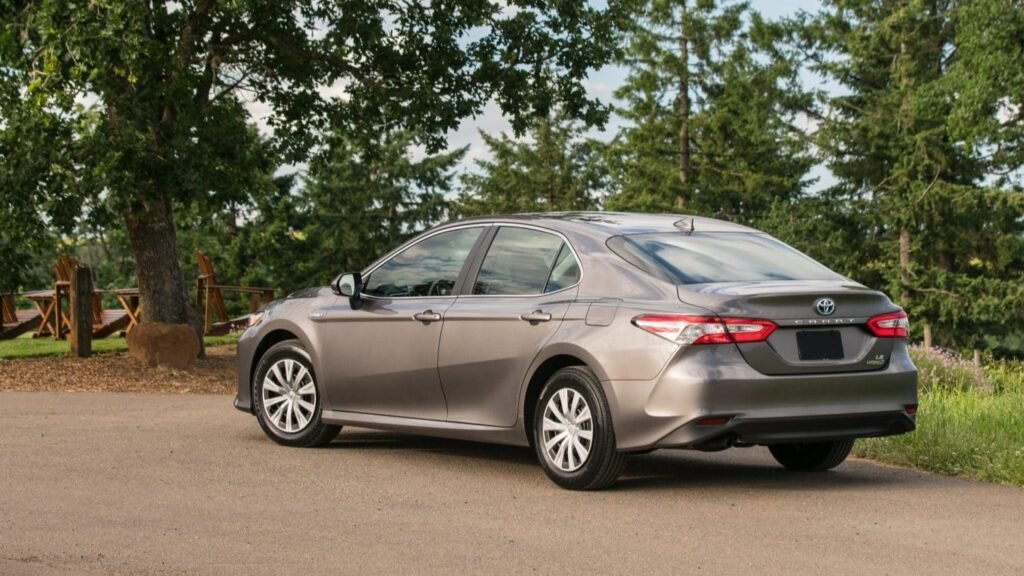
The Toyota Camry XV70, Toyotas go-to car in the midsize sedan game. Has changed how people see the Camry, moving it from a plain family car to a stylish sedan you’d actually enjoy driving, on top of the usual reliability we expect from it. Introduced in 2018, the XV70 edition mixed Toyota’s TNGA/GA-K platform with super-efficient Dynamic Force engines, up-to-date safety features, and hybrid options.

The goal was clear: keep the low running costs and solid resale value that people love, but with better looks, improved handling, and tech that buyers actually want. This guide is gonna break down everything year by year, offer some handy tips for buying, test-drive suggestions, maintenance tips, and a look at what owning one might cost you. So let’s jump in!

Quick Overview

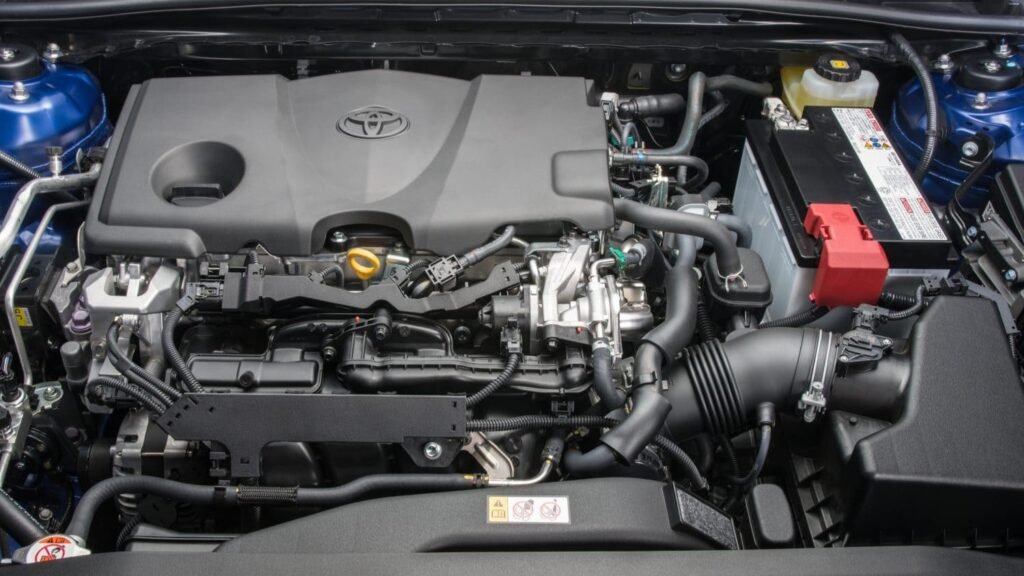
The eighth-gen Camry known as XV70 wasn’t just a simple update from the last model. This car sits a bit lower, it’s got a stiffer body, the steering got fine-tuned, and for the first time, the Camry switched to a wishbone suspension in the back instead of sticking with those old McPherson struts. This change made a big difference in terms of handling, especially when you compare it to its long-time rival, the Honda Accord. The 2.5-liter four-cylinder engine is punchier and has a better torque curve, while the 3.5-liter V6, which car fans love, is still around as the top power option. Plus, this is the last Camry generation that comes with a naturally aspirated V6. The hybrid versions also got a smart upgrade with their control systems and design so they didn’t take away trunk space. The end result is a Camry that feels new to drive and live with, while still being the dependable choice buyers are used to.


Also Read:
Kia reliability vs Toyota — data-backed comparison of dependability, repair costs, warranties, and resale. Which brand should you actually buy?


Camry Trim guide

Here’s a quick rundown on how to tell apart the different Camry trims and figure out which one’s right for you:

  • LE: Best for value buyers and high-mile commuters. Comfortable, efficient, and typically the cheapest to buy and insure.
  • SE: Sportier tuning and styling; a firmer ride and slightly sharper steering feel. Good if you want engagement without sacrificing practicality.
  • XLE / XSE: XLE emphasizes comfort and quiet; XSE blends sport and premium features. Both raise interior fit-and-finish, screens and convenience content.
  • TRD: A driver’s halo — chassis tuning, sport cosmetic cues and exclusivity. Not a race car, but a noticeably livelier Camry.
  • Hybrid trims: Offer the best long-term running costs for highway and mixed commuting. Hybrids hold value with economy-minded buyers — always check battery state-of-health on purchase.

2018 Camry

The Reinvention

Toyota rolled out the Camry in 2018 with a clear goal in mind: make it appealing to a wider group of folks. The design was bold – it sat lower, was wider, and looked a lot more unique than the old models. Right from the start, Toyota offered gas, V6, and hybrid options. People who got on board early loved the feel of the new chassis, but like with most new models, the 2018s had some expected hiccups – there were a few bugs in the infotainment system, some calibration issues at the dealer level, and a handful of small service campaigns in certain areas. For those looking for value, the 2018 Camrys are pretty appealing: you get all the new upgrades in driving and style without paying a premium for the latest model, as long as the VIN shows the recall was taken care of and it has a clean service record.

2018 Camry Common Problems

  • Brake vacuum-pump wear / loss of brake assist (recall). Toyota issued a safety campaign for certain 2018 builds, dealers will inspect/replace the pump under recall.
  • Infotainment glitches / early CarPlay availability problems. Early owners reported frozen or laggy screens, Bluetooth dropouts and slower firmware that got fixed via software updates or dealer patches.
  • Transmission roughness / “8-speed” shift complaints (software-related). Some owners reported rough or hesitant shifts in early 8-speed units — many shops and dealers start with a TCM/software update before mechanical diagnosis.

2019 Camry

Refinement & Connectivity

In 2019, the main goal was to smooth out the bumps. The new platform worked well, which was a good thing, while Toyota put its energy into software updates, connectivity, and helping out dealers. They rolled out updates for Entune and the infotainment system, plus Apple CarPlay became more available across different models, which tackled a big issue for early buyers. Dealers also fixed warranty and calibration problems that popped up during the first year, so used 2019 Camrys usually have fewer software quirks. Basically, if you’re looking for a solid car with updated tech without the high price of a newer model, the 2019 is a smart choice.

2019 Camry Common Problems

  • Same vacuum-pump population carried into early 2019 builds. The vacuum-pump campaign covered certain 2018–2019 VIN ranges.
  • Electronics & software niggles. Fewer than 2018, but owners still reported occasional radio/cluster oddities and Bluetooth pairing quirks resolved by dealer updates.
  • Normal wear items (brakes, bushings, tires) — nothing unusual for the model; typical owner complaints were more about trim/fit & finish in some examples.

2020 Camry

Tech standardization & the TRD halo

2020 is where the Camry got significantly more smartphone-friendly. Apple CarPlay and Android Auto became standard or widely available on many trims in several markets; that made daily life with a used 2020 Camry noticeably easier. Toyota also introduced the TRD Camry as a visual and chassis halo — suspension tuning, unique styling and more aggressive aesthetics gave the Camry a personality that appealed to buyers who wanted something less anonymous. Mechanically, the line remained unchanged: Dynamic Force engines, 8-speed automatics and hybrid e-CVTs.

The takeaway: 2020 is a sweet spot for buyers who want modern connectivity and a more engaging look without premium pricing.

2020 Camry Common Problems

Top repeat issues

  • Engine short-block / coolant leak campaign (20TA04): an incorrectly manufactured short block could leak coolant internally/externally, affected engines were inspected and replaced as needed. This is a high-priority VIN check.
  • Electrical / battery drain complaints. Addressed with software or component fixes. If a used 2020 has unexplained battery history, get a walk-around electrical check.
  • Infotainment / cluster complaints continue (less frequent). Dealer firmware updates reduced many issues but it’s worth checking.

2021 Camry

Mid-Cycle Refresh

2021 brought a tasteful mid-cycle refresh and, more importantly, a meaningful safety upgrade. Toyota expanded Toyota Safety Sense 2.5+ availability, improving pre-collision detection, adding intersection support in some markets, and refining adaptive cruise and lane-keep logic. Those improvements reduced false alerts and made sustained highway driving less fatiguing when ADAS features were used. Interior materials and fit-and-finish improved in upper trims, and many software builds were matured. For buyers looking for the best balance of safety and value, 2021 Camrys are especially compelling — you get more reliable ADAS, widely available smartphone connectivity and the benefit of several dealer-applied fixes from earlier production.

2021 Camry Common Problems

  • ADAS / Toyota Safety Sense behavior quirks (TSS 2.5+ rollout issues in some examples). Owners occasionally reported lane-keep or adaptive-cruise erratic behaviour that dealers often corrected with calibration or software updates.
  • Occupant Classification System (OCS) / airbag sensor programs affecting adjacent years. Toyota ran airbag/OCS sensor campaigns that covered some 2020–2022 models.
  • Routine wear & minor electrical niggles. Consumer comments show the usual list: small interior trim complaints, HVAC oddities, or minor exhaust/noise notes.

2022 Camry

Mature Product

By 2022 the XV70 Camry was a mature product. Toyota’s updates were focused on convenience, appearance packages (Nightshade and similar), and incremental interior upgrades rather than mechanical changes. Some markets saw larger infotainment screens and slightly improved material quality; Toyota continued to push software updates through dealers and OTA where supported. This maturity is a practical advantage — technicians know the platform, parts are abundant, and the common failure modes are well documented. A 2022 Camry generally gives you most of the perks of the near-new car without the new-car depreciation hit.

2022 Camry Common Problems

  • Service/Special Service Campaigns (SSCs) on niche production ranges. Toyota periodically issued targeted SSCs (inspection, reprogramming or small part replacements).
  • Wear items (brakes, bushings, tires) and occasional noise complaints. Nothing model-ending but expect typical midlife service.

2023 Camry

Incremental Polish

2023 continued the pattern of polishing the execution. NVH (noise, vibration, harshness) margins improved slightly, ADAS logic and infotainment firmware were refined, and a handful of cosmetic and trim updates kept the model visually current. OTA updates in certain regions meant many 2023 examples left dealers with the latest firmware, decreasing the chance a buyer would need immediate software patches. The hybrid calibrations showed incremental gains in real-world economy. If you want the freshest XV70 with the least number of pending dealer fixes, 2023 is a smart pick — priced near the top of the used run, but often the most trouble-free.

2023 Camry Common Problems

  • Under-torqued wheel lug nuts (limited recall 23V-432). A small number of 2023 Camrys were affected (some tied to third-party service)ز
  • Electronics / infotainment / cluster complaints continued among owner reports. As with prior years, many complaints are software/firmware related.
  • Consumer Reports owner notes: exhaust, climate, in-car electronics and suspension/steering complaints.

2024 Camry

The Final Adjustments

The 2024 model year is notable because it represents the last mainstream Camry examples in many markets to offer the naturally aspirated 3.5-liter V6. Toyota used the final year to refine NVH characteristics, tweak option assortments, and ensure platform maturity. For buyers who still value a naturally aspirated six-cylinder — for its linear throttle, quiet highway cruise and a different sound profile — 2024 is the last chance in the XV70 run. Practically speaking, 2024 cars combine the matured software, broad safety content and the final V6 option; expect a small premium for that configuration on the used market.

This is mostly a pretty mature car, as with all car models or really any product out there, by the time it reaches the end of its product cycle, you can expect all those little quirks and issues to be worked out and smoothed over. That’s exactly what you’re getting with the 2024 Camry, but there’s more to it than just that.

2024 Camry Common Problems

The last production year is mostly a pretty mature car with very few issues:

  • Rear-seat head restraint weld noncompliance (recall 24V-128). Certain 2023–2024 Camry and Camry Hybrid vehicles. Dealers will replace the affected seat back assemblies. Confirm VIN. NHTSA
  • All earlier small items remain possible: infrequent electronics niggles, usual wear items, and the occasional ADAS calibration need — but by 2024 most software fixes had been distributed and the platform was stable.

Common Repair Costs

Here’s a quick list of some of the usual repair costs you might run into with an average car that gets regular use. This way, you’ll know what to look out for and can see how it stacks up against what you’re paying for your car right now.

Common Repair Costs
Repair Typical cost (USD) Typical frequency Quick tip
Oil change (synthetic) $50 – $120 Every 5k–10k mi Use OEM-spec oil; DIY or independent shop saves money.
Brake pads (per axle) $150 – $350 20k–50k mi Resurface rotors when within spec to reduce cost.
Pads + rotors (both axles) $300 – $800 30k–70k mi Replace rotors in matched pairs for consistent braking feel.
12-V battery $100 – $350 3–6 years Buy battery+install bundle from local retailers to save.
Alternator $350 – $900 6+ years (as needed) Consider a remanufactured unit with warranty.
Starter motor $300 – $700 Uncommon; after high mileage Confirm it isn’t an electrical/relay issue first.
Spark plugs (set) $150 – $450 90k–120k mi Use OEM/iridium plugs for longevity.
Water pump + coolant service $300 – $800 80k–150k mi Bundle with belt jobs to save on labor.
Struts / shocks (pair) $300 – $1,200 60k–120k mi Replace in pairs for balanced handling.
A/C blower / HVAC repairs $200 – $900 8–15 years Check cabin filter & resistor before big replacements.
Transmission service / small repairs $150 – $900 Fluid intervals 60k–100k mi Regular fluid checks catch issues early.
Transmission rebuild / replacement $1,500 – $8,000+ Rare but high cost Get multiple reman/indie vs dealer quotes; demand warranty.
Hybrid battery / inverter work $1,500 – $6,000+ 8–15+ years (varies) Request SOH test; reman module repairs cut cost.
Oxygen / emissions sensors $150 – $450 each As codes appear Scan first — don’t replace parts blindly.
Fuel pump $400 – $1,200 High mileage / contamination Verify electrical/fuse issues before replacing.

Camry XV70 Notable Recalls

Here’s a look at the main recalls for each model of the eighth generation Camry. If you want to see if your car or one you’re thinking about buying has any recalls, just check out the NHTSA’s recall portal or the Toyota recalls page. And if you’re curious to learn more about this topic, check out our post on Toyota Engine Recalls.

2018 Camry Recalls

Main issue: A vane/cap inside the mechanical vacuum pump that supplies vacuum to the brake booster may break or wear prematurely — braking still works but requires much greater pedal force.

2019 Camry Recalls

Main issue(s): The largest recall that specifically mentioned 2019 Camrys was the same vacuum-pump brake-assist campaign that covered certain 2018–2019 build ranges.

2020 Camry Recalls

Main issue: Toyota reported that certain engine short blocks were manufactured incorrectly and could develop internal/external coolant leaks, potentially causing an engine stall (or, in rare cases, a fire).

2021 Camry Recalls

Main issue: During the 2020–2022 model-year timeframe Toyota issued a multi-model recall for certain OCS (occupant classification) sensors that could short circuit and prevent the front-passenger airbag from deploying correctly.

2022 Camry Recalls

Main issue: In addition to the OCS/airbag sensor recall that covered many 2020–2022 models, Toyota ran targeted Special Service Campaigns (SSC) and limited service campaigns addressing items such as crankcase vent inspection or other production/service issues for small subsets of Camry builds.

2023 Camry Recalls

Main issue (notable): A limited recall (NHTSA Campaign No. 23V-432) covered a small number of 2023 Camry and Camry Hybrid vehicles where wheel lug nuts were under-torqued/loose.

Other items: 2023 also fell within the broader OCS / sensor-related campaigns affecting the 2020–2022 window (see above) and Toyota continued issuing service campaigns and ECU/firmware updates for targeted build ranges.

2024 Camry Recalls

Main issue: Toyota issued a recall (NHTSA 24V-128) for certain 2023–2024 Camry and Camry Hybrid vehicles because the second-row center and right-side seat back assemblies may have had insufficiently welded head-restraint brackets.


Also Read:
Tired of dropping your phone between the seats? Discover 2025 best leather-safe seat gap fillers and instantly upgrade your car’s comfort, safety, and storage.


Camry XV70 vs Main Rivals

The midsize-sedan battlefield hasn’t been about shock-and-awe for a while; it’s about doing more things very well. Toyota’s XV70 Camry, Honda’s 10th-gen Accord and Hyundai’s 8th-gen Sonata each offer a clear philosophy: Camry doubles down on predictable durability and composed road manners, Accord trades a little everyday civility for sharper steering and engagement, and Sonata undercuts on features and warranty while packing modern styling and tech. Buyers usually ask the same practical questions: which is cheaper to own, which drives better, and which one is the smarter long-term value? Below are concise, buyer-focused comparisons that answer those points directly.

Camry vs Accord

Honda Accord: typically sportier and more engaging; Camry tends to win on resale and lower unexpected repair spend

If you boil the difference down, the Camry is the conservative winner for ownership peace of mind; the Accord is the energetic choice for drivers who still want involvement. The XV70’s TNGA chassis gives it a refined, balanced ride with predictable steering and well-tuned suspension that soaks up miles without drama — a quality that shows up in long-term reliability scores and resale.

The Accord, meanwhile, often rewards a more hands-on driver: it usually has crisper steering feel, a slightly more rewarding chassis tune, and engines that rev with a bit more personality (including the slick 2.0T variants in some trims). Practicalities favor the Camry: slightly lower average repair costs, very broad dealer service networks, and Toyota’s demonstrated hybrid longevity if fuel economy is a priority.

The Accord can be cheaper to buy used at times and offers a more driver-centric interior layout and often more cabin space for rear passengers. For families or high-mileage commuters who value predictability and resale, the Camry nudges ahead. For people who want a sedan that’s genuinely enjoyable on twisty roads while still sensible for daily life, the Accord is the better emotional—and sometimes financial—pick.

Camry vs Sonata

Camry vs Sonata

Hyundai Sonata: often undercuts on price and warranty; Camry trades steadier resale and stronger reliability perception.

Camry vs Sonata is a matchup of conservative engineering vs aggressive value play. The Sonata’s 8th-gen redesign pushed bold styling, generous standard equipment, and competitive pricing—Hyundai aims to give more features per dollar and a reassuring warranty that softens ownership risk.

The result: buyers get modern infotainment, often more cutting-edge active safety tech at a lower initial price, and a compelling ownership package if you prioritize upfront value. The Camry counters with a stronger track record for long-term reliability and typically better resale — important if you plan to keep the car for many years or resell it later.

On the road, the XV70 feels more composed at highway speeds and tends to hold composure under load; the Sonata is fine for daily driving and can feel peppier in certain turbo trims, but it’s generally tuned for comfort-and-economy rather than the Camry’s calibrated balance. In short: choose the Sonata if you want tech, looks and warranty perks at a lower purchase price; choose the Camry if you want proven long-term ownership economics, steadier depreciation and a sedan that ages gracefully.

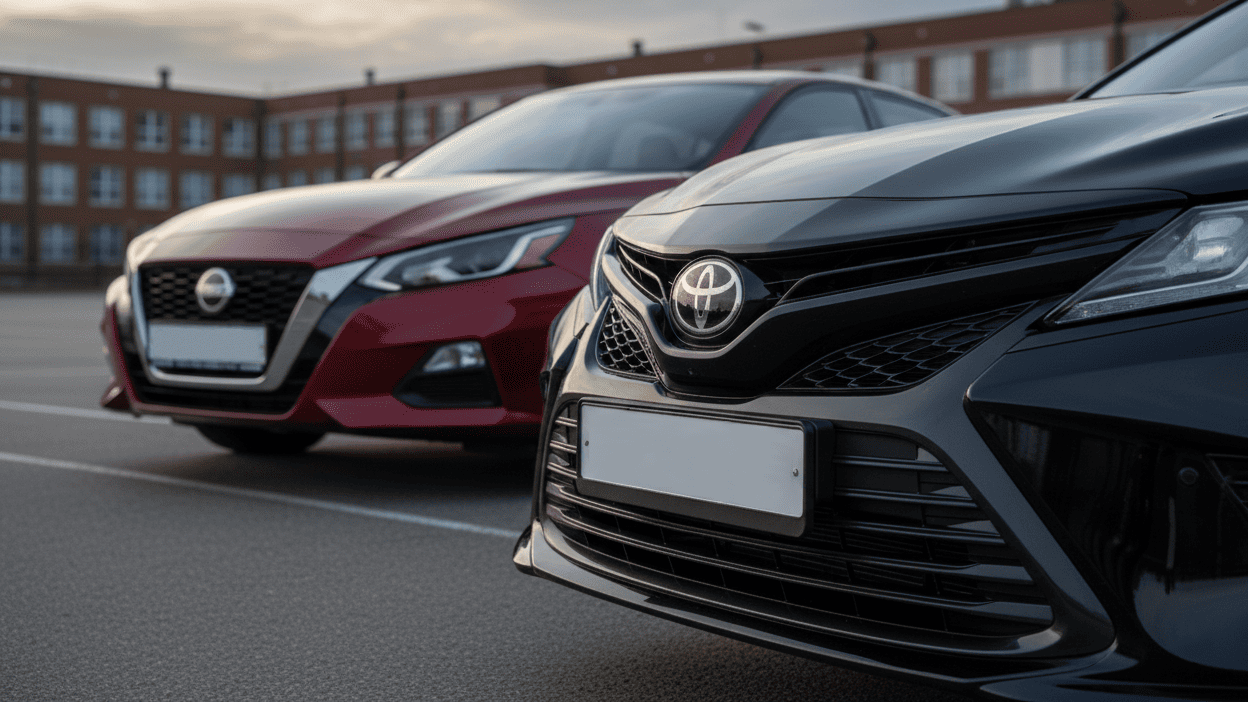
Camry vs Altima

Nissan Altima: comfortable and value-priced; less dominant on long-term reliability and resale than Toyota/Honda.

The Camry and Nissan Altima trade similar territory—practical midsize sedans aimed at commuters and families—but they come at the problem from different angles. Toyota leans into predictability; a long track record for low ownership costs and resale. Nissan, meanwhile, often pitches comfort and a slightly more engaging ride for the money, with a suspension tune that feels cushy and composed in everyday driving.

Mechanically the split is obvious: many Altimas are fitted with CVTs (continuously variable transmissions) and available VC-turbo engines/AWD in some trims, while the Camry uses the 8-speed torque-converter automatic for its gas engines and a well-sorted hybrid e-CVT for hybrid variants. CVTs give Altima smoothness and fuel economy but draw mixed reactions on long-term durability and driving feel—some owners praise them for efficiency, others complain about noise or the “rubber-band” sensation during spirited acceleration. Camry’s torque-converter layout sacrifices a little mechanical efficiency in some scenarios but tends to feel more natural and has a stronger reputation for longevity.

On ownership costs and resale, Camry usually leads—lower average repair bills and stronger demand on the used market. The Altima can undercut on price and offer attractive AWD and comfort-first packaging, making it a smart choice if you prioritize a softer ride or need AWD in winter climates. Bottom line: pick Camry for steady long-term value and fuss-free ownership; pick Altima for comfort, available AWD, and a slightly better initial price if you’re willing to accept CVT tradeoffs.


Conclusion

Alright, let’s break down which Camry XV70 is the right fit for you. You might even want to widen the scope and ask which Camry overall is the best. What’s cool about the XV70 is that it comes with a double wishbone suspension for the back wheels. This means you get way better handling than the older Camrys could offer. If that sounds good to you, I’d say start with this model. Plus the UB80E 8-speed transmission is known to be pretty tough. So you’re getting a solid Toyota that can easily hit a million miles or more. You can also grab it with a strong V6 engine which isn’t available in the newer ninth-gen XV80. Here it’s just offered as a hybrid. So you’ll be using the eCVT transmission which is awesome for getting better fuel economy but if you’re looking at the used ones be ready to spend a bit more since they’re still pretty new.

Let’s talk money for the XV70. Right now, you should be looking at prices between $18k and $28k for the 2021-2022 SE/XLE trims, which is really a sweet spot. You get a good mix of safety, handy features like CarPlay and Android Auto, and a system that’s gotten rid of a lot of glitches. These trims give you a solid value.

If you’re on a tighter budget, check out the 2018-2019 LE/SE models. If they’ve got full service records, you should be able to snag one for under $18k. But if cash isn’t a big deal, you could go for the TRD, XSE, or the later V6 models. They bring some nice upgrades in comfort and sportiness, but you might be looking at over $28k. However, if you’re willing to look a little further out, you might find one for less.

Overall, you really can’t go wrong with any XV70 Camry as long as you check the recall history. Just keep an eye out for those early infotainment quirks on some units, and you’ll be set with a reliable ride that’s cheap to maintain, holds value well, and is comfy on the highway. Plus, you get modern safety features in later models and solid hybrid fuel economy.

Just remember, even though we have marked the XV70 as the sporty Camry, it’s not going to outshine its main rivals in that department. For a livelier ride, the Accord might still be a better pick.


Also Read:
Monitor tire pressure in real time with the best TPMS systems for 2025. Top picks for cars without factory sensors, better safety, and fuel efficiency.


FAQ

Which XV70 Camry year should I buy?

2018–2019 models are great value if they have proven recall completion and service history, 2021–2023 for safety and value, widely available CarPlay/Android Auto and matured software; 2024 if you want the final V6.

Are XV70 Camrys reliable?

Yes; they consistently score well on reliability and have low average annual repair costs versus many rivals.

How long will they last?

200k–300k miles is common with regular maintenance.

Do hybrid Camrys have expensive batteries?

Failures are relatively rare; replacement cost varies by reman/OEM option and region.

What should a PPI focus on?

Transmission, hybrid SOH, ADAS calibration, underbody and suspension play.


*Disclaimer: This website provides automotive content for informational purposes only and should not be considered professional advice. While we strive for accuracy, we do not guarantee the reliability or suitability of any vehicle or product mentioned—always conduct your own research before making purchasing decisions. Additionally, some links on this site are affiliate links, meaning we may earn a commission if you make a purchase, at no extra cost to you.

**This article contains Amazon affiliate links. If you purchase via these links I may earn a small commission at no extra cost to you..

Magnetic Phone Mounts & Mounts for Thick Cases: That Actually Work!

Modern smartphones just keep getting bigger and heavier and so do the cases that protect them. If you’re using a wallet case or any of those rugged types you probably notice that most phone mounts give up the ghost the moment you hit a pothole. In winter especially, having a good phone mount is super important because cold weather and bumpy roads really show off the weaknesses of those suction and magnetic grips. You want a mount that stays put without having to take off your case. 

That’s where the next-gen magnetic car mounts come in. These 2025 models have stronger magnets, metal vent hooks, and sturdy clamping systems to keep even the heaviest phones secure while also keeping your car’s interior neat and tidy. 

In this guide you’ll find recommendations that focus on a compatibility with thick cases, so your phone stays put for navigation and hands-free calls.

Before you choose your mount, check out our guides on the Best Seat Gap Fillers for Leather Seats and Best Car Interior Cleaning Kits for 2025 — they pair perfectly with a cleaner, tech-upgraded cockpit.

In this guide, you’ll see some recommendations that work great with thicker cases. This way, your phone stays secure for navigation and hands-free calls during your daily commute. Let’s dive right in.

How We Picked These Mounts

You want a mount that actually works with thick cases and in winter conditions, so we focused on practical, real-world factors: magnetic holding force and measured magnet ratings for MagSafe-style mounts; suction reliability in low temperatures and on textured dashboards; multi-mount flexibility (dashboard, windshield, vent) so you can place the mount where it’s safest for you; build quality and materials that resist wear and temperature changes; ease of one-handed operation and rotation for quick angle changes while driving; compatibility with larger phones and thick cases; and price, warranty, and customer service notes so you know the long term value. Each pick balances those elements depending on what you’re likely to need.

Top Phone Mounts for Thick Cases:

Category

Product

Price

Score

 Best Magnetic Grip

ANDERY Magsafe

25.61

92/100

 Most Versatile Mount

VICSEED Suction

24.16

89/100

 Best Anti-Vibration

VANMASS Anti-Vibe

25.99

87/100

 Best Budget Suction

Romuto Suction

9.99

85/100

 Most Powerful Magnet

Estbuc Magnetic

18.78

90/100

 Most Adjustable

Peerock Magsafe

32.99

88/100

1. ANDERY MagSafe Carbon Fiber Mount

ANDERY MagSafe Carbon Fiber Mount


ANDERY MagSafe Carbon Fiber Mount

MagSafe-compatible car mount with 360° rotation, 22 N55 magnets (2400gf), adhesive + vacuum suction base, cooling vent design, and included magnetic ring for non‑MagSafe phones.

If you want a MagSafe-style mount that actually holds phones with thick cases, this is one to consider. The ANDERY mount pairs a strong magnetic array (they quote 2400gf) with a four-layer nano gel suction + adhesive pad, so you get a grip that stays put on dashboards or windshields — even in cold winter temps.

You can swivel it 360° and fold the arm down when you don’t need it, which makes it handy for commutes, road trips, or just propping your phone at your desk. Installation is straightforward and it includes a sticky disc for uneven surfaces, so you won’t have to fight to find a flat spot.

Key Benefits

  • Very strong magnetic hold (2400gf) that works with cases
  • Suction + adhesive base stays put in extreme temperatures
  • 360° rotation and foldable arm for flexible viewing
  • Cooling vent design reduces heat when running navigation

Why it stands out: Strong suction base + powerful magnet, reportedly capable of handling heavy phones and thick cases securely — a solid all-arounder.

Pros

  • Excellent MagSafe hold
  • Premium aluminum build
  • Secure metal hook latch
  • Works with thick MagSafe cases

Cons

  • Must be tightened correctly to avoid wobble

Check out our Best Seat Gap Fillers for Leather Seats if you want a cleaner side-console layout to match.


2. VICSEED 3-in-1 Suction Cup Mount

VICSEED 3-in-1 Suction Cup Mount


VICSEED 3-in-1 Suction Cup Mount

3-in-1 car phone mount with upgraded suction cup, vent clip and dashboard pad; extra-wide cradle fits large phones with thick cases and offers 360° rotation.

If you’re juggling a big phone and a bulky case this winter, this VICSEED mount makes life easier. You get three mounting options — suction cup for windshield or dash, a vent clip, and a dashboard pad for textured surfaces — plus a wide cradle that fits most phones even with thick cases.

It’s adjustable with 360° rotation and a retractable arm, so you can position your device for navigation, hands-free calls, or quick passenger-ready viewing. I’d reach for this one for daily commutes, long road trips, or when you need a reliable mount that won’t wobble over potholes.

If you’re upgrading your cockpit aesthetics, pair this with our Best Car Interior Cleaning Kits for 2025 to complete the refresh.

Key Benefits

  • Three mounting options: windshield, dashboard pad, or vent clip
  • Extra-wide cradle designed to handle thick cases
  • Upgraded suction with 2-step locking for stronger hold
  • 360° rotation and retractable arm for flexible viewing
  • Washable, reusable materials and long warranty coverage

Why it stands out: Affordable, versatile, and works either on vents or dashboard — a solid choice for budget-conscious drivers.

Pros

  • Budget-friendly price while offering good magnetic grip for regular phone + case.
  • Dual mounting options (vent or dash)
  • Compact and discreet size.
  • Good for everyday commuting.

Cons

  • Magnetic strength limited compared to high-end mounts.
  • Vent mounts may block airflow or get knocked if vents are adjusted frequently.

3. VANMASS 2025 Anti-Vibration Car Phone Holder

VANMASS 2025 Anti-Vibration Car Phone Holder


VANMASS 2025 Anti-Vibration Car Phone Holder

[True Anti-Vibration] 3-in-1 car phone mount with upgraded suction cup, vent clip and dashboard/windshield options; fits 4–7″ phones and handles thick cases with military‑grade shockproof design.

The VANMASS mount gives you three mounting styles — suction cup for dash or windshield, a vent clip, and a dashboard option — plus a wide cradle and one‑click release so you can pop your phone in and out with one hand. The arm telescopes and rotates so you can position the screen for navigation, calls, or passenger viewing, and the maker leans on military‑grade shockproof testing and wide temperature tolerance so it won’t give up on cold winter mornings or hot afternoons.

I’d reach for this one for daily commutes, weekend road trips, or any time you want a steadier, more versatile mount that handles thick cases.

Key Benefits

  • Three mounting options: suction cup (dash/windshield), vent clip, or dashboard pad
  • Designed to fit phones 4–7″ and most thick cases (cases < 0.7″)
  • Military‑grade anti‑vibration tech and reinforced arm for minimal wobble
  • Large suction cup with washable, reusable surface and strong hold
  • One‑click release, 360° rotation and retractable arm for flexible viewing
  • Temperature and UV resistant with a 36‑month warranty

Why it stands out: Designed for dashboard or windshield use with an anti-slip base — promising stability and good hold even with heavier setups.

Pros

  • Strong adhesive/anti-slip pad helps mount stay put — good for hot climates.
  • Magnet strong enough for everyday use.
  • Good for windshield or dash mounting.
  • Neat and low-profile design.

Cons

  • Adhesive mounts can degrade over time.
  • Removal and re-mounting may leave residue.

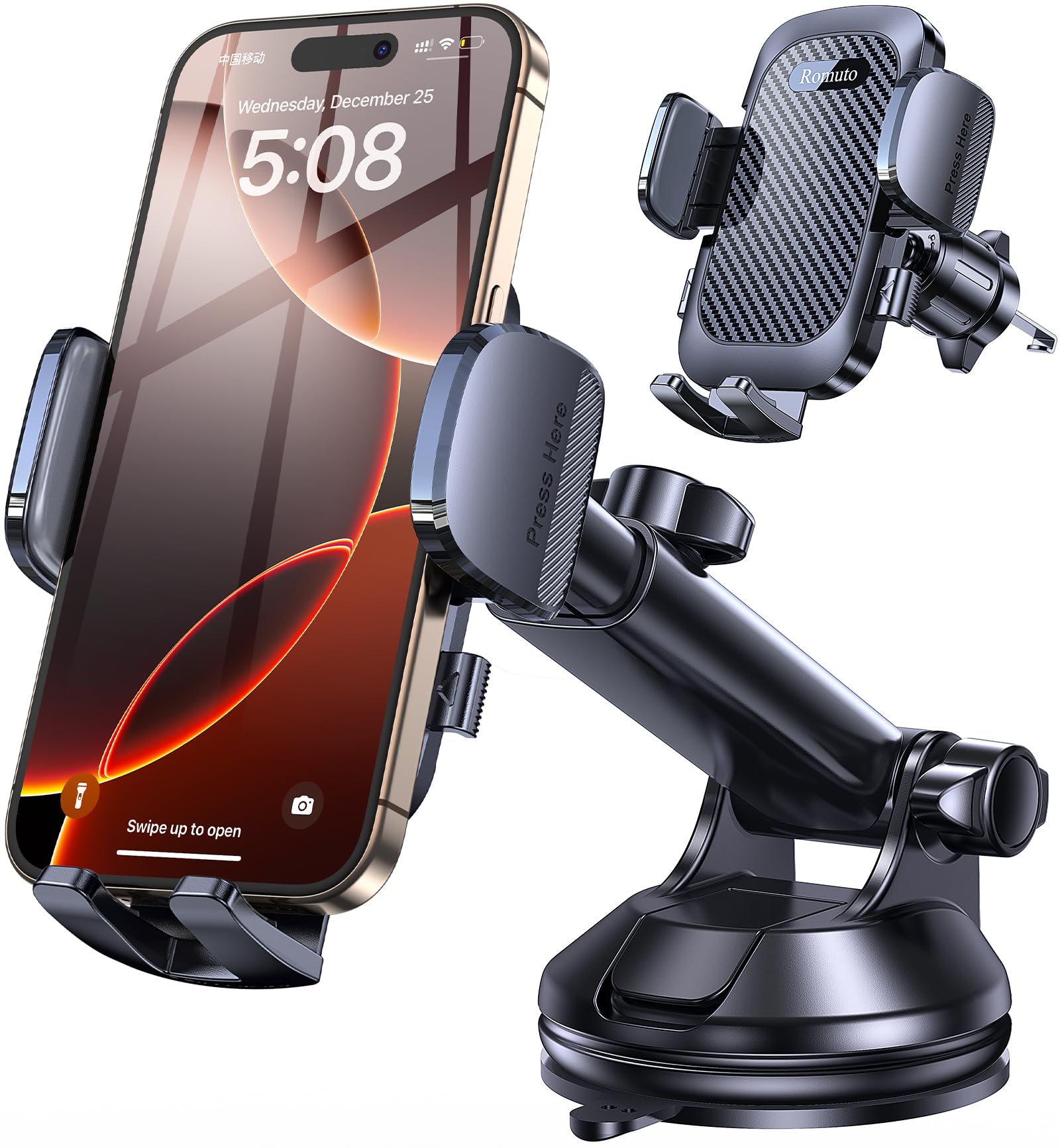
4. Romuto 3-in-1 Car Phone Mount

Romuto 3-in-1 Car Phone Mount


Romuto 3-in-1 Car Phone Mount

3-in-1 car phone holder with super suction cup, vent hook and 3M dashboard adhesive; fits large phones and thick cases, washable suction and one-hand operation.

The Romuto mount is one of the easier picks to live with. You get three mounting options — suction for dash or windshield, a vent hook, and a VHB dashboard pad — plus wide, deeper arms that actually clamp around bulky cases.

The suction material is washable and rated for extreme temps (it’s made to behave from very cold mornings through hot afternoons), and the design aims for one-handed placement so you won’t be fumbling while you drive. I’d reach for this for everyday commutes, weekend road trips, or whenever you need a reliable holder that won’t make you take your case off.

Key Benefits

  • Three versatile mounting options: suction (dash/windshield), vent hook, and 3M VHB dashboard pad
  • Deep, adjustable cradle accommodates large phones and thick cases
  • Washable super-suction cup that tolerates wide temperature ranges
  • One-handed placement and release for safer use while driving
  • Sturdy metal vent hook and reinforced arm for stable positioning
  • Includes replacement GPS dash ball mount compatibility and durable materials

Why it stands out: Offers adjustable pivot + magnetic hold — a balanced mount for drivers wanting flexibility in phone positioning.

Pros

  • Adjustable pivot allows for better viewing angles.
  • Magnetic grip solid for daily driver phones or wallet cases.
  • Works well for dashboard or windshield.
  • Balanced price-to-performance ratio

Cons

  • Adhesive strength may weaken over time or if exposed to sun or heat.
  • Not ideal for extremely heavy phones + rugged cases on rough terrain.

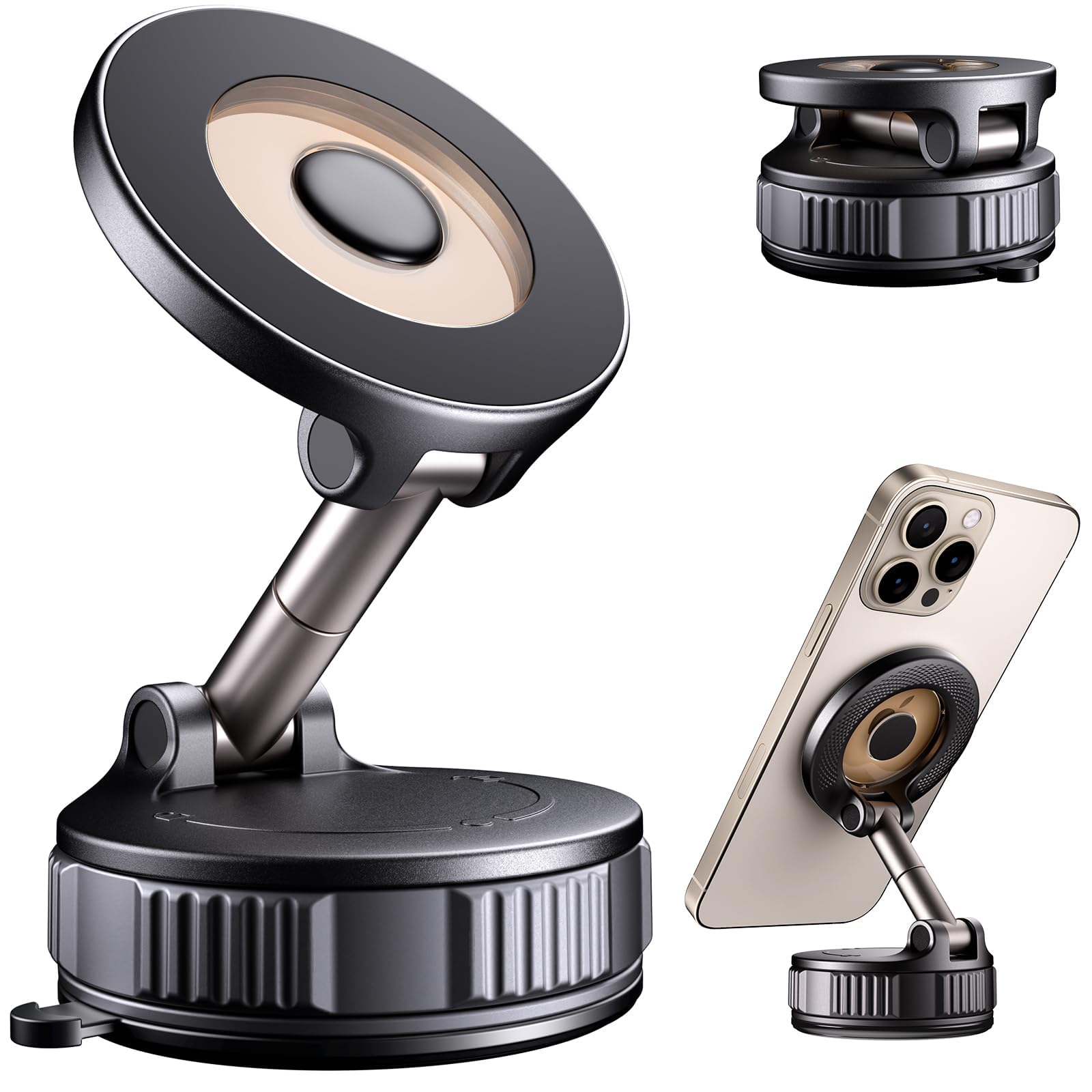
5. Estbuc MagSafe Car Mount

Estbuc MagSafe Car Mount


Estbuc MagSafe Car Mount

MagSafe-compatible magnetic car mount with rotating-lock vacuum suction, N52 dual-ring magnets, 360° adjustment, foldable arms, supports thick cases and extreme temperatures.

With the Estbuc MagSafe mount you get a rotating-lock suction base that clings to smooth dashboards and windows, plus a powerful dual-ring N52 magnet array that’s built to hold heavier phones and thick MagSafe cases.

It swivels a full 360° and folds down neatly, so you can switch between portrait and landscape without wrestling the phone free. The materials are rated for extreme temps, so cold winter mornings and hot afternoons are less likely to mess with the suction.

For daily drives, rideshare work, or longer road trips where you don’t want to remove your case, it’s a solid, compact choice you can rely on.

Key Benefits

  • Very strong N52 dual-ring magnets (claimed up to 2800gf) for secure hold with MagSafe cases
  • Rotating-lock vacuum suction that sticks to smooth dashboards and glass
  • Full 360° rotation and foldable arms for flexible viewing angles
  • Designed to tolerate extreme temperatures for more reliable winter performance
  • Compact profile that doesn’t block your view or take up much dash space
  • Multi-surface use — works on mirrors, windows and other smooth areas

Why it stands out: Another suction-based mount claiming strong magnetic hold + adjustable placement — attractive for flexible mounting across different vehicles.

Pros

  • Suction base can move between cars or re-position easily (windshield, dash, or flat surfaces).
  • Strong magnetic for heavy phones.
  • Adjustable bracket supports multiple viewing angles.

Cons

  • Suction mounts are inherently less stable than vent- or clip-based mounts.
  • Suction adhesion degrades over time — especially under heat.

6. Peerock MagSafe Car Mount

Peerock MagSafe Car Mount


Peerock MagSafe Car Mount

Vacuum magnetic car phone holder with 108+ lb suction and 3000gf magnetic force, 4-axis 360° adjustable carbon-fiber arm, folds flat and includes metal ring for non-MagSafe phones.

The Peerock mount pairs a push-lock nano-gel suction base that claims a 108 lb hold with a dense magnet array (about 3000gf) so phones snap on and stay put.

The arm offers four axes of adjustment and full rotation, then folds down neatly when you don’t need it. The package even includes a metal ring for older phones or thicker cases, and the materials are tested for extreme temps so cold winter mornings are less likely to mess with the suction. For everyday navigation, rideshare shifts, or longer trips where you don’t want to remove your case, it’s an easy, dependable option you can actually live with.

Key Benefits

  • Very strong combo of vacuum suction and 3000gf magnetic array for a confident hold
  • Engineered nano-gel push-lock cup that sticks to smooth dashboards and glass
  • Four-axis, 360° adjustment for precise viewing angles and easy portrait/landscape switching
  • Includes metal ring for non-MagSafe phones and cases up to ~4 mm thick
  • Foldable, compact design that tucks away when not in use
  • Tested for wide temperature ranges to help during cold winter use

Why it stands out: Compact but strong — a good pick if you want a mount that’s easy to install, minimal inside the cabin, yet firm enough for thick-case phones.

Pros

  • Compact form-factor — ideal for small cabins or minimalist interiors.
  • Sufficient for daily driving.
  • Fits different phone sizes & viewing angles.
  • Easy install & quick mount/unmount.

Cons

  • Not ideal for off-road or rough terrain.
  • Not suitable for heavy phones or large battery cases.

How to Choose the Right Magnetic Mount for Thick Cases

You’ll want to think about temperature, mounting surface, and installation method. Cold can make suction cups less flexible and plastics more brittle, while extreme heat can soften adhesives, so look for mounts that list wide operating ranges or reusability; a few models advertise resistance to very low and high temperatures.

If your dash is textured, use the included adhesive disc for a flat bonding surface and clean both surfaces with the supplied wipe before installing. For vent mounts check that the clip won’t stress fragile louvers in freezing weather, and position the mount so it doesn’t block vents, airbags, or your sightline.

Finally, test the setup on short trips: try different arm lengths, rotate between portrait and landscape, and confirm one‑hand removal so you’re not fumbling while driving.

What to Keep in Mind

  • Suction mounts can fail if dashboard/windshield isn’t clean, or in extreme heat/cold — always prep the surface before installing.
  • Magnetic mounts with metal plates may interfere with wireless charging unless plate is precisely aligned or removed when charging.
  • Vent mounts can block airflow or vent controls in some car interiors — check vent blade shape and orientation.
  • Heavy phones + thick cases still stress the magnetic hold — test before full reliance (e.g. cornering, speed bumps).
  • Adhesive bases on dashboards may leave residue or damage textured dashboards — the trade-off for stability.

For a full interior refresh, pair your mount with our Best Car Interior Cleaning Kits for 2025.

How Do Magnetic Mounts Work With Thick Cases And Will They Hold My Phone Securely?

You might worry that a bulky case will stop a magnetic mount from working, but most modern magnetic mounts are designed for that scenario. If you use a MagSafe‑compatible case or a mount that includes a metal ring, the magnets will align with the phone’s coil or the ring so the hold stays strong even with thicker covers; examples in this roundup range from 9.99 to 32.99 Dollars, so you can find options at different price points. Thicker, metal‑reinforced cases or card‑holding wallets can reduce magnetic grip, so choose a mount with a higher advertised magnetic force or strong suction base (some models list stronger gf or pound ratings) and test it before relying on it for long drives.

Always place the phone so the magnet meets the case’s alignment point and give it a gentle tug after mounting to confirm a secure connection.

FAQs

1. Which magnetic mount is best for thick or rugged phone cases?

TORRAS Ultra-Strong and FBB 28-N mounts offer the strongest magnetic hold for OtterBox, SUPCASE, and other rugged cases.

2. Will a magnetic mount work with MagSafe cases?

Yes — mounts like LISEN and TORRAS use strong MagSafe-compatible magnets for secure attachment.

3. Can magnetic mounts damage my phone?

No. Modern smartphones have magnetic shielding, and these mounts are designed not to interfere with charging or sensors.

4. Are magnetic mounts safe for my Phone wireless charging?

You don’t need to panic about magnets frying your phone—modern smartphones are built to tolerate the small magnets used in car mounts. What you should watch for is interference with wireless charging and nearby magnetic stripe cards.

5. What is the best mount for hot climates?

Scosche MagicMount Dash Kit is ideal because its adhesive pad is heat-resistant.

6. What mount should I use if I drive an SUV or truck?

The FBB 28-N mount is engineered for heavy vibration, making it perfect for SUVs, trucks, and off-road use.

If you want uninterrupted wireless charging, use a MagSafe‑certified mount and a MagSafe‑compatible case or place the included metal ring outside the phone’s wireless coil. Also keep credit cards, hotel keys, or pacemaker info away from the magnet. If you notice slower wireless charging or compass/magnetometer odd behavior, remove the case and test; most issues are resolved by repositioning the ring or using a compatible case.

Wrapping Up

Choosing the right mount makes your drives safer and less frustrating, especially if you keep a thick case on your phone. If you need raw magnetic holding power with a clean look and MagSafe compatibility, the ANDERY Magsafe and Estbuc Magnetic stand out for reliable grips. If you switch vehicles or want multiple mounting options, the VICSEED Suction gives the most flexibility. For rides with lots of vibration, the VANMASS Anti-Vibe targets stability; if you’re on a tight budget but still need strong suction, the Romuto Suction is a sensible pick.

Finally, the Peerock Magsafe is best if you want fine-grained adjustability and a fold-flat profile for storage. Use the category that matches how you drive and where you mount your phone, and you’ll keep your device secure all winter long.

Pair your mount with upgrades like the Best Seat Gap Fillers for Leather Seats or Best Wireless CarPlay Adapters for a cleaner, safer, and more modern commute.

Product Image Rating Price Mounting Type Special Highlights
ANDERY Car Phone Holder for MagSafe
Product Image
4.5/5 (15,081 reviews) 25.61 No.1 Suction Car Mount
  • 360° Adjustable
  • 2400gf Magnetic Strength
  • Lightweight Design
  • Luxury Packaging Included
VICSEED Extra Strong Suction Cup Phone Holder
Product Image
4.4/5 (31,044 reviews) 24.16 Durable Car Phone Holder
  • 72-Month Warranty
  • Thick Case Friendly
  • 360° Rotatable Navigation
  • Military Grade Certification
[True Anti-Vibration] Car Phone Holder VANMASS
Product Image
4.3/5 (1,863 reviews) 25.99 Dash, Windshield, Vent
  • 36-Month Warranty
  • Patented Shockproof Technology
  • Super Suction – No Pad Required
  • Compatible with 99% Phone Cases
Romuto Phone Holders for Your Car
Product Image
4.4/5 (3,008 reviews) 9.99 Wall Mounts, Dashboard, Windshield, Vent
  • 80 Pounds Strong Sticky Suction Cup
  • Replaceable GPS Dash Ball Mount
  • Extendable Metal Hook
  • Multiple Mounting Options
Magnetic Phone Holder for Car
Product Image
4.5/5 (977 reviews) 18.78 Rotating-Lock Vacuum Suction
  • 120+ LBS Strongest Suction
  • 2800gf Strong Magnetic Strength
  • One-Hand Operation
  • Compact and Adjustable Design
Car Phone Holder for MagSafe
Product Image
4.4/5 (9 reviews) 32.99 Dashboard, Windshield, Car Screen, Side Window, BackBoard
  • 108+ LBS Strongest Suction
  • 3000gf Magnetic Strength
  • Foldable for Easy Storage
  • Multiple Viewing Angles

*Disclaimer: This website provides automotive content for informational purposes only and should not be considered professional advice. While we strive for accuracy, we do not guarantee the reliability or suitability of any vehicle or product mentioned—always conduct your own research before making purchasing decisions. Additionally, some links on this site are affiliate links, meaning we may earn a commission if you make a purchase, at no extra cost to you.

**When you click on links we might get a small commission on purchases that qualify.
Best Wireless CarPlay Adapters for Older Cars

Older cars age in funny ways. The seats develop character, the suspension stiffens with wisdom… but the tech? That part ages like milk. There’s a moment every owner of an older car faces: you’re sitting in traffic, juggling a Lightning cable that’s seen better days, wondering why your car still demands a leash to talk to your iPhone. Wireless CarPlay solved that problem years ago… if you bought a newer car.

But what if you didn’t?

Fortunately, turning wired CarPlay into wireless CarPlay is one of the simplest upgrades you can make — no tools, no coding, no tearing apart the dashboard. Just plug in a small adapter, wait a few seconds, and your infotainment system suddenly behaves like a 2025 model.

Before you modernize your cockpit, you may also want to look at our guide on the most reliable used cars — a must-read if you’re trying to keep an older daily driver on the road.

Now let’s get into the adapters that are actually worth your time.


Top Wireless CarPlay Adapters

RankProductNotes
⭐ Top PickOttoCast U2-AIR Fastest pairing, top reliability
Best ValueCarlinkit 4.0 CarPlayCarPlay-only version; strong US support
Best 2-in-1Carlinkit CP2AWorks with iPhone + Android
Budget PickTeeran 2in1Cheap and dependable
Most CompactAutoSky USBSuper stable & highly rated
Simple & ReliableJemluse Adapter“Set it and forget it” option

If you’re also refreshing the interior, you’ll like our roundup of the best trunk organizers — another high-value upgrade for older vehicles.

How We Picked

You need an adapter that fits your daily driving habits. We prioritized: connection stability (fewer dropouts), boot time (how fast CarPlay appears after you start the car), latency/input lag (important for maps and touch control), compatibility (iPhone and Android support and wide vehicle coverage), ease of setup and daily use, firmware update path and manufacturer support, physical size and cable options, and price/value. Each pick balances those factors differently so you can pick the one that matches your priorities.


1. OTTOCAST U2-AIR — Still the Most Polished Wireless CarPlay Adapter

Best overall

OTTOCAST U2-AIR


OTTOCAST U2-AIR

Fastest mini wireless CarPlay dongle that converts wired CarPlay to wireless with quick startup (as low as 7s). Compact design; includes USB-A to C and USB-C to C cables.

Some products just get it right. The OTTOCAST U2-AIR has been the gold standard for years, and nothing in 2025 has dethroned it.

Pairing takes under 10 seconds. Navigation feels smooth. Music changes instantly. Even in hot climates — Texas, Arizona, Gulf countries — it refuses to overheat.

If you’re upgrading an older daily driver, pair this with our Pre-Purchase Inspection Checklist so you don’t miss potential electrical issues.

If you want to ditch the cable but keep your factory CarPlay, this little OTTOCAST U2-AIR is exactly the kind of plug-and-play fix you’ll appreciate. You plug it into a USB port and it turns your wired CarPlay into a wireless connection that usually wakes up fast and stays usable; setup is simple and the dongle is small enough to tuck out of sight.

It’s handy for everyday commuting when you just want your maps and music ready the second you start the car, and equally useful for longer road trips where you don’t want to fumble with cords. If your car already supports wired CarPlay, this is a low-effort way to get wireless without swapping the head unit, and I’d recommend it as an affordable, practical upgrade for most drivers.

What People Say

Most customers say the U2‑AIR makes wireless CarPlay feel effortless — praise centers on fast connection times, reliable performance in many cars, and how small it is. People also mention how easy the initial setup is and appreciate the included cables. A minority report vehicle‑specific quirks or occasional reconnect issues, so some users recommend checking compatibility first.

Versatility

Works with most cars that have factory wired CarPlay and supports a variety of iPhones, plus it comes with two cable types so you can hook it up regardless of your port.

Key Benefits

  • Quick startup so CarPlay is ready soon after you start the car
  • Compact plug-and-play design keeps things tidy
  • Generally stable connections with minimal audio lag
  • Includes both USB‑A to C and USB‑C to C cables for flexible hookups

Pros

  • Fastest reconnection in the class
  • Extremely low lag
  • Great build quality
  • Reliable OTA updates

Cons

  • Slightly more expensive than generic brands

2. CarlinKit 4.0 Wireless CarPlay Adapter (CarPlay Only)

Best Value for iPhone User

CarlinKit 4.0


CarlinKit 4.0

Wireless CarPlay adapter that converts factory wired CarPlay to wireless CarPlay or wireless Android Auto. Plug‑and‑play with auto‑connect, dual‑band Wi‑Fi and GPS support.

A clean, stable, no-nonsense option for drivers who only care about Apple CarPlay. If you need a secure place to mount that iPhone you’re no longer plugging in, check our guide on Magnetic Phone Mounts for Thick Cases — one of the most-read accessory guides on TopCarList.

If your car has wired CarPlay but you keep an Android phone in your pocket (or you just want wireless convenience), this little dongle makes the swap painless. You plug it into the USB port and it can trick the factory system into running wireless CarPlay or wireless Android Auto, and it remembers multiple devices so you don’t have to fuss with pairing every time.

It’s handy for daily driving—maps and music come up without grabbing a cable—and great for longer trips when you want fewer cords and easier sharing between phones. Do check compatibility for your exact make and model, but if it matches your car it’s a simple, cost‑effective way to add wireless functionality.

What People Say

People generally like how the CarlinKit 4.0 brings wireless convenience to cars that only have wired CarPlay, and many praise the easy setup and automatic reconnect feature. Users point out the multi‑device memory and support for Android Auto as big wins.

At the same time, reviewers commonly mention occasional reconnect glitches, mixed call/audio quality, and a few vehicle‑specific compatibility quirks—so it’s a practical solution that benefits most but isn’t flawless for every car.

Versatility

Supports iPhones (iPhone 6 and newer) for wireless CarPlay and Android phones (Android 11+) for wireless Android Auto. It’s designed to work with many OEM wired CarPlay systems and includes both USB‑A and USB‑C cable options for flexible hookups.

Key Benefits

  • Converts wired CarPlay to wireless CarPlay or wireless Android Auto
  • Dual‑band Wi‑Fi and claimed low latency for smoother media and navigation
  • Stores up to five devices and auto‑connects for quick, hands‑free use
  • Plug‑and‑play setup with included USB cables keeps installation simple
  • Works with a wide range of factory CarPlay systems so you avoid a full head‑unit replacement

Pros

  • Fast pairing
  • Smooth animations
  • Better heat resistance than older versions

Cons

  • iPhone only (no Android Auto)

3. CarlinKit 4.0 (2-in-1) Wireless CarPlay & Android Auto Adapter

Best for households with both iPhone + Android

CarlinKit 4.0 Wireless Adapter


CarlinKit 4.0 Wireless Adapter

2‑in‑1 wireless CarPlay and Android Auto dongle that plugs into a factory wired CarPlay USB; 5 GHz Wi‑Fi, Bluetooth, OTA updates, multi‑device auto‑connect (requires wired CarPlay).

This is the upgraded 2-in-1 model. If you share the car with someone who uses Android, this is easily the best pick.

If you’re tired of plugging in every time you jump in the car, this CarlinKit dongle is a tidy way to make a factory wired CarPlay system act like a wireless one. You plug it into the car’s CarPlay USB, pair your phone once, and it usually reconnects automatically so maps, music and calls are ready when you start driving.

It also aims to support wireless Android Auto on compatible phones, includes OTA updates for occasional fixes, and keeps the whole setup compact so your center console stays uncluttered. There are some car‑specific quirks and the update flow isn’t perfect, but if your car already has wired CarPlay and you want less cable fuss on daily drives or longer trips, it’s a practical, affordable fix.

What People Say

Most users like how easy it is to set up and that it brings wireless Android Auto to cars that only had wired CarPlay. People frequently mention steady audio and navigation performance, the compact design, and the convenience of auto‑reconnect. Common cautions are occasional disconnects, some head‑unit compatibility oddities, and a firmware/update process that can be fiddly for some setups.

Versatility

This adapter is geared to cars that already have factory wired CarPlay — it won’t add CarPlay where none exists. It often works with Android phones to provide wireless Android Auto if the phone and head unit support it, and the multi‑device memory is handy in mixed households.

Keep in mind some car models (notably certain BMW and Tesla setups and a few specific OEM radios) are listed as incompatible, and the built‑in USB lead is short if you want to tuck the dongle completely out of sight.

Key Benefits

  • Converts factory wired CarPlay to wireless with a simple plug‑in setup
  • Supports wireless Android Auto on compatible phones, adding flexibility
  • 5 GHz Wi‑Fi plus Bluetooth helps keep navigation and streaming responsive
  • Over‑the‑air firmware updates let you get fixes without extra tools
  • Saves up to 5 devices for quick handoffs between drivers

Pros

  • Dual compatibility
  • Reliable firmware updates
  • Great for family/shared cars

Cons

  • Slightly slower boot-up than OTTOCAST

4. Teeran Wireless CarPlay Adapter

Best Under $60

Teeran 2-in-1 Wireless Adapter


Teeran 2-in-1 Wireless Adapter

Converts factory wired CarPlay/Android Auto to wireless; plug‑and‑play adapter with dual‑band Wi‑Fi, auto‑reconnect, compact metal design and USB‑A/C cables.

Teeran is the best bang-for-buck option for older Toyotas, Hondas, Mazdas, and compact SUVs. If you’re refreshing the interior at the same time, our Best Seat Gap Fillers for Leather Seats article pairs perfectly with this upgrade.

If your car already has wired CarPlay or Android Auto and you’re tired of plugging in every time, this little Teeran dongle makes life easier. You just plug it into the USB port, pair once, and most of the time your phone reconnects automatically when you start the car, so maps, music and calls come up without fiddling with cables. It’s handy for daily commutes where you want a no‑fuss setup, and it’s equally nice on weekend road trips or when friends and family swap phones — the adapter handles both iPhones and many Android phones. It won’t replace a full head‑unit upgrade, but for adding wireless convenience to a factory system it’s a simple, budget‑friendly option worth considering.

What People Say

Most users praise how easy the Teeran adapter is to set up and how reliably it reconnects after that initial pairing. Reviewers frequently call out the small, unobtrusive design and steady streaming for maps and music, and they appreciate that it supports both Apple CarPlay and Android Auto.

A few people do mention car‑specific quirks or occasional reconnect delays and note that it can draw power if the car keeps the USB port active when off.

Versatility

Works with iPhones (iPhone 6 and later) for wireless CarPlay and many Android phones (Android 11+) for wireless Android Auto. The package includes USB‑A and USB‑C extension cables to fit hidden or awkward ports, and it’s designed to work with a wide range of OEM wired CarPlay/Android Auto systems.

Key Benefits

  • Turns wired CarPlay/Android Auto into wireless with plug‑and‑play setup
  • Fast auto‑reconnect so your phone links up quickly when you start the car
  • Dual‑band Wi‑Fi and Bluetooth for smoother maps, music and voice calls
  • Ultra‑compact metal design that sits flush and frees your dash from cables
  • Includes USB‑A and USB‑C cables for flexible installation in most vehicles

Pros

  • Affordable
  • Compact
  • Surprisingly stable

Cons

  • Reconnection can take 1–2 seconds longer than premium models

5. AutoSky Wireless CarPlay Adapter

AutoSky Wireless CarPlay Adapter


AutoSky Wireless CarPlay Adapter

Turns a wired CarPlay system into wireless; plug‑and‑play USB dongle with 5 GHz module and included USB‑A/USB‑C cables (wired CarPlay required).

AutoSky is the adapter that keeps popping up in real-world user reviews as “boringly reliable.” Not the flashiest, but extremely dependable on long commutes and road trips.

Great for people who want something they never have to touch again.

If you’re fed up with plugging your phone into the dash every time you drive, this little AutoSky dongle is one of the simplest ways to go wireless. You plug it into a factory CarPlay USB port, pair your phone once, and most of the time it reconnects automatically when you start the car so navigation, music and calls come up without hunting for cables.

It’s compact enough to sit flush in a port or use the supplied USB‑A/USB‑C extensions if your socket is hard to reach, and the 5 GHz radio aims to keep maps and streaming steady. It won’t magically add CarPlay if your vehicle doesn’t already support wired CarPlay, and a few users note occasional head‑unit quirks or update steps, but if you want an affordable, low‑fuss way to ditch the cord for daily drives or weekend trips, it’s worth considering.

What People Say

People commonly highlight how easy the adapter is to set up and how compact it is — many like that it behaves like a tiny USB stick and frees the dash from cables. Reviewers often mention steady navigation and music streaming thanks to the 5 GHz connection and appreciate the included USB‑A and USB‑C leads. At the same time, a number of users report car‑specific quirks: some needed extra steps to update firmware, a few experienced audio or pairing oddities with multiple phones, and a minority ran into compatibility or connection failures that required troubleshooting.

Versatility

Designed to work with vehicles that already have wired CarPlay, the adapter supports a wide range of OEM systems and ships with both USB‑A and USB‑C extensions to fit awkward ports. It comes in a few finishes so it doesn’t look out of place in most interiors.

Note that aftermarket head units and some specific models may be incompatible, so check compatibility or be prepared to test before committing.

Key Benefits

  • Converts factory wired CarPlay to wireless with plug‑and‑play setup
  • 5 GHz module for improved connection stability and lower latency
  • Auto‑reconnect so your phone typically links up as soon as you start the car
  • Includes USB‑A and USB‑C extension cables for flexible port placement
  • Compact, thumb‑drive form that sits flush and keeps the dash tidy

Pros

  • Very stable
  • Good heat resistance
  • Clean, compact design

Cons

  • No Android Auto

6. Jemluse Wireless CarPlay Adapter

Simple & Reliable

Jemluse Wireless CarPlay Adapter


Jemluse Wireless CarPlay Adapter

Converts a wired Apple CarPlay system to wireless; plug‑and‑play USB dongle with Bluetooth and 5.8 GHz Wi‑Fi, multi‑user auto‑connect, aluminum housing (requires wired CarPlay).

This one is for the “I don’t care about specs — I just want it to work” crowd. Simple, stable, and gets the job done.

If you’re tired of fishing for a cable every time you drive, this little Jemluse dongle is an easy way to go wireless without swapping your head unit. You plug it into your car’s wired CarPlay USB port, pair your iPhone once, and most of the time it reconnects automatically so maps, music and calls appear without fuss.

The aluminum shell keeps it compact and tidy, and the combo of Bluetooth and a 5.8 GHz Wi‑Fi radio aims to keep streaming and navigation responsive. It won’t add CarPlay to cars that don’t already have a wired system, and a few users mention cordless placement or rare head‑unit quirks—but for everyday driving and weekend trips it makes life noticeably simpler.

What People Say

You’ll notice reviewers mostly praise how simple it is to set up and how reliably it reconnects—many say it behaves like a tiny USB stick that just works. People also appreciate the compact metal build and steady audio/navigation performance. Common caveats include the short USB lead in some setups and occasional car‑specific quirks or slight delays with certain head units, so it’s smart to check compatibility first.

Versatility

This adapter is built specifically for vehicles that already have wired Apple CarPlay, and it generally works across many OEM systems. A number of users also report success with Android Auto setups, so it can be flexible if you switch phones.

It comes in a small, metal package and a few color options so it won’t look out of place, but keep in mind the built‑in USB lead is fairly short—if you want to hide the dongle you may need an extension cable.

Key Benefits

  • Turns factory wired CarPlay into wireless with plug‑and‑play setup
  • 5.8 GHz Wi‑Fi plus Bluetooth for steadier streaming and navigation
  • Auto‑reconnect so your phone usually links up when you start the car
  • Compact aluminum design keeps the dash clean and resists heat
  • Supports multiple users so different drivers can pair their phones

Pros

  • Easy to install
  • Fast reconnection
  • Clean design

Cons

  • Lacks the advanced settings of higher-end models

Ratings

ModelLatencyCarPlay / Android AutoBest For
OttoCast U2⭐⭐⭐⭐⭐CarPlayBest overall
Carlinkit 4.0⭐⭐⭐⭐CarPlayBest value
Carlinkit CP2A⭐⭐⭐⭐BothMixed devices
Teeran 2in1⭐⭐⭐⭐CarPlayBudget
AutoSky USB⭐⭐⭐⭐CarPlayLong-term reliability
Jemluse Adapter⭐⭐⭐⭐CarPlaySimplicity

What Actually Matters When Choosing an Adapter

Here’s what to keep in mind when picking the right CarPlay adapter for you. And if you’re unsure if it’s even worth upgrading an older car, take a look at our Most Underrated Cars — there’s still a bunch of hidden gems out there on the road.

  • Latency: it’s all about the gap between being usable and just plain annoying
  • Heat tolerance: really important when it’s super hot outside
  • Reconnection speed: how quickly it gets back online
  • OTA updates: those over-the-air updates that keep things fresh

If you’re sticking with your car and giving it a little upgrade instead of hunting for a new ride and it’s got over 150,000 miles on it, check out our High-Mileage Maintenance Guide for some handy tips.


FAQ

How Do I Choose The Right Wireless CarPlay Adapter For My Car?

Start by making sure your car has wired CarPlay support and your phone runs iOS 10 or later; many adapters only convert an existing wired CarPlay port rather than adding CarPlay to a car that never supported it. Check the connector type (USB‑A vs USB‑C), the adapter’s stated compatible model years, and whether the maker provides ongoing firmware updates. Prioritize adapters with 5 GHz Wi‑Fi, fast auto‑reconnect, and multi‑user support if you frequently switch phones.

You can expect reliable options in the $34.99–$45.99 range: models like OTTOCAST ($39.80), Teeran ($39.99), Jemluse ($39.99) and CarlinKit ($45.35) are common picks; compare stability, update policy, and return support before you buy.

Will A Wireless Adapter Affect Audio, Navigation, Or Phone Call Quality?

Wireless CarPlay can introduce a slight, usually sub‑second delay compared with a wired connection, which is normal for wireless streaming and control; audio fidelity and navigation data are typically the same in everyday use. Call quality sometimes routes differently (Bluetooth vs CarPlay audio) and can vary by head unit and adapter, so if calls are mission‑critical you may prefer plugging in.

Many users report rock‑solid music and maps once paired, but be prepared for occasional disconnects after phone or head‑unit updates; keeping adapter firmware and your phone OS current minimizes problems.

How Do I Set Up And Troubleshoot Common Connection Issues?

The usual setup is plug the adapter into your CarPlay USB port, pair it via Bluetooth once and allow the adapter’s Wi‑Fi connection; after that it should auto‑connect when you start the car. If you run into trouble, restart your phone and head unit, try a different USB port or cable, disable the car’s native Bluetooth if it competes with the adapter, and make sure your phone isn’t auto‑joining your home Wi‑Fi while in range.

For firmware updates use a powered USB port or a computer if the head unit cuts power during installs and consider removing old paired devices if multiple phones confuse the adapter; if problems persist contact the manufacturer for a firmware fix or replacement.

Does this work if my car doesn’t already have wired CarPlay?

No. You’ll need factory CarPlay for these to work.
Not sure what your car came with? Run through our Pre-Purchase Inspection Checklist.

Will wireless drain my battery faster?

A bit, yes. Bluetooth + Wi-Fi always pull more power than wired.

Is wireless slower than wired?

Premium options like OTTOCAST and Ottoadapter come surprisingly close.

Final Verdict

your driving experience easier and safer. If you’re after something that you can count on every day, go for the Jemluse adapter since it’s known for its great stability.

If you’re looking for the best bang for your buck, the Teeran 2in1 is super convenient with its plug-and-play setup and it works for both CarPlay and Android Auto. If you want something that starts up quickly and reconnects easily, OttoCast is a solid option. For those who need Android Auto specifically, the Carlinkit versions are what you want. And if you’re after something compact and affordable, AutoSky is the way to go. No matter what you end up picking, a wireless adapter can really give a boost to an older car infotainment system and help you stay focused on the road while your phone is safely stowed away.

Pair this small tech upgrade with inexpensive fixes — like seat gap fillers or car covers for all-weather protection — and any older car instantly feels less “last decade” and more “new again.”

Product Image Rating Price Weight Compatibility Special Highlights
OTTOCAST Wireless CarPlay Adapter 2023
Product Image
3.8/5 (2,851 reviews) 39.80 4.6 ounces Designed for OEM Wired CarPlay Cars (2016-2022) and iOS 10 or later
  • Auto-Connect via 5GHz Wi-Fi
  • Online Software Updates
  • Built-In Microphone
CarlinKit 4.0 Wireless CarPlay 2024
Product Image
3.9/5 (91 reviews) 45.35 4.8 ounces Compatible with iPhone 6 or newer (iOS 10+) and Android devices (Android 11+)
  • Plug & Play Setup
  • 2-in-1 Wireless Android Auto & CarPlay
  • 5.8GHz Wi-Fi Connectivity
Teeran 2 in 1 Wireless CarPlay and Android Auto Adapter
Product Image
4.2/5 (1,342 reviews) 39.99 2.39 ounces Works with 1000+ Cars equipped with Wired CarPlay/Android Auto
  • Easy Plug & Play Setup
  • Fast Seamless Connection
  • Lifetime Firmware Upgrades
AutoSky Wireless CarPlay Adapter
Product Image
3.8/5 (2,413 reviews) 34.99 2.08 ounces Compatible with vehicles that have Wired CarPlay
  • Fast Auto-Connect
  • USB-C and USB-A Compatibility
  • Protective Circuitry
Jemluse Wireless CarPlay Adapter
Product Image
4.4/5 (6,582 reviews) 39.99 0.8 ounces Compatible with iOS 10+ devices
  • Multi-User Seamless Connection
  • No Latency Experience
  • Automatic Connection on Startup
CarlinKit 4.0 CarPlay Wireless Adapter
Product Image
3.7/5 (110 reviews) $ 4.6 ounces Supports vehicles with OEM Wired CarPlay
  • Seamless OTA Upgrades
  • Bluetooth Connectivity
  • Dual Connections for iOS & Android

*Disclaimer: This website provides automotive content for informational purposes only and should not be considered professional advice. While we strive for accuracy, we do not guarantee the reliability or suitability of any vehicle or product mentioned—always conduct your own research before making purchasing decisions. Additionally, some links on this site are affiliate links, meaning we may earn a commission if you make a purchase, at no extra cost to you.

**When you click on links we might get a small commission on purchases that qualify.
Best Seat Gap Fillers for Leather Seats

There’s a small but maddeningly persistent problem in almost every car: the gap between the front seats and the center console. Drop your phone, keys, sunglasses, or a stray coin — and it falls. Forever. What often starts as a minor annoyance can end up becoming a serious distraction when you try to fish out what you dropped while driving. And for drivers with leather seats, reaching down there feels like a crime against good upholstery.

That’s why getting a good seat gap filler is one of the best and cheapest upgrades you can do for an older car. These fillers have come a long way. They keep your stuff within reach, stop you from getting distracted, and if you go for leather or higher-end materials, they fit right in with your car’s look. Forget those cheap foam blocks from back in the day there are now premium PU leather inserts, flexible neoprene fillers, and sleek organizers that look great in modern cars, especially those with leather interiors.

Before we dive in, if you’re giving your interior a full refresh, check out our guide on the Best Car Interior Cleaning Kits for 2025 and Best Magnetic Phone Mounts for Thick Cases — these upgrades pair perfectly with gap fillers.

Now let’s break down the best seat gap fillers for leather seats in 2025 — all tested for fit, aesthetics, and durability.

What Makes a Great Seat Gap Filler

When I evaluate seat-gap fillers — especially for leather-interior cars — I pay attention to a few key features:

  • Material & Finish: PU leather or high-quality Neoprene blends better with leather interiors and avoids scratching or wear.
  • Fit & Flexibility: It should adapt to different gap sizes (sedans vs. SUVs vs. trucks), and ideally move with the seat so it doesn’t shift or fall out. The original design of Drop Stop, for example, hooks over the seatbelt catch so it stays put even if you adjust the seat.
  • Added Functionality (Optional): Built-in storage, small compartments or organizers — useful if you want more than just a “blocker.”
  • Ease of Installation: No tools, no drilling; just slide it in. Most of the products above satisfy this.
  • Durability & Longevity: Leather or high-quality materials resist wear, make cleaning easier, and stay intact over time.

Top Seat Gap Fillers for Leather Seats

RankProductWhy It Made the List
⭐ Top PickDrop Stop Car Seat Gap FillerBest universal fit, moves with the seat
Best Leather MatchHiseanllo Car Seat Gap FillerCleanest look for leather interiors
Best OrganizerGivifive Seat Gap OrganizerStorage + filler combo
Best Simple FillerSupin PU Leather Seat Gap FillerAffordable, clean fit
Compact OrganizerSojoy WEDGEE Seat Gap PocketSmall, strong, minimal storage
Rugged OptionZento Deals Seat Gap FillerGreat for trucks/SUVs

1. Drop Stop Original

Still the King of Seat Gap Fillers

Drop Stop Seat Gap Filler


Drop Stop Seat Gap Filler

Original patented seat gap filler that blocks the gap between your car’s seat and center console; set of 2 with slide-free pad and LED light; universal fit; attaches to seat belt catch.

Drop Stop tucks into the gap, attaches to the seat-belt catch, and moves with the seat so you don’t have to fish for your phone or keys.

It comes as a two-pack and includes a slide-free pad and a small LED card light, handy for night-time fumbling in winter. Whether you’re commuting every day or heading out on a holiday drive, it keeps small items accessible and blends into most interiors—worth trying if you want a tidy, durable fix.

What People Say

Customers commonly note that Drop Stop actually keeps small items from disappearing and that the fit is snug in a wide range of cars. Reviewers appreciate that it moves with the seat thanks to the seat-belt catch attachment and that the bonus slide pad and tiny LED add practical value.

A few people mention installation can be a bit fiddly on certain models, but most call it durable, low-maintenance, and a helpful everyday solution.

Key Benefits

  • Blocks the seat-console gap so phones, keys and change don’t fall through
  • Universal fit that moves with the seat via the seat-belt catch slot
  • Durable neoprene cover that’s easy to wipe clean
  • Includes slide-free pad and small LED card light as useful extras
  • Two-pack covers both driver and passenger sides

Drop Stop is the original patented gap blocker — and it’s still the easiest, most universal solution for leather interiors. Its neoprene body compresses and expands to match any gap size, and the smart design hooks around the seatbelt stalk, so it moves with your seat instead of slipping out.

If you’re upgrading the tech in your older vehicle, pair it with our Best Wireless CarPlay Adapters for a noticeably more modern cabin.

Pros

  • Fits almost all cars
  • No leather scratching
  • Moves with your seat (huge advantage)
  • OEM-style minimal appearance

Cons

  • No added storage

2. Hiseanllo PU Leather Gap Filler (2-Pack)

Best Matching Aesthetics

Hiseanllo Car Seat Gap Filler


Hiseanllo Car Seat Gap Filler

Universal PU leather 2-pack seat gap plugs that fill the space between seat and console to stop phones, keys and coins from falling.

These are made with a soft sponge core wrapped in faux leather, so it looks discreet in most interiors and won’t scratch your seats.

Works great for daily commutes, road trips, rides with kids who drop toys, or any time you want fewer distractions while driving; just be aware it’s best for gaps under about 2.3 inches and can be less helpful on seats with memory/motorized adjustments.

What People Say

You’ll find most customers say this actually prevents small items from disappearing and that it fits snugly in a wide range of vehicles. Folks commonly praise how easy it is to install and clean, and how it blends into the car’s interior.

A smaller group points out fit issues with certain memory or heavily motorized seats, and a few mention returns when it didn’t match their gap size.

Key Benefits

  • Stops phones, keys and coins from slipping into the seat gap
  • Soft sponge interior with PU leather cover—easy to wipe clean
  • Quick, tool-free installation that stays put during normal seat adjustments
  • Universal fit for most cars, trucks and SUVs with gaps under 2.3 inches
  • Two-pack covers both driver and passenger sides

Pros

  • Best aesthetic match for leather seats
  • Dense construction sits flush
  • Doesn’t slip or rattle

Cons

  • Not ideal for very narrow gaps

3. Givifive Seat Gap Organizer

Best for Storage Lovers

Givifive Seat Gap Filler (2-Pack)


Givifive Seat Gap Filler (2-Pack)

Givifive 3-in-1 soft foam seat gap filler 2-pack: gap stopper, console organizer and hook for drinks; washable high-density foam and universal fit for most cars.

You slide the soft, high-density foam strip into the space between the seat and center console and it stays put as the seat moves, while the built-in pocket and ring give you a place for small items or a lightweight drink. It’s handy for daily commutes, school runs or long road trips, and it’s especially useful in winter when you don’t want to bend and fumble for dropped gloves or a slippery phone. There are Standard and Narrow sizes, so pick the one that matches your gap, and if your seats have very tight gaps or unusual belt housings you might need to test fit first.

For most people who drop stuff between seats, it’s an easy, inexpensive upgrade I’d recommend trying.

What People Say

Most customers say the fillers noticeably cut down on dropped items and tidy up the area between seat and console. People often mention the soft, durable foam and how simple the install is, and reviewers appreciate the extra pocket and ring.

A minority report it can be snug in very tight gaps or that it sometimes makes buckling slightly fiddlier, so double-check your gap size before buying.

Key Benefits

  • Stops phones, keys and coins from falling into the seat-console gap
  • 3-in-1 design: gap stopper, small-item organizer and hanging ring for light drinks or bags
  • Soft, washable high-density foam that won’t scratch interior
  • Moves with the seat and covers the seatbelt catch area for full protection
  • Available in Standard and Narrow sizes to fit most cars, trucks and SUVs

Some drivers want more than just blocking the gap. Givifive adds pockets for your phone, cards, notes, or SlimFit wallet — without looking bulky or cheap. A smart option for commuters and rideshare drivers.

Pros

  • Adds real usable storage
  • PU leather housing looks upscale
  • Stays secure even on uneven roads

Cons

  • Can feel tight in smaller cabins

For more interior upgrades, check our Best Car Interior Cleaning Kits for 2025 — perfect pairing with organizers.


4. Supin PU Leather Gap Filler

Best Budget Pick

Supin Seat Gap Fillers (2-Pack)


Supin Seat Gap Fillers (2-Pack)

Car Seat Gap Filler Pad PU Leather Console Side Pocket Organizer with removable cup holder — holds cellphone, wallet, coins, keys and attaches to the seatbelt.

Just like the Givifive, you thread the built-in slot over the seatbelt post so the filler stays put as you move the seat, and the extra pocket plus a detachable cup holder give you a small, handy spot for keys, cards or a bottle.

The PU leather looks tidy next to leather interiors, wipes clean easily, and the firm, snug fit means it won’t slip during daily commutes, grocery runs or longer winter trips when you don’t want to bend down in the cold. If your car has a very narrow gap the pieces can feel stiff to install, but for most trucks, SUVs and sedans this is a practical upgrade I’d suggest trying.

What People Say

Most buyers notice a big drop in items disappearing between the seat and console and like the cleaner look the fillers provide. People frequently praise the snug, non-slip fit and the faux-leather material that’s easy to wipe down, plus the extra pocket and removable cup holder for small items.

Common downsides mentioned are that the cup holder can be flimsy for heavier drinks and the pieces can be too firm for very tight gaps, so fit varies by vehicle.

Key Benefits

  • Stops phones, keys and coins from slipping into the seat-console gap
  • Faux leather surface wipes clean and matches many interiors
  • Detachable cup holder gives extra small-item storage (removable if it gets in the way)
  • Secures to the seatbelt post so it moves with the seat and stays put
  • Universal fit for most vehicles — best for medium to larger gaps

If you want a clean look and simple functionality at the lowest cost, Supin offers the most impressive price-to-quality ratio. Works great with both leather and synthetic interiors.

Pros

  • Affordable
  • Soft PU leather
  • Simple, discreet design

Cons

  • No storage pockets

6. Sojoy WEDGEE

Compact Organizer With a Slim Profile

Sojoy WEDGEE Car Seat Gap Filler


Sojoy WEDGEE Car Seat Gap Filler

Patented wedge design fills the seat-console gap and adds two rounded pockets for small-item storage; fits most cars, trucks and SUVs.

Currently unavailable

Check Availability

The WEDGEE is basically a molded plastic wedge with two rounded pockets that tucks into that gap and gives you reachable storage. It’s handy for your phone, gloves, receipts or a spare mask during daily commutes, and on cold winter drives it saves you from awkwardly bending down with frozen hands. Installation is simple—slide it into the gap and the bridge design helps it stay put—though some cars with very tight or oddly shaped gaps may need a bit of tape or Velcro to stabilize it.

This one is an easy option to try if you want a low-fuss way to stop lost items and add a little extra storage.

What People Say

Buyers commonly like that it creates usable storage and reduces the number of lost items between the seat and console. Many people find it easy to install and appreciate the two-pocket layout, while others note the hard plastic feel and that fit can be hit-or-miss depending on seat shape. A fair number mention having to add adhesive or Velcro in cars with very narrow or irregular gaps to keep it from sliding.

Key Benefits

  • Blocks the gap so phones, keys and small items don’t fall through
  • Two rounded pockets for organizing essentials within reach
  • Patented wedge-and-bridge shape designed to stay seated once installed
  • Quick to install—no tools; just slide it into the gap
  • Fits most cars, trucks and SUVs for everyday and seasonal use

This seat gap filler gives you just the right amount of space for your essentials without cluttering your center console. So if you’re tight on space or have a small sedan, this simple organizer is a great choice.

Pros

  • Slim and subtle
  • Small storage pocket
  • Good fit for narrow gaps

Cons

  • Not suitable for wide console gaps

7. Zento Deals Neoprene Filler

Best for SUVs & Trucks

Zento Deals Mesh Cargo Net


Zento Deals Mesh Cargo Net

Stretchable mesh three-pocket trunk organizer (44″ x 12″ x 12″) with hooks, screws and buttonholes; heavy-duty nylon/polyester for cars, trucks and SUVs.

This stretchable mesh cargo net is a simple fix. You slide or clip it into place using the included hooks, screws or your own tie-downs and the three-pocket layout keeps items separated so nothing rolls into the seat gap or tailgate.

It works great for everyday errands—stashing grocery bags, a pair of gloves or a thermos—and it’s handy for winter trips when you don’t want to bend down with frozen hands to retrieve spilled items. The material feels sturdy for the price, though you may need to add a few extra fasteners or stretch it a bit on wider full-size beds. If you want an affordable way to keep the trunk tidy and prevent sliding on icy or bumpy drives, this is a practical choice.

What People Say

Customers generally praise the net as a good value that stops groceries and gear from sliding around and like the three compartments for organization. Many reviewers find it easy to clip on and remove, and they comment that the material feels durable for the price.

Common caveats are that it can be a bit short on full-size beds, may need extra fasteners for a snug fit, and prolonged exposure to the elements can reduce elasticity over time.

Key Benefits

  • Three divided pockets keep groceries and small items from shifting
  • Stretchable mesh fits many truck beds and trunk layouts
  • Includes hooks, screws and buttonholes for multiple mounting options
  • Lightweight, heavy-duty nylon/polyester construction for everyday use
  • Affordable, easy to install and stows away when not needed

Pickup trucks and body-on-frame SUVs often have wider gaps. This neoprene filler adapts beautifully, stays put on rough roads, and won’t damage leather seats.

Pros

  • Rugged, flexible neoprene
  • Great for bumpy terrain
  • Fits wide gaps well

Cons

  • Not as “luxury-looking” as PU leather

Comparison Table

ProductMaterialStorageBest For
Drop Stop OriginalNeopreneNoUniversal fit & daily drivers
Hiseanllo PU LeatherPU LeatherNoLeather seat aesthetics
Givifive OrganizerPU LeatherYesCommuters needing storage
Supin PU LeatherPU LeatherNoBudget buyers
Sojoy WEDGEEPU LeatherYesCompact cabins
Zento Deals NeopreneNeopreneNoTrucks/SUVs

How to Choose the Right Seat Gap Filler

You want a gap filler that actually fits and stays put, so start by measuring the gap between your seat and center console (width and depth) and note where the seatbelt buckle sits. If your vehicle has motorized seats or seat memory, pick a flexible, low‑friction option that moves with the seat rather than a rigid plastic wedge.

Consider material: faux leather or PU is easy to wipe clean, soft foam is forgiving in irregular gaps, and neoprene or smooth fabric glides when you slide the seat. Think about extras you care about—some models like Drop Stop include a slide‑free pad and a small flashlight, while budget leather options like Hiseanllo and foam styles like Givifive focus on simple coverage. Also check whether a built‑in cup holder or hooks might interfere with your driving comfort. Finally, read the fit notes and return policy so you can swap sizes if the universal claim doesn’t match your car.

How Do I Install, Maintain, And Use A Seat Gap Filler Safely During Winter Drives?

Installation is usually simple: lean the seat back, slide or tuck the filler into the gap until it reaches the console or seat base, then move the seat forward and back to seat it properly—for many products the trick is to lean the seat back and tuck the front edge firmly. If it slips, a small patch of double‑sided automotive tape or a tether to the seatbelt post can help.

For winter care, clean salt and grit off regularly so material doesn’t abrade your upholstery; wipe faux leather with a damp cloth, hand‑wash foam and air dry, and vacuum crumbs out of crevices. Keep in mind bulky winter clothing can change how the filler sits, so recheck fit when you switch coats or boots.

If the unit causes any binding, unusual noises, or interferes with safety features, remove it immediately and try a different model or position. Finally, check the seller’s return policy if your car needs a different style—many brands are inexpensive enough to test risk‑free.

Benefits Of Using Seat Gap Fillers

Seat gap fillers are super handy but there’s more to them. Here are a couple of reasons why you might want one if you’re still on the fence about getting it.

  • Safety: Fishing for dropped items while driving is a major distraction — a gap filler reduces that risk.
  • Cleanliness: Prevents food crumbs, dust, coins, small trash from disappearing down the gap — keeps interior cleaner and easier to vacuum later.
  • Interior Value: For leather seats and premium cabins, maintaining a clean, intact interior preserves value; gap fillers prevent scratches or wear that come from reaching into the gap.
  • Organization & Peace of Mind: Everything stays in place — no more awkward dives for sunglasses or coins. And that counts for a lot if you care about the driving experience.

FAQs

1. Are seat gap fillers safe for leather seats?

Yes. PU leather and neoprene fillers are designed to sit flush without scratching or pressing into the leather surface. Drop Stop and Hiseanllo are ideal for premium interiors.

2. Will a seat gap filler fit my specific car model?

Most fillers are universal and expand to fit sedans, SUVs, trucks, and crossovers. If you have very narrow gaps, choose LEORX; for wide gaps, choose Zento Deals.

3. Can seat gap fillers block heated or ventilated seats?

No. They sit beside the seat, not under it. They don’t affect heating elements or ventilation channels.

4. Do organizer-style gap fillers interfere with shifting?

Only if the console is extremely tight. For manual transmissions or tight cabins, stick with Drop Stop or Supin.

5. Will A Seat Gap Filler Interfere With Seat Movement, Seatbelt, Or Safety Systems?

It can if you don’t pick and position it carefully, so always test before you drive. Keep the filler clear of the seatbelt latch and any seat‑mounted airbags or sensor housings; do not block airbags or seat occupancy sensors. If your seat has memory or power adjustment, move the seat through its full range after installing the filler to make sure it doesn’t jam the motor or pull loose. Some rigid or bulky designs can push the seatbelt buckle into an awkward position or make buckling harder; flexible, slim designs generally avoid that.

6. Which gap filler looks best in a leather interior?

Hiseanllo and Drop Stop Deluxe match leather aesthetics best, thanks to PU leather design and flexible neoprene construction.


Note: Avoid relying on gap fillers to support heavy cups or hot drinks—many cup attachments are cosmetic and can droop. If you notice resistance, buckling issues, or warning lights, remove the filler and choose a different style.

Wrapping Up

If you’re fed up with searching for your keys and phone in the freezing cold a gap filler is an easy upgrade that saves you time and keeps you focused. Go for Drop Stop if you want something that’s been proven to work and moves with your seat. If you’re looking for something easy on the wallet check out Hiseanllo for basic protection at a decent price. Givifive or Supin are great picks if you want some extra storage or a cup holder. Sojoy Wedgee is perfect if you like a design that focuses on storage. And for organizing your trunk or cargo the Zento net is the way to go. Each of these choices helps you keep your stuff close so you can pay attention to the road and stay warm and less stressed.

Pair this upgrade with a TopCarList Cleaning Kit Guide or Wireless CarPlay Adapter Upgrade and your interior will feel dramatically more modern.

Product Image Rating Material Dimensions Weight Price
Drop Stop – The Original Patented Car Seat Gap Filler
Product Image
4.6/5 (72,096 reviews) Polyester with a slide-free pad 17.95 x 5.04 x 2.6 inches 11.2 ounces 24.99
Car Seat Gap Filler 2 Pack, Universal Fit PU Leather
Product Image
4.4/5 (2,374 reviews) PU Leather 15.59 x 3.7 x 1.5 inches 9 ounces 13.99
Car Seat Gap Filler Set of 2, Soft Foam Multifunctional
Product Image
4.2/5 (3,609 reviews) Soft Foam 17.24 x 1.97 x 1.38 inches 12.9 ounces 19.68
Supin 2 Prices Car Seat Gap Filler Pad PU Leather
Product Image
4.1/5 (3,648 reviews) Faux Leather 17.12 x 1.57 x 2.16 inches 1.06 pounds 19.99
Sojoy WEDGEE Car Seat Gap Filler Organizer
Product Image
3.8/5 (71 reviews) Plastic 16 x 5 x 1.5 inches 1.1 pounds 20.00
Zento Deals Black Stretchable Mesh Organizer
Product Image
4.1/5 (2,411 reviews) Nylon, Polyester 44 x 12 inches 3 ounces 15.78

*Disclaimer: This website provides automotive content for informational purposes only and should not be considered professional advice. While we strive for accuracy, we do not guarantee the reliability or suitability of any vehicle or product mentioned—always conduct your own research before making purchasing decisions. Additionally, some links on this site are affiliate links, meaning we may earn a commission if you make a purchase, at no extra cost to you.

**When you click on links we might get a small commission on purchases that qualify.
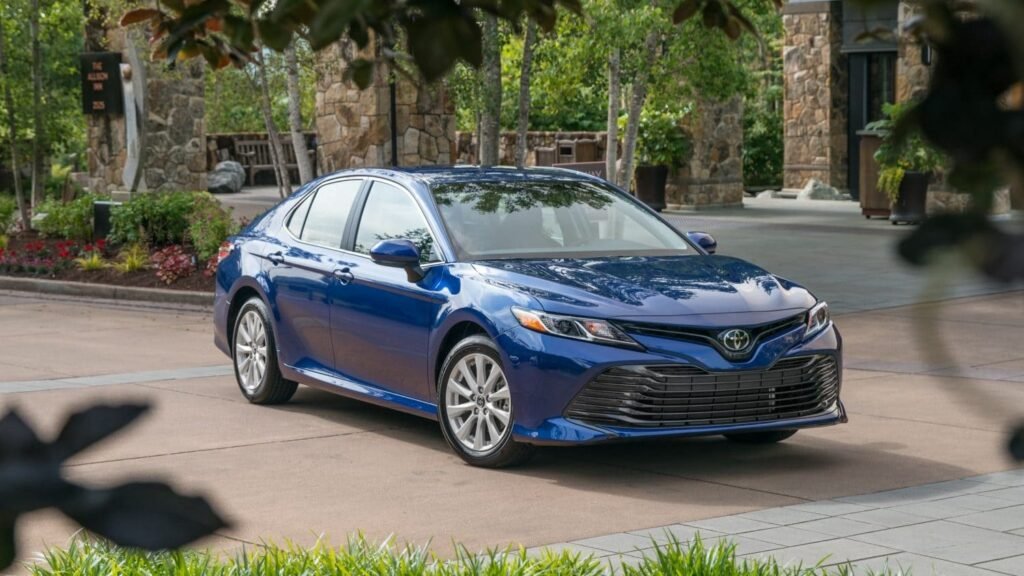
The Most Underrated Cars — Hidden Gems You Should Actually Consider

The car hype is always moving at lightning speed. Some really great cars end up getting overlooked. This usually happens because they don’t fit neatly into the usual marketing molds, they lose value quickly, or they just aren’t on the influencer radar. That’s why we’re all about those “underrated” cars. They can give you amazing value, surprising performance, or a fun driving experience without costing you an arm and a leg. 

You know, sometimes you stumble upon some awesome car models that just don’t get the love they deserve. It’s not that they’re bad rides, but sometimes their marketing just doesn’t hit right, or maybe their design is a little quirky. It could also be bad timing or they’re up against a flashier competitor. This happens not only with cars but with all sorts of products out there.

Below you’ll find 12 carefully chosen underrated cars, including both newer models and late-generation used ones that critics rave about and owners truly stand by. You’ll see quick reasons why they’re being overlooked, what makes them secretly fantastic, and some solid buying tips. Plus, we’ve thrown in a couple of handy comparison tables so you can make a wise purchase without any buyer’s regret. If you’re a smart shopper, you’ll definitely want to check these out before settling for something more mainstream. Let’s dive in!

Feel free to read it all the way through or jump straight to the section that catches your interest.

How We Picked Them

We picked these rides based on our own experiences and trusted reviews from sources we trust. These top picks all share some cool features:

  • They deliver more than their sales numbers suggest (handling, comfort, tech),
  • get repeated praise from professional testers but low-profile sales, and
  • are reasonably practical to own (parts/support available).

Our 12 Most Underrated Cars

  1. Volkswagen Arteon — stylish, roomy, and far better to drive than people expect.
  2. Kia Stinger — a true GT with surprising performance and value.
  3. Mazda6 — athletic handling and premium character for a mid-size price.
  4. Subaru BRZ — driver-focused, lightweight, and criminally practical for the fun it offers.
  5. Volvo V60 — compact luxury wagon that checks almost every box.
  6. Genesis G70 — a sporty luxury sedan that punches above its badge.
  7. Buick LaCrosse / Regal family — quiet, comfortable, and inexpensive to own.
  8. Toyota Avalon (late gen) — big-car comfort without conspicuous status-pricing.
  9. Acura TLX — sharp chassis, Honda reliability DNA; ignored next to German rivals.
  10. Volkswagen Jetta GLI — hot-hatch spirit in a sensible package; quietly excellent.
  11. Ford Flex — weird styling, huge interior, surprising utility and longevity.
  12. Hyundai / Genesis G80 (previous-gen Genesis) — luxury comfort at used-car prices.

1) Volkswagen Arteon

The handsome fastback nobody bought

Why it’s underrated: the Arteon blends coupe-roof style with a roomy hatchback boot and composed German chassis tuning — essentially a grown-up sporty sedan without a brand-tax. It’s easy to miss on the lot because it’s not an SUV and VW didn’t market it as loudly as its SUVs. But buyers who test one often leave surprised at how complete it feels.
Who it’s for: someone who wants an elegant daily with more presence than a Passat and far better cargo utility than a conventional coupe.
What to watch for: buyer demand is low so dealer inventory and used pricing can be excellent — but check infotainment software updates and get a full pre-purchase inspection (PPI) for typical VW quirks.


2) Kia Stinger

The overlooked four-door GT

Why it’s underrated: the Stinger puts rear-wheel bias, strong engines and a growly exhaust into a four-door package for well under the money of many European rivals — it’s a performance GT in sensible clothing. MotorTrend and many reviewers called it hugely capable and underappreciated.
Who it’s for: drivers who want BMW-level dynamics without BMW levels of depreciation (or service complexity).
What to watch for: confirm service history and prefer models with the 3.3T engine if you want the full GT vibe; tires and brakes on performance trims are a wear item.


3) Mazda6

The mid-sizer that still drives like an enthusiast’s car

Why it’s underrated: the Mazda6 mixes sharp steering, near-luxury interior finishes, and conservative reliability. It never had the sales buzz of the Accord or Camry, but it rewards drivers with better chassis engagement.
Who it’s for: people who hate “vanilla” midsize sedans and want something that still makes daily driving fun.
What to watch for: late-model Mazda6 examples with turbo engines (where available) may command a premium — otherwise used examples represent tidy value.


4) Subaru BRZ

Light, cheap, and outrageously fun

Why it’s underrated: while sports-car fans love it, the BRZ’s compact, rear-wheel format makes it an odd fit for buyers who need family practicality. That mismatch keeps prices friendlier than you’d expect for its chassis brilliance.
Who it’s for: enthusiasts who want an honest driver’s car that won’t bankrupt them.
What to watch for: earlier NA models have less power (but superb balance). Check for track-use wear (suspension, bushings) if the car’s claimed history includes autocross or track days.


5) Volvo V60

The practical premium wagon people forget

Why it’s underrated: wagons are unfashionable in some markets, which hides gems like the V60 — premium interior, safety tech, and excellent long-distance comfort in a compact footprint. It’s often ignored by shoppers who reflexively pick SUVs.
Who it’s for: buyers who want cargo flexibility and a luxury feel without stepping up to an SUV.
What to watch for: ensure service history (Volvo’s maintenance costs are moderate but not trivial) and verify timing-belt/chain schedules depending on engine.


6) Genesis G70

Luxury with a sporty heart

Why it’s underrated: Genesis undercuts established premium brands with highly engineered cars and generous value. The G70 is a compact sports-luxury sedan that earned praise but still lives under the luxury-radar for many buyers — which makes it a bargain used.
Who it’s for: shoppers who want a Bavarian driving experience for less.
What to watch for: trims with performance options (and AWD) are great, but optioned G70s can wear tires and brakes faster than expected.

The G-70 made its debut in 2018, hitting the North American market in 2019. It got a makeover in 2020 that has a look similar to the second-gen G-80. Honestly, I prefer the original design myself, but that’s just my opinion and we all have our own tastes.


7) Buick LaCrosse / Regal

Old-school American luxury at thrift-store prices

Why it’s underrated: these big-car Buicks gave smooth ride quality, quiet cabins, and often feature-rich content — but depreciation hit hard, leaving smart used-car buyers with cushy bargains.
Who it’s for: buyers after quiet comfortable highway miles without the German service premium.
What to watch for: prioritize models with clean maintenance history. Some GM direct-injection engines may be sensitive to fuel quality and carbon buildup.

The LaCrosse and Regal are built on the same platform so they have a lot of parts in common. The LaCrosse is a bit bigger and feels more upscale, while the Regal has a sportier vibe. No matter which one you go with, you’re definitely getting a great deal for your money.


8) Toyota Avalon

Large-car comfort, Toyota reliability

Why it’s underrated: Avalon quietly gives a Lexus-level ride and build quality without the badge markup. It’s a big sedan for people who value comfort and low hassle ownership.
Who it’s for: long-mile commuters who want relaxation instead of sport.
What to watch for: Avalon is typically very reliable — focus on standard PPI items and confirm firmware updates for infotainment.


9) Acura TLX

Precise chassis, sensible maintenance

Why it’s underrated: the TLX often gets passed over for German names despite offering comparable driving poise and Honda-grade reliability — excellent value used.
Who it’s for: drivers who want a competent sporty sedan without the Euro tax.
What to watch for: ensure proper suspension alignment and check for wear if the car was used enthusiastically.


10) Volkswagen Jetta GLI

Hot-hatch levels of fun in a buttoned-down package

Why it’s underrated: the GLI serves hot-hatch thrills in a four-door, subtle wrapper — people skip it in favor of flashier compacts, which keeps resale down and value up. MotorTrend praised the 2024 GLI as a great unsung driver’s car.
Who it’s for: someone who wants everyday practicality with a sporty driver’s personality.
What to watch for: check for DSG service history (if equipped) and typical VW fluid/service items.


11) Ford Flex

The pleasantly odd long-roof people still adore

Why it’s underrated: odd styling makes buyers look away, but the Flex is superbly practical, roomy and durable — a great value for large families or hauling.
Who it’s for: families who want max interior space without an enormous footprint.
What to watch for: confirm AWD system health, and be conscious of fuel economy — it’s a roomy cruiser, not a thrifty commuter.


12) Genesis G80 / Older Genesis Sedans

Luxury leftover value

Why it’s underrated: older Genesis models deliver high levels of comfort and features for family-car prices on the used market. They’re often overlooked because new buyers focus on current Genesis momentum instead.
Who it’s for: buyers who want solid luxury for much less than a German rival.
What to watch for: check for electronic updates and software patches; higher-trim cars can have more expensive service items.


Buying Tips

  1. Test-drive like you mean it. Underrated cars often reward enthusiasm — flog them mildly on twisty roads to reveal their strengths.
  2. Read owner forums for model-year quirks. A problem avoided is money saved.
  3. Check long-term costs. Sometimes a neglected model has cheap purchase price but expensive parts. Cross-check RepairPal/KBB.
  4. Consider resale vs. enjoyment. Buying underrated often means you’ll pay less up front — sometimes at the cost of resale. That’s fine if you love the car.
  5. Try before you buy. Dealers will let a car be tested; taste (and torque) matters more than the hype.
  6. Do a VIN/title check for salvage, flood, or odometer issues.
  7. Ask for service records — that’s gold when it exists.
  8. Get a PPI that covers the usual suspects for the make (timing service, turbo health, AWD systems, electrics).
  9. Confirm software/ECU updates (VW/Audi family cars often need infotainment/TCU flashes).
  10. Budget for tires and brakes — sporty trims eat rubber.
  11. If buying a European car: verify maintenance schedule and get a local independent specialist’s estimate for next-year service costs.

Note: many “underrated” cars are also cheaper to insure and maintain used because mainstream dealers ignore them — but the flip side is parts time and vendor availability. Always check local parts access before you buy.

Final Thoughts

Underrated cars are like finding a hidden gem before everyone else does. They bring a lot of fun and are usually a smart choice financially. It’s funny how value and character often go in opposite directions. When everyone wants the same popular ride, prices go up and so do expectations. But these underrated cars offer real value in the real world with better driving feel, cool designs like wagons and fastbacks, or top-notch features without the steep price tag.

The twelve cars mentioned really hit the mark – pros rave about them, owners can’t get enough, and scoring one means you’re ahead of the pack. If you’re looking for a tip, go for the one you’d love to drive for hours because that’s where the true value shines. With a solid PPI (Pre-Purchase Inspection) and being mindful of the key maintenance points we talked about, you can snag a car that’s not just useful but also a blast to drive – and you can let others chase the trendy picks.

You might want to take a look at our article on the top used SUVs for under 15K too! It’s worth checking out.


*Disclaimer: This website provides automotive content for informational purposes only and should not be considered professional advice. While we strive for accuracy, we do not guarantee the reliability or suitability of any vehicle or product mentioned—always conduct your own research before making purchasing decisions. Additionally, some links on this site are affiliate links, meaning we may earn a commission if you make a purchase, at no extra cost to you.

The Most Reliable Used Cars in 2025 — Shop Without Getting Burned

If you’re in the market for a used car that’s gonna keep running smoothly for years, look for solid engineering, easily available parts, and models that have a good reputation for reliability. Below, we’ve put together a simple list of the most dependable used cars for 2025. We’ll also share why we think each one deserves a spot based on our own experiences and what reliable sources say when we can.

This is for those who appreciate real facts and trust hands-on experience instead of all the flashy talk—and who want a car that stays reliable when the going gets tough.

How We Picked These Cars?

We pulled together three helpful inputs to create a list that’s way more trustworthy than some of the crazy ones floating around online.

  1. Proven dependability studies (J.D. Power 2025 Vehicle Dependability Study and 2025 dependability awards). These track problems per 100 vehicles (PP100) for 3-year-old cars and are the backbone of modern reliability work.
  2. Repair-cost and reliability ratings (RepairPal) to estimate ongoing ownership expense and how likely a repair bite will be painful.
  3. Editorial and market validation (Consumer Reports, Edmunds, CarMax and U.S. News used-car roundups) to ensure the cars chosen are plentiful on the used market and have real owner-satisfaction data.

Put simply: J.D. Power tells us what tends not to break, RepairPal tells us what it costs when it does, and Consumer Reports/Edmunds confirm the long-term track record. I prioritized models that appear strongly across all three.

(If you want the raw spreadsheet with each model’s PP100, RepairPal score, and average used-market availability, I’ll export it for you.)

Top Reliable Used Cars In 2025

Below are the models that consistently rank high on reliability and have plentiful used supply in 2025. For each I give the why, best years to target, and what to watch for.


1. Toyota Camry (incl. Hybrid Variants)

famously durable and excellent long-term value, the Camry is the quiet, competent backbone of the used-car market — the kind of car that quietly accumulates miles and almost no drama. Its modern generations pair conservative engineering with sensible refinement, and the hybrid versions add exceptional real-world fuel economy without introducing exotic failure modes; Toyota’s hybrid system has matured into a predictable, low-maintenance package. Aim for 2018–2022 examples for modern safety tech (and excellent value), check for regular service history, and expect common wear items—brakes, tires, cabin bits—rather than headline mechanical failures. If you want a dependable daily that won’t keep you awake at 3 a.m., the Camry is the safe, smart bet.


2. Honda Accord (Gas & Hybrid)

You can’t talk about reliable cars without mentioning the Honda Accord. Just like the Camry, it’s a well-rounded ride with strong engines and happy owners.

This grown-up sports sedan is composed, efficient, and mechanically sensible. Modern Accords balance dependable K-series-derived engines (and refined hybrids) with comfortable interiors that don’t pretend to be flashy. Aim at 2018–2022 model years for the best blend of safety tech and proven drivetrains; these years ironed out early-CVT flutters and improved infotainment. When shopping, insist on full service records, verify no outstanding TSBs, and check for evidence of regular transmission/coolant service. A well-kept Accord is a long-term friend — predictable maintenance bills and strong resale make it an exceptionally pragmatic choice.

2017 Honda Accord

The 2017 Accord is a great pick if you’re after a dependable ride with a naturally aspirated V6 engine. It’s got a classic 6-speed automatic that really handles things nicely. Just keep in mind that it doesn’t have all the safety features you’ll find in the newer tenth generation.


3. Toyota Corolla / Corolla Cross

Low repair costs and ubiquitous parts make the Corolla a reliability staple; great for low-mileage city drivers.

Small, boring, but brilliant: the Corolla’s reputation exists for a reason. It’s cheap to run, parts are everywhere, and the Cross variant adds SUV practicality without stretching the engineering. The 2017–2022 Corolla models are sweet spots — modern infotainment, good fuel economy, and conservative powerplants that rarely surprise. For commuters, the Corolla Hybrid delivers Prius-like economy with a smaller footprint. Watch for cosmetic wear, ensure routine oil/service intervals, and verify tire/wheel condition — these cars are often traded in with high cosmetic but low mechanical issues. If you want trouble-free transport, the Corolla family is hard to beat.

Even though the Corolla Cross hasn’t changed much since it came out in 2022, this model got a perfect score of 98 out of 100 for reliability according to Consumer Reports and people hardly had any complaints about it. On the flip side newer models have gotten a bunch of complaints especially about electrical problems and some annoying rattling sounds.


4. Lexus ES / RX

The ES sedans and RX SUVs deliver quiet cabins, refined suspensions, and Toyota-grade dependability with more amenities. Target 2016–2021 examples to get modern safety tech and conservative build quality without the brand-new premium. Pay attention to scheduled maintenance, especially for air suspension (if equipped) on older RXs and the typical wear items—brakes, tires, and cabin electronics. Lexus owners often trade service records and pamper receipts; those papers are gold. Buy one and you’ll get luxury manners with the reassuring dullness of a Toyota under the skin.

If “luxury that behaves” were a car, it’d definitely have a Lexus badge. Lexus is always at the top of the reliability charts and it’s really not surprising since it’s basically luxury made with Toyota parts.


5. Mazda CX-5 / Mazda3

The CX-5 and Mazda3 combine sharp steering, premium interior touches, and surprisingly robust reliability, especially in 2017–2021 models. They reward drivers who want character without weird maintenance surprises. Check for routine oil changes (Mazda’s SkyActiv engines like clean oil), inspect for suspension wear on higher-mile examples, and favor less-track-abused cars. The CX-5 is a balanced compact SUV for people who dislike floaty handling, while the Mazda3 gives you the same driver engagement in a smaller, more efficient package. Both age gracefully and hold value.

Mazda made “fun-to-drive” a mainstream claim and then actually delivered. They keep ranking high in J.D. Power and RepairPal for reliability while giving you a driving experience that outshines a lot of their competitors.


6. Honda CR-V

Honda CR-V is the practical compact SUV everyone forgets to derail by fashion — roomy, efficient, and straightforward to maintain. Look for 2017–2021 models for the sweet balance of modern features and established mechanicals. Early-generation CVT models require attention to service history (fluid changes) and any transmission-related TSBs; otherwise, these trucks are reliable, flexible daily drivers. Inspect the rear hatch for water intrusion and make sure the A/C system and infotainment operate properly — minor electrical quirks are the most common annoyances. For families and commuters alike, a clean CR-V usually means years of reliable service.


7. Toyota Prius / Prius Prime

Toyota Prius offers exceptional fuel economy and proven hybrid systems;

It’s the reliable workhorse of hybrid vehicles—not fancy but super efficient and trustworthy. From 2016 to 2020, Toyota really nailed down the hybrid controls and battery management, making it a hassle-free option. If you’re shopping for a used one, definitely get a battery-health check and make sure there’s proof of any hybrid-system service done. Keep an eye out for signs of heavy fast charging or any extra use from things like taxis or ride-shares, which isn’t too usual. Also, check that the cabin electronics and HVAC system are working well. If saving fuel and keeping costs down is what you need, a well-cared-for Prius will definitely save you gas without the stress.

The Prius Prime which got a new name as Prius PHEV in 2025 is a more flexible option with a bigger range and a bit of a different look. It does come at a slightly higher price but both versions are great picks if you’re after a dependable car that’s also good for the planet.


8. Subaru Outback / Forester

Subaru’s AWD DNA is priceless for drivers who live where winter exists or where dirt roads are a daily reality. The Outback and Forester blend safety, practicality, and good owner satisfaction — especially in 2017–2021 years. Typical caveats: check oil-consumption history and older head-gasket notes on pre-2012 boxes, and verify the timing-chain/belt status depending on engine. Inspect underbody corrosion (salt areas), CV boots, and wheel-bearing play. If you need real-world traction and a practical cargo area, a clean Outback or Forester is one of the most sensible, long-lived choices you can make.

Consumer Reports gives high marks to the Subaru Outback and Forester when it comes to long-term owner happiness, especially for all-wheel drive and safety features. The fifth generation Forester stands out in particular.


9. Hyundai Palisade / Kia Telluride

These two spacious three-row SUVs really changed the game when it comes to value. They offer nice interiors, sturdy setups, and better long-term reliability. If you’re looking at models from 2020 to 2022, you’ll get the latest tech and the advantage of long factory warranties (just check if they can be transferred on used ones). When you’re shopping around, make sure to check on the scheduled maintenance, look for any signs of wear like bushings or struts, and see if the third row has been used properly by previous owners (think about things like car seats and spills). If you’re after a roomy ride without the hassle of maintaining a German brand, the Telluride and Palisade give you great comfort, good resale value, and satisfied owners all at a pretty fair price.

The Hyundai Palisade and Kia Telluride are surprisingly reliable and they’ve got happy owners plus great warranties, which makes them solid picks for big families. Just be sure to check if the warranties transfer over when you’re looking at used ones.


10. Toyota Tacoma

If there was a truck that could be called “made for work and kept forever” it would definitely be the Tacoma. This truck is known for lasting a long time and it truly earns its reputation. If you’re checking out older models, just keep an eye out for any rust on the frame and underbody. These trucks are tough and can take a beating, so they often end up being the last ones a family wants to part with. Look at the 2016 to 2021 models since they mix modern features with reliable engines. Before you buy, make sure to check for rust underneath and on the frame—especially in places where they use salt on the roads. Also, grab any service history if it was used for towing or had a hard life, and check for wear on the suspension if it was a work truck. While Tacomas might not be the cheapest used truck right away, their durability, easy access to parts, and good resale value make them a smart long-term choice for anyone who appreciates a reliable ride.


Comparison Table

ModelReliability (J.D. Power / RepairPal / CR)Typical used price band (approx.)Ownership note
Toyota CamryHigh (Toyota + J.D. Power dependability) $15k–$30kLow running costs; hybrid saves fuel long-term
Honda AccordHigh (RepairPal & Edmunds) $14k–$30kSmooth, reliable; check service records
Toyota Corolla / CrossVery high (CR + RepairPal) $12k–$22kParts cheap; ideal commuter car
Lexus ES / RXExcellent (Lexus high dependability) $18k–$40kLuxury comfort with Toyota-like reliability
Mazda CX-5 / Mazda3Above average (J.D. Power/RepairPal) $13k–$28kEngaging drive; parts availability good
Honda CR-VHigh (RepairPal / Edmunds) $15k–$30kRugged, practical; watch CVT service
Toyota Prius / PrimeHigh (CR + Toyota) $12k–$28kHybrid tech proven; battery checks essential
Subaru Outback / ForesterVery good (CR high ranks) $14k–$30kAWD and safety; check earlier head-gasket items
Kia Telluride / PalisadeGrowing dependability (RepairPal, owner satisfaction)$25k–$45kBig value; warranty history helpful
Toyota TacomaExcellent (J.D. Power owners/rugged reputation)$20k–$40kLifetime value is strong; check frame/undercarriage

Note: used price bands above are wide, approximate ranges (depends on trim, mileage, region). Use them as rough shopping buckets and check local listings for current pricing.

3-Year Maintenance & Repair Costs

If you take a look at RepairPal you can get a rough idea of what to expect for yearly repair costs and how often they might pop up:

  • Low annual cost group: Toyota, Lexus, Honda — average annual repair cost typically under ~$500–$600.
  • Moderate cost group: Mazda, Subaru — higher than mainstream compacts but cheaper than many premium European brands.
  • Warranty sweet spot: Kia/Hyundai (if buying a relatively new used vehicle) because of long original warranties and potentially transferable programs — still verify before purchase.

Make sure to set aside some cash for things that need replacing like brakes, tires, and fluid services. Every car owner deals with this stuff no matter what brand you drive.

Read Next…

  • Buying a Toyota/Lexus? Don’t miss our Toyota & Lexus recalls article and the emergency callout box for 127K Tundras/Lexus SUVs — important if you’re shopping those models.
  • Before you make an offer, run the Pre-Purchase Inspection Checklist — it’s the last sane thing you’ll do before buying.

How To Choose The Right Used Car For You

  1. Decide your use case: long highway miles? Pick a Prius/Camry hybrid. Towing and hauling? Look at the Tacoma. Family of five? Telluride / Palisade.
  2. Check local availability: a reliable car is only reliable if parts and service are within reach — check local dealer service capacity and independent specialists.
  3. Prefer simpler powertrains if you want the lowest running cost: naturally aspirated engines and conventional automatics are often cheaper to maintain than highly boosted or very new hybrid systems (unless warranty remains).
  4. Verify the vehicle history and recalls: use NHTSA recall lookup and manufacturer VIN services; remember recent Toyota & Lexus recalls (we covered a large engine-debris recall earlier) and confirm remedy work before purchase. (See our Toyota & Lexus recall update and the emergency callout for what to do.)
  5. Always do a PPI before you buy: even the most reliable make can come from a negligent owner. Use our Pre-Purchase Inspection Checklist to know which items matter most.

Hybrid vs Gas

FactorHybrid (e.g., Camry Hybrid, Prius)Gas (e.g., Camry non-hybrid, Accord)
Upfront used costOften higherOften lower
Fuel & running costsMuch lower fuel costHigher fuel expense
Long-term repair riskBattery/inverter risk (but proven tech)Simpler systems — fewer exotic parts
Warranty helpMay be covered for battery (check transfer)Standard powertrain warranty may be expired

Tip: If the hybrid battery has a documented warranty or a recent health check, hybrids are an excellent long-term value. Consumer Reports and J.D. Power both show mature hybrid systems have become more dependable.

Shopping Playbook

  1. Make a short list of 2–3 models that fit your needs from the list above.
  2. Search active local listings (Carvana, CarMax, Autotrader) and filter by maintenance records and one-owner history. CarMax’s reliability pages are useful for market validation.
  3. Run VIN checks (Carfax/AutoCheck) and NHTSA recall lookups.
  4. Arrange a test drive — follow our PPI test-drive script (see Pre-Purchase Inspection Checklist).
  5. Book a full independent PPI (ask them to include an OBD-II scan and — for EVs/hybrids — a battery SOH report). Don’t skip this.
  6. Use the PPI results to negotiate — the PPI gives you concrete estimates to request a repair credit, a price cut, or to walk. (See our PPI FAQ pack for the best negotiation lines.)

Final verdict

In 2025 the basic rules still win: choose conservative, well-tested powertrains (Toyota, Honda, Lexus), prefer models with strong owner-service ecosystems (Mazda, Subaru, Hyundai/Kia), and always verify the individual car’s history with a PPI. Follow this plan and you’ll own a car that behaves like an adult — dependable, predictable, and oddly comforting when other people’s cars are being dramatic.

FAQ

What are the most reliable used cars to buy in 2025?

Top dependable picks for 2025 buyers include Toyota Camry (and Camry Hybrid), Honda Accord (gas & hybrid), Toyota Corolla/Corolla Cross, Lexus ES/RX, Mazda CX-5/Mazda3, Honda CR-V, Toyota Prius/Prime, Subaru Outback/Forester, Kia Telluride/Hyundai Palisade, and Toyota Tacoma — all consistently rated highly by J.D. Power, RepairPal and Consumer Reports.

Is buying a hybrid used car in 2025 safe?

Yes — mature hybrid systems (Toyota, Honda) are proven; insist on a battery state-of-health (SOH) check and service records, and prefer cars with remaining battery warranty or documented hybrid-system maintenance.

How many miles can I expect from a reliable used car?

With proper maintenance, many reliable used models (Toyota, Honda, Lexus) regularly exceed 200,000 miles; the key is service history, regular oil changes, and addressing small issues early.

What is the best reliable used car under $20,000 in 2025?

Strong budget choices under ~$20k often include Toyota Corolla, older Honda Civic/Accord models, Mazda3, and well-kept Toyota Prius examples — prioritize documented service history and a PPI.

Should I buy Certified Pre-Owned (CPO) for reliability?

CPO cars add value because they include manufacturer inspection, extended warranty coverage and often roadside assistance — excellent if you want extra peace of mind and can accept a slightly higher price.

How much should I budget annually for maintenance on a reliable used car?

Expect roughly $400–$1,200 per year depending on make, age and driving; Toyotas/Lexus tend to sit at the lower end while European luxury and heavily optioned SUVs trend higher.

How do I check a hybrid or EV battery before buying?

Ask the seller or dealer for a battery SOH report (BMS logs), request recent charging and thermal-management service records, and have a shop run a diagnostic with manufacturer or dealer tools when possible.

Do extended warranties make sense for reliable used cars?

They can — especially for higher-mileage buys or models with expensive component risks (transmission, hybrid inverter). Compare coverage, exclusions, and repair-cost estimates before buying a plan.

Which used SUV is the most reliable in 2025?

Compact choices: Toyota RAV4 and Honda CR-V; midsize/value picks: Kia Telluride and Hyundai Palisade — all rank high on dependability and owner satisfaction when properly maintained.

What pre-purchase checks should I never skip?

Never skip a professional PPI (including OBD-II scan), VIN/title check, recall lookup, and (for hybrids/EVs) a battery health report — use the [Pre-Purchase Inspection Checklist] to convert findings into negotiation leverage.


*Disclaimer: This website provides automotive content for informational purposes only and should not be considered professional advice. While we strive for accuracy, we do not guarantee the reliability or suitability of any vehicle or product mentioned—always conduct your own research before making purchasing decisions. Additionally, some links on this site are affiliate links, meaning we may earn a commission if you make a purchase, at no extra cost to you.

**When you click on links we might get a small commission on purchases that qualify.
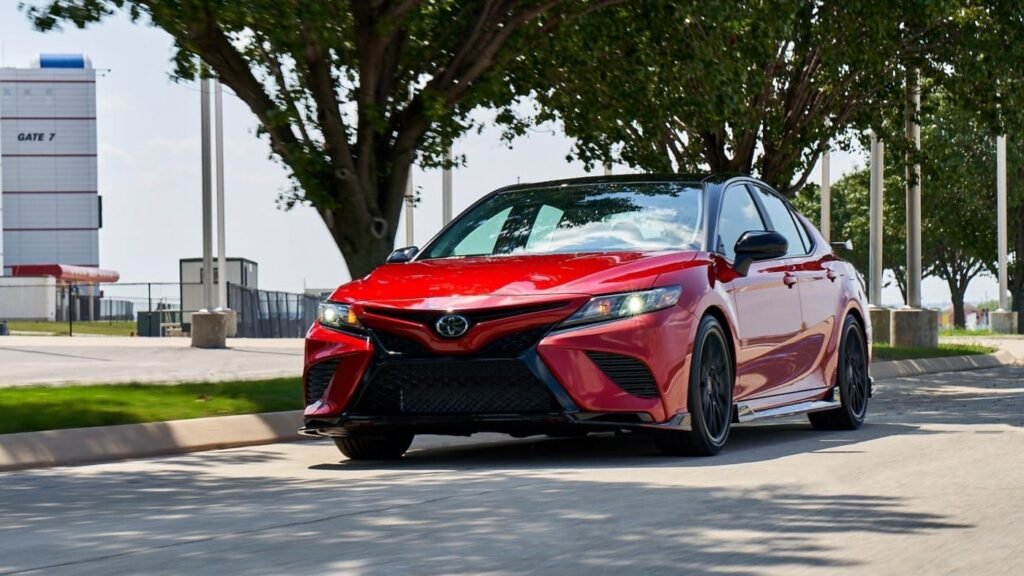
Pre-Purchase Inspection Checklist — For Buying a Good Car!

Thinking about picking up a used car? Make sure to get a good pre-purchase inspection because it can really save you cash and headaches. If you skip it, you could end up with someone else’s costly issues. This guide gives you a handy checklist to take to any inspection whether you’re doing it yourself or getting a pro to help. It also shows when you should call in an expert, what each item means, and how to use what you find to come up with a fair offer. Think of it like a doctor’s check-up before surgery—super important, focused, and definitely not something to rush through.

The One Question You Should Ask

So why shell out for a PPI? Well, even the shiniest ride can be hiding things like worn-out control-arm bushings or a head gasket about to go. Not to mention, that odometer could be messed with. Getting a PPI turns those gut feelings into real info: knowing “this car needs three grand in repairs” can give you an edge when you negotiate and could save you a lot more than getting stuck on the side of the road with a broken-down car. 

Think about it: do you want to play it safe or take a gamble? If you’re leaning towards safety, keep reading.

Types Of Inspections

Inspection typeCost (typical US range)Best forLimitations
Dealer inspection (sales pre-check)Free–$200Cars sold by franchised dealers; quick readiness checkSurface-level; may miss mechanical/structural issues
Independent pro PPI$150–$400Used-car buyers — full mechanical, electronic & road-test reviewBest value; choose specialist for exotic/Tesla/EV/classic
Mobile mechanic (YourMechanic-style)$100–$250Convenience at seller’s location; good for early screeningMay not have lift or full diagnostic gear
DIY inspection$0–$50 (tools)Cheap, learn the car — ideal if you know what you’re doingRisk of missing hidden problems; no third-party report for negotiation

It’s a good idea to go with a professional PPI for most buying. Try doing it yourself only if you feel sure or if the item’s price is really low. Below, you’ll find a list of handy tools that can make your inspection easier.


The 10-Minute Quick Check

If you’re at a private sale and only have 10 minutes to spare it’s smart to do a quick check before you take the car for a test drive. If it doesn’t pass that quick 10-minute test then you’ve saved yourself some time from a wasted trip.

  1. Title and keys: Make sure the name on the title matches the seller. Also, watch out for multiple sets of keys—might be a sign of something funky.
  2. VIN match: Look at the VIN on the dashboard, door jamb, and title. All three spots should have the same number.
  3. Smell test: If you catch a whiff of strong coolant, burning oil, or lots of exhaust fumes, that’s a red flag.
  4. Rust or damage: Check out the door sills, wheel arches, and frame rails. Surface rust is usually okay, but stay away from any structural rust.
  5. Tire condition: Look for even wear on the tires. If they’re uneven or have weird patterns like cupping or feathering, it could mean alignment or suspension issues.
  6. Start and idle: When you start it cold, listen for any knocks, smoke, or if it takes a long time to crank up.
  7. Dashboard lights: Make sure there aren’t any lights left on, especially check-engine or airbag warnings.
  8. Quick test drive: Take it for a short spin, shift through the gears, and see how the brakes feel—no grabbing or pulling, please!

If anything doesn’t look good during this quick check, make sure to set up a full PPI (Pre-Purchase Inspection). If it checks out fine, you’re all set for the test drive!

The Full PPI Checklist:

A. Paperwork & Provenance

  • Verify VIN vs title vs registration vs seller ID.
  • Title status: clean, salvage, rebuilt, or flood? (Any salvage/rebuilt must be disclosed.)
  • Service records: oil-change schedule, major services, timing-belt/chain dates.
  • Ask for receipts for major items (clutch, transmission service, timing belt, CV axles, head work).
  • Check recall lookup (NHTSA / manufacturer VIN search) and whether recalls were addressed.

B. Exterior & Body

  • Paint consistency and overspray patterns (patch paint may hide repairs).
  • Panel gaps and alignment (mismatched gaps hint at previous collision repair).
  • Rust: rocker panels, door sills, undercarriage, frame rails, suspension pickup points.
  • Glass: chips in windshield (especially in driver’s view) and calibration of ADAS cameras (if windshield replaced).
  • Tires: brand, age (DOT code), tread depth and evenness; check spare condition.

C. Undercarriage & Suspension

  • Fluid leaks: oil, transmission, differential, coolant, brake lines.
  • Frame: dents, bends, repair marks, fresh welds—walk away from welded frame repairs unless properly documented.
  • Bushings, shocks/struts: excessive play, oil leakage from shocks.
  • Brake lines, exhaust hangers, fuel lines condition.

D. Engine Bay

  • Cleanliness vs gloss: recent degreasing may hide leaks — ask why.
  • Oil level & color; coolant level and color.
  • Belts and hoses: cracks, swelling, age.
  • Battery: date code and secure mounting. Corrosion on terminals is common and fixable.
  • Evidence of overheating: warped overflow, odor, residue around cap.

E. Interior & Electronics

  • Odometer consistency with service records and wear patterns.
  • HVAC: A/C cold, heater hot, blower fan speeds.
  • Infotainment, cameras, sensors, ADAS self-tests.
  • Seat mounts, window regulators, sunroof operation (if fitted).
  • Smell: heavy air-fresheners may disguise smoke or mold.

F. Transmission & Drivetrain

  • Manual: clutch slip test, smooth engagement, gearbox whine, synchro crunch on downshifts.
  • Automatic/CVT/DCT: firm shifts, no lag, no shudder; check service history for fluid changes.
  • AWD/4×4: engage transfer case and verify front/rear drive engagement; listen for carrier whine.
  • Differentials: noise under load, leaks.

G. Exhaust & Emissions

  • Smoke color on cold/hot start: blue = oil burn; white = coolant burn; black = rich/EFI issue.
  • Catalytic converter: rattles or reduced power hint toward failure or theft damage.
  • Tailpipe soot: extreme deposits can flag tuning or injector issues.

H. Test-drive protocol (exact sequence)

  1. Start cold. Listen for starter/long crank.
  2. Idle warm-up: note smoke, idle stability, leaks.
  3. Low-speed drive: listen for clunks, CV joint clicks when turning.
  4. Acceleration sweep: smooth power delivery, no hesitation.
  5. Hill/grade: transmission downshift behavior and sustained cooling.
  6. Highway: cruise at 60–75 mph — check for vibration or wind noise.
  7. Braking: full-stop tests — pulsing indicates warped rotors; pulling indicates alignment/brake caliper issue.
  8. Reverse & parking: check for noises and ease of maneuver.

I. Electronic diagnostics

  • OBD-II scan: read and clear codes; note pending/active codes.
  • For EVs/Hybrids: check high-voltage system logs, battery state-of-health (SOH) if available, charging port status, and regenerative braking behavior.
  • For modern cars with OTA and ADAS: ask if latest firmware/AD calibration performed.

EV & Hybrid Specific Checks

  • Battery SOH / capacity report and warranty remaining.
  • Charging history (fast-charge frequency can accelerate battery wear).
  • Inverter and traction-motor fault codes.
  • Thermal management system (coolant loops for battery & inverter) — look for leaks or evidence of overheating.
  • Range validation: drive if possible to compare claimed range vs real-world.

Classic & Collector Cars

  • Rust field-mileage mapping, previous frame-off restorations (photos & receipts).
  • Compression & leak-down per cylinder/rotor (rotary engines).
  • Originality checklist (matching numbers, VIN tags, factory options).
  • Documented storage & use history (covered/garage vs daily driver vs track car).

Red Flags (Walk Away!)

  • Title branded salvage, flood, or rebuilt without full disclosure.
  • Structural/frame mis-repair or active rust-through.
  • Major oil or coolant leak tracing to head or block (head gasket or cracked block).
  • Significant dash lights + no diagnostics performed (especially ABS/airbag + engine together).
  • Tampered odometer (mismatched wear vs indicated mileage).
  • Seller hostile to a professional inspection or to sharing service records.

Post-PPI: Negotiate

  • If the PPI shows minor issues (pads, wear items), ask seller to either fix them or reduce price by a realistic quote from a local shop.
  • For medium issues (CV axle, patch rust, minor coolant leak), get a written repair estimate and deduct that from your offer.
  • For major issues (frame damage, head gasket, transmission fault), walk or insist on a steep discount that reflects full repair or replacement costs.
  • Always get estimates from two independent shops if the PPI gives a big bill — shop quotes vary.

Typical Repair Costs

  • Spark plugs (parts + labor): $80–$350.
  • Brake pads per axle: $120–$600.
  • Fuel pump replacement (part + labor): $300–$1,200.
  • Alternator replacement: $300–$1,000.
  • Wheel bearing: $150–$500.
  • Head gasket or major engine repair: $1,500–$6,000+.
  • Transmission (rebuild/replace): $2,000–$6,000+.
    (Always get local estimates — labor rates and parts differ by region and model.)

Also Read:
Discover the best used SUVs under $15K! We review the 2016 Honda CR-V, 2014 Mercedes M-Class, and 2015 Toyota Highlander for reliability, comfort, and value.


DIY PPI: Essential Tools

When you’re checking out a used car, having the right tools helps you find any hidden issues. In that quick 10-minute check we talked about earlier, each tool helps you look at a different part of the car. Bring the right stuff and you can catch problems early, bargain for a better price, and feel good about your purchase.

OBDLink MX+


OBDLink MX+

Pocket-size Bluetooth OBD2 adapter that turns your phone or PC into a pro-grade diagnostic scanner with manufacturer-specific code access and lifetime firmware updates.

This is a fast, professional-grade wireless OBD adapter (good if you use ForScan / advanced apps). Plug the OBDLink MX+ into the car’s OBD-II port, pair it with your phone or laptop, and you can read trouble codes, pull live sensor data, and even check manufacturer-specific systems on many Fords, GMs, Toyotas and more.

DIY Guide

  1. Locate the OBD-II port under the dash and plug the MX+ in.
  2. Install a compatible app on your phone (Torque, FORScan, Car Scanner, etc.) and pair via Bluetooth. 
  3. Run a quick scan for stored and pending trouble codes, note any that appear, and check VIN/vehicle info.
  4. Monitor live parameters (RPM, O2, coolant temp, etc.) while you idle and then again on a short road test to see how sensors behave under load.
  5. Save or export logs and screenshots so you can show them to the seller or a mechanic; if codes are present, ask why they were erased or ignored.
AstroAI DT132A Multimeter


AstroAI DT132A Multimeter

TRMS 4000-count digital multimeter; measures AC/DC voltage & current, resistance, continuity, capacitance, frequency and temperature; manual and auto-ranging (red).

This little multimeter can check battery voltage, confirm alternator charging, test fuses and continuity, or measure sensor signals and capacitors when you’re inspecting a used car.   

The True RMS circuitry and 4000-count display mean readings are useful for both household jobs and light automotive troubleshooting, and features like backlight, data-hold and a kickstand make it easy to use on the roadside or in a dim garage. It’s not built like an industrial Fluke, so handle it a bit more gently, but for routine checks and DIY diagnostics it’s a practical, wallet-friendly pick.  

DIY Guide

  1. Before you start, set the meter to the correct function and range — wrong settings can damage the meter.
  2. Check the car battery at rest: with the car off, measure DC voltage at the battery terminals to see if it’s around 12.4–12.7 V for a healthy battery.
  3. Start the engine and re-measure battery voltage to confirm the alternator is charging (typically ~13.5–14.8 V).
  4. Use continuity mode to test fuses, switches and wiring — a quick beep means the circuit is complete.
  5. For more detailed checks, measure ignition coils, sensors or capacitors as needed, but avoid measuring high current directly unless you use the proper 10 A jack and follow safety precautions.  
JACO ElitePro Digital Tire Gauge


JACO ElitePro Digital Tire Gauge

Digital tire pressure gauge with professional accuracy to 100 PSI; 2.5-inch backlit LCD, built-in bleeder valve and 10″ HybridFlex hose.

The JACO ElitePro reads up to 100 PSI with shop-grade accuracy, has a flexible 10″ hose with a 360° swivel chuck so you don’t have to awkwardly bend the valve stem. Use it for routine pre-purchase checks, before a long road trip, or anytime you want to verify the seller’s tyre claims — it’s a simple tool that removes the guesswork.     

DIY Guide

  1. Check tires cold (car parked for a few hours) so readings match manufacturer specs.
  2. Know the recommended PSI from the driver-side placard or owner’s manual before you start. 
  3. Press the swivel chuck firmly and squarely onto the valve stem—hold it until the display stabilizes.
  4. Use the bleeder valve to release tiny amounts of air if you’re over the target; re-check to confirm.
  5. Measure all four tires (and the spare) and compare front vs. rear—big differences can signal alignment or suspension issues.
  6. If the car has TPMS, compare its reading to the ElitePro to verify sensor accuracy.
  7. Store the gauge with the included batteries and keep it in a small case so it’s ready for your next inspection.  
CM-8826FN Thickness Gauge


CM-8826FN Thickness Gauge

Digital paint/coating thickness gauge with F and NF probes; measures 0–1250 µm (0–50 mil), automatic substrate recognition, single/continuous modes, calibration foils and protective case included.

To check whether a used car has been repainted or has uneven coatings, it automatically recognizes the substrate so you don’t have to guess probes, which makes spot-checking fenders, doors and roofs fast.

It’s light enough to use one-handed at the curb, comes with calibration foils and a padded case, and the continuous mode is handy for curved panels. For pre-purchase checks and occasional deeper inspections, it’s a practical tool to carry with you.

DIY Guide

  1. Find a few reference spots: inside door jambs, under the hood, and behind the wheel arches.
  2. Turn the meter on, let it settle, and verify with a calibration foil before you start.
  3. Take at least three readings per panel (center and two edges) and use continuous mode when scanning curved areas.
  4. Compare readings across matching panels—big differences (e.g., 30–100 µm or more) can indicate respray or filler.
  5. Use both probe types as needed; the unit’s auto recognition helps, but be consistent with where you place the probe.
  6. Record your readings on your phone or a notepad so you can show them to the seller or a mechanic.
Milwaukee 2735-20 M18 LED Work Light


Milwaukee 2735-20 M18 LED Work Light

Milwaukee 2735-20 M18 LED work light, battery-powered (M18), 100 lumens, 90° rotating head, integrated hook, water‑repellent, up to ~10 hours runtime with a 5.0Ah battery.

A, dependable work light that is compact and light enough to hold in one hand or hang with its built‑in hook, and the 90° rotating head makes it easy to aim at tight spots under the hood or inside wheel wells.

It’s not a blinding spotlight — the neutral white output is even and great for close work, so you can spot leaks, rust, interior damage or uneven paint without chasing hotspots. Because it runs off M18 batteries, it fits into the same system if you already own Milwaukee tools, and with a larger battery it can last through a full day of inspections.

DIY Guide

  1. Bring a charged M18 battery (and a spare if you can).
  2. Start with the engine bay: hang the light or prop it on the fender and angle the head to illuminate seams, hoses and the firewall.
  3. Use the rotating head to light up the underside of the car and wheel wells — look for rust, fresh undercoating, or wet spots.
  4. Scan door jambs, trunk hinges and rocker panels for paint differences or filler.
  5. Put the light inside the cabin to check dash surfaces, carpet edges and seat mounts for moisture or repairs.
  6. Shine across panels at a low angle to reveal dents or uneven paint.
  7. Keep your phone handy to take photos of any issues while they’re well lit.
WORKPRO Spark Plug Socket Set


WORKPRO Spark Plug Socket Set

WORKPRO 6‑pc 3/8″ drive magnetic swivel spark plug socket set with 14mm, 9/16, 5/8, 13/16 sockets and 4, 6, 11‑inch extensions.

This compact WORKPRO 6‑pc set makes spark plug access a lot less annoying. The mix of 4, 6 and 11‑inch extensions gives you reach into recessed wells while the magnetic core holds the plug as you lift it out or lower a new one in.

The 360° swivel action and thin‑wall design help you work in cramped engine bays without fighting angles, and the chrome‑alloy finish cleans up easily after a messy job.

DIY Guide

  1. Confirm the correct plug size for the car and bring a rag, anti‑seize and a torque wrench if you have one.
  2. Disconnect the battery and remove any engine covers blocking access.
  3. Pick the socket size that matches the plug, attach an extension, and use the magnet to hold the plug while you loosen it.
  4. Pull the plug straight out on the extension to avoid breaking the porcelain.
  5. Inspect the plug for oil, carbon or unusual wear and compare readings across cylinders.
  6. Thread new plugs by hand first, then snug with the socket and finish to factory torque.
  7. Store the sockets and extensions together so you don’t lose pieces between inspections.

Used Car Inspection List (PPI Checklist)

PPI QUICK FORM
Seller: ___________________   VIN: ___________________   Odometer: ________  Date: _______

Paperwork:
- Title status: _______  |  Owner matches title? Y / N
- Service records: Y / N  |  Major receipts attached? Y / N
- Recall check done: Y / N

Exterior:
- Panels aligned: Y / N
- Paint overspray/panel repairs: Y / N
- Rust at sills/wheelarches/frame: Y / N
- Windshield chips/gps camera/camera calibration: Y / N
- Tires even wear + DOT: Y / N

Undercarriage:
- Frame damage/welds: Y / N
- Fluid leaks: oil / trans / coolant / diff / fuel
- Suspension play/noise: Y / N

Engine bay:
- Oil level & color OK: Y / N
- Coolant level & smell OK: Y / N
- Belts/hoses condition OK: Y / N
- Battery date & terminals OK: Y / N

Interior/Electronics:
- A/C & heat work: Y / N
- All lights / windows / seats / infotainment: Y / N
- Airbag light on? Y / N

Drivetrain:
- Cold start & idle OK: Y / N
- Transmission shifting & clunk free: Y / N
- AWD/4x4 engagement checked: Y / N

Test Drive (notes):
- Acceleration / hesitation: __________________
- Braking / pull / pulsation: __________________
- Highway stability / vibration: _______________
- Strange noises: _____________________________

OBD-II Scan:
- Codes found: _______________________________
- Pending codes: _____________________________

Inspector recommendation:
- Pass / Minor work estimate $______ / Major issues: _______
Inspector name & license: ______________________  Contact: ____________

Final checklist

Here’s a quick rundown of what you should do:

Pay the full price only if you get a clean report, a documented service history, and it matches the market value.

Walk away if you find any frame damage, flood history, salvage title, major engine leaks, or if the seller won’t let you do a pre-purchase inspection.

Bargain hard if the inspection shows minor stuff that needs fixing but isn’t a safety issue like brake pads, tires, or a few small leaks. You can ask for repair credits or try to get a lower price.


Also Read:
Modernize your older car with the best wireless CarPlay adapters. Fast, low-lag, plug-and-play options with top Amazon picks for 2025.


FAQs

What is a pre-purchase inspection (PPI)?

A PPI is a professional mechanical, electrical and road-test evaluation of a used car performed before purchase to identify safety issues, hidden damage, and impending repairs.

When should I get a PPI?

Always after a satisfactory test drive and before handing over a deposit or signing — never after purchase.

How much does a PPI cost?

Expect $150–$400 for a thorough independent shop PPI; mobile mechanics are usually $100–$250 and dealer checks are often less detailed.

What does a PPI check (quick list)?

Paperwork/VIN, frame & rust, engine & fluids, transmission, suspension, brakes, tires, electrics/OBD-II codes, undercarriage, and a multi-condition road test.

How long does a professional PPI take?

A full PPI usually takes 60–120 minutes; classics, EVs or detailed diagnostics can take longer.

Can I just do a DIY inspection instead of a pro PPI?

DIY is good for a quick filter, but a pro PPI uncovers structural, electronic, and drivetrain issues you’ll miss — use DIY only for cheap, low-risk buys or to prep for a pro inspection.

What should a PPI include for electric vehicles (EVs)?

Battery state-of-health (SOH) report, charging/port checks, inverter/thermal system inspection, high-voltage diagnostics and a range validation drive.

Which PPI findings should make me walk away?

Frame or structural repairs with poor documentation, flood or salvage brands on the title, odometer tampering, major engine or transmission failure, or seller refusal to allow a PPI.

Can I use the PPI report to negotiate the price?

Yes — use itemized repair estimates from the PPI as leverage for repair credits, a price reduction, or insist the seller performs the fixes before sale.

How do I pick a trustworthy PPI inspector or shop?

Choose ASE-certified techs, shops with good local reviews, a sample report, and experience with the vehicle type (European, classic, EV, exotic, rotary). Ask for references and a written repo


*Disclaimer: This website provides automotive content for informational purposes only and should not be considered professional advice. While we strive for accuracy, we do not guarantee the reliability or suitability of any vehicle or product mentioned—always conduct your own research before making purchasing decisions. Additionally, some links on this site are affiliate links, meaning we may earn a commission if you make a purchase, at no extra cost to you.

**When you click on links we might get a small commission on purchases that qualify.
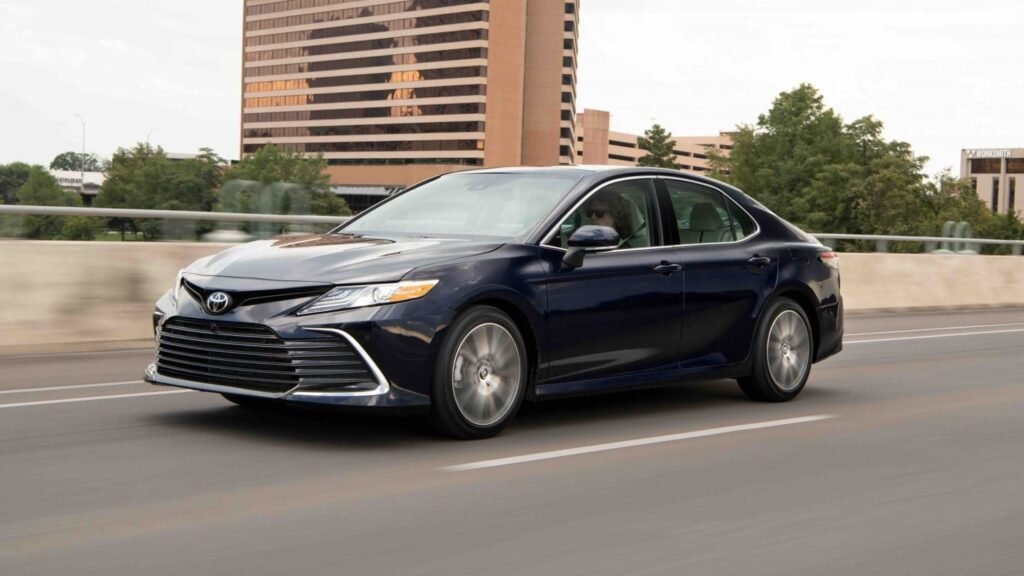
Suzuki Jimny — The Little Off-Roader We All Need!

If you’re looking for a small, fun 4×4 that can handle rough spots where bigger SUVs struggle, then the Jimny is a blast. But if you want comfy rides on the highway, space for the whole family, or easy support from dealers in the U.S., you might have to make some sacrifices and be ready for a bit of work.

The Jimny feels like a classic off-roader, which can be great or not so great, depending on what you’re expecting. Here’s the scoop so you don’t get swept away by the dream and end up with a surprise bill.

Quick facts

  • The Jimny is Suzuki’s tiny, ladder-frame off-roader, built since 1970 and revived globally in 2018 as the modern JB64/JB74 family.
  • Not sold new in the U.S. (Suzuki exited the US new-car market long ago). Americans who own a Jimny either imported one under specific rules or bought an older model already legal here. If you see a “brand-new” Jimny for sale in the U.S., treat it as unusual and dig into the paperwork.
  • Legally importing nearly-new Jimnys is normally blocked by U.S. rules — except via the 25-year import exemption, or complicated compliance routes. That drives rarity and price.

How many Jimnys are running in the U.S. today?

There’s no tidy government number that says “X Jimnys are registered in the U.S.” What we can say with confidence:

  • Official U.S. dealer availability: none — Suzuki does not sell the new Jimny through U.S. dealers.
  • How Jimnys show up here: some are legally imported under the 25-year rule, a handful arrive through brokered compliance or special exemptions, and a very small number have been smuggled/titled via loopholes — which is risky for buyers. Journalists and enthusiast sites regularly show odd listings (e.g., a 2024 Jimny for sale in Oklahoma that raised red flags).
  • Practical reality: expect hundreds rather than thousands of Jimnys on U.S. roads (mostly older 1980s–1990s models and rare gray-market imports). If you want a Jimny in the U.S., you’ll likely either find an older JDM example or import one yourself — which brings paperwork, cost, and risk.

How Much You Can Get One?

Prices vary wildly by year, condition and legality:

  • Classic / 25-year JDM Jimnys (1990s and older): currently commonly seen on auction sites and Bring a Trailer — $5k–$20k depending on condition and desirability (turbo models and clean rust-free examples push toward the high end). Recent BaT sales show numbers in this band.
  • Newer JB64/JB74 imports (if you find one legally titled): brokers and exporters list FOB prices $10k–$16k for the car alone (Japan export price) — add freight, duties, registration and possible compliance/RI work and the delivered U.S. cost can climb into the $18k–$40k range depending on how it was brought in. Listings that claim “new” and legal in the U.S. deserve detailed title & customs scrutiny.
  • Average market figure (all ages): data aggregators put the average sale price near $10–12k for Jimnys tracked worldwide, but U.S. availability skews the local price higher because of import hassle and rarity.

Jimny vs Competitors

The Jimny sits in a small niche: ultra-compact, light, highly capable off-roader. Closest practical alternatives:

Model (type)Why it’s comparableHow it differs (quick)
Jeep Wrangler (2-door)Iconic, purpose-built off-roader with genuine axle articulation and low-range gearing.Much larger, heavier, pricier to run; better on high-speed roads but heavier to trail-recover.
Ford Bronco Sport (Active) / Bronco 2-doorSmall, off-capable variants; modern safety/tech.More on-road focus; heavier and less simple than Jimny’s ladder frame.
Toyota FJ Cruiser (used)Retro hard-core vibes and off-road competence (used market only).Discontinued, larger and heavier — not as tossable as a Jimny.
Subaru Crosstrek / Forester (Adventure trims)All-wheel traction, better everyday manners and dealer support in the U.S.Not body-on-frame; not as capable in extreme off-camber or recovery situations.

Bottom line: no direct U.S. factory product mirrors the Jimny’s small ladder-frame package. The Wrangler is the most direct “if you want proper trails and dealer support” alternative; small crossovers will be more comfortable on pavement but less fun off-road.

Jimny Pre-Purchase Checklist

If you’re considering a used Jimny (especially a JDM import), don’t skip these checks — they matter more than glossy black bumpers.

  1. Title / import paperwork / VIN provenance. Verify how it entered the U.S. — 25-year imports are legal, recent imports may have compliance or title issues. Ask to see Customs/CBP paperwork, the HS-7 form if applicable, and the state title history.
  2. Rust & frame health. Jimnys are ladder-frame trucks — the frame, subframe mounts, floor pans and suspension pickup points must be solid. Surface rust is normal; structural rot is a dealbreaker. Inspect frame rails, spring mounts, and shock towers.
  3. Drivetrain & low-range function. Test 4×4 engagement, high- and low-range shifts (transfer case), front diff lock if equipped, and listen for strange noises when engaging. Off-road use stresses these parts.
  4. Engine health & service history. Compression check (older two-stroke/early engines aside), fresh oil, timing-belt/chain service as recommended, any oil leaks. Newer K15B 1.5 engines are robust but need normal checks.
  5. Suspension & steering play. Look for worn tie-rod ends, bushings, and shocks — Jimnys are light and survive on simple parts, but worn steering creates a dangerous experience on road.
  6. Electrical & emissions paperwork. If the car was converted to left-hand drive or modified by an RI, ensure all emissions & wiring work correctly; some imports are “as-is” projects.
  7. Test-drive checklist. Highway stability, gearbox feel, transfer-case noise, clutch freeplay (manuals), and heat/AC. Jimnys are noisy and high-revving — know what to expect.

Common Repair Costs

Parts for Jimnys are generally inexpensive; labor can swing the bill. These are rough U.S./global ballpark numbers compiled from parts sellers, service aggregators and Jimny-specialist shops:

  • Spark plug replacement (parts + labor): $100–$350 — plugs themselves are cheap (NGK sets are inexpensive), but labor and shop minimums vary. Smaller Jimny engines are simpler than V-engines, so expect lower labor on many models.
  • Front or rear brake pads (per axle): $100–$500 depending on parts (aftermarket vs OEM) and whether rotors are replaced. Specialist rotor or performance sets add cost.
  • Fuel pump (part): $100–$400 for the part; installation/labor can add another $150–$400 depending on accessibility and shop rates. Many aftermarket pumps are available at moderate prices.
  • Typical small suspension job (bushings/links): $200–$1,000 depending on parts and labor.
  • Major items (transfer case, engine rebuild, or battery for imported hybrids/EV variants): highly variable — $1k–$6k+ depending on parts availability and whether you source OEM or aftermarket.

Even though Jimnys have basic mechanical setups and parts are affordable pretty much everywhere, in the U.S. they’re kind of rare. This can jack up labor costs and the time it takes to get parts if you’re after specific JDM stuff. Don’t forget to consider shipping and any extra broker fees for those hard-to-find parts too.

Buying strategy

  1. Decide whether you want a project or a daily. A 1990s JDM Jimny can be cheap and charming, but may require rust and parts work. A newer JB64 is closer to a modern car but is much harder and costlier to import legally.
  2. Use a Jimny-savvy mechanic for the PPI. Ask them to crawl under the frame and check transfer-case engagement, leaks and steering play. A generic PPI misses what makes Jimnys special.
  3. Budget for parts shipping and non-dealer repair. Expect to do some DIY or find a specialty shop — that’s part of the ownership package for a rare import.

Finally – Who should buy a Jimny?

Get one if: you’re after a small and lively 4×4 that can tackle tough trails, love keeping things simple with mechanics, and don’t mind a few quirks like some noise and tight space.

Skip it if: you’re looking for something that won’t break the bank on gas, needs reliable dealer support in the U.S., or you want a comfy ride for the whole family on long trips.

If you want a taste of the Jimny vibe in the U.S. with easier support, check out a used Jeep Wrangler for serious off-road adventures with dealership support. Or go for a Subaru Crosstrek or Forester if you prefer something that’s easier to drive every day but still has some off-road fun.


Also Read:
Discover the best used SUVs under $15K! We review the 2016 Honda CR-V, 2014 Mercedes M-Class, and 2015 Toyota Highlander for reliability, comfort, and value.


*Disclaimer: This website provides automotive content for informational purposes only and should not be considered professional advice. While we strive for accuracy, we do not guarantee the reliability or suitability of any vehicle or product mentioned—always conduct your own research before making purchasing decisions. Additionally, some links on this site are affiliate links, meaning we may earn a commission if you make a purchase, at no extra cost to you.

**When you click on links we might get a small commission on purchases that qualify.
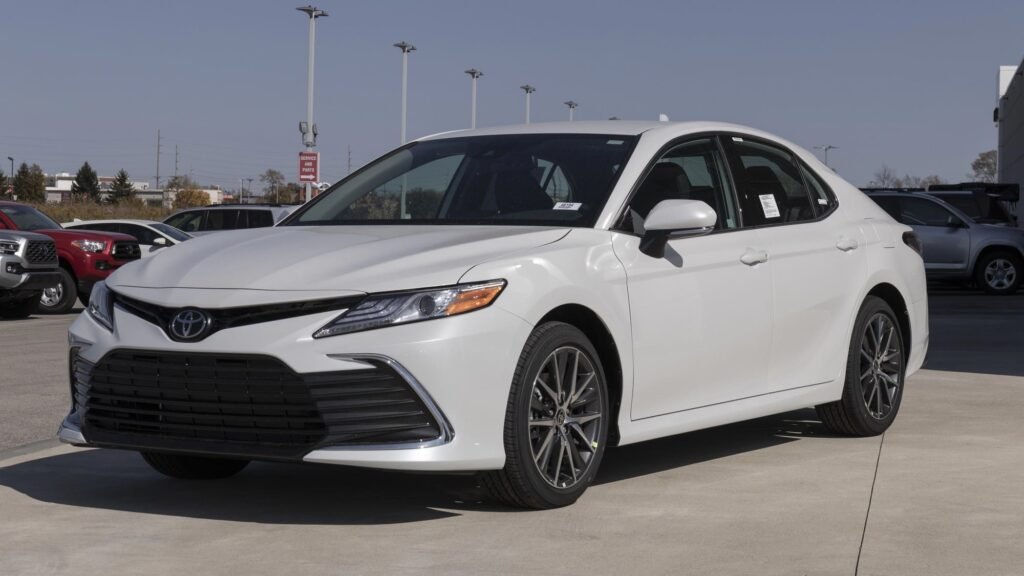
Is A Used 2024 BMW X4 The Right Luxury SUV For You?

The 2024 BMW X4 is a compact luxury coupe-SUV with a slight trade-off in cargo space, which is expected since it’s a “coupe-SUV” or in BMW’s jargon a “”Sport Activity Coupé”. But if all you care about is responsive steering, powerful engines, a slightly raised seating position and a high-end interior, then, this is might be your ride. It’s built on the X3 platform, but adds more style which is of course a matter of preference.

So if you’re curious about whether a gently used 2024 X4 could be a reliable car that doesn’t end up costing you more to keep it running, keep reading for so you don’t get swayed by the looks and forget the important stuff.

Overview Of The 2024 BMW X4

The BMW X4 has a cool look thanks to its sloped roofline that makes it feel a bit like a coupe. This sporty vibe is what attracts customers who want something with a bit more flair. It definitely takes design cues from its bigger brother, the X6. This model known as the G02 is now in its second and last version—we’ll talk more about that soon—. In terms of performance, it’s pretty similar to the X3. But let’s be real, it looks way fancier. Just keep in mind, you might lose a bit of cargo space and some headroom in the back compared to the more classic X3. Here are some quick facts you should know right away:

  • Base X4 xDrive30i: 248 hp, 258 lb-ft (2.0-liter turbo 4); X4 M40i: ~382 hp, ~365 lb-ft (3.0-liter turbo I6). That lineup gives real on-road punch across the range.
  • Transmission: 8-speed automatic with all-wheel drive (xDrive) as standard.​
  • Fuel Economy: Combined MPG of 21.​
  • Cargo Capacity: 18.5 cubic feet behind the rear seats
  • Interior & tech: BMW’s 12.3-inch central display and upscale materials; options include Vernasca leather, Harman-Kardon audio and driver-assistance packs. iDrive (modern but not always newest version on X4) handles screens and phone integration.
  • Ownership: expect above-average maintenance/repair costs vs mainstream rivals — CareEdge estimates roughly $19k in maintenance/repairs across the first 10 years for an X4. Annual service averages for BMWs typically sit north of mainstream.

Interior & Technology

Inside the X4, you’ll find the lovely BMW driver-centric cabin which is filled with quality materials. Everything is laid out in a way that makes it easy to reach the controls. The cabin gives off an upscale vibe with a sporty feel from the front seats. Now, the cargo space is a bit tighter than your typical SUV due to the sloping roofline. BMW claims you get about 18.5 cubic feet behind the back seats, and even more room if you fold those seats down, so keep that in mind when packing for a weekend getaway. Here’s what you get as standard:
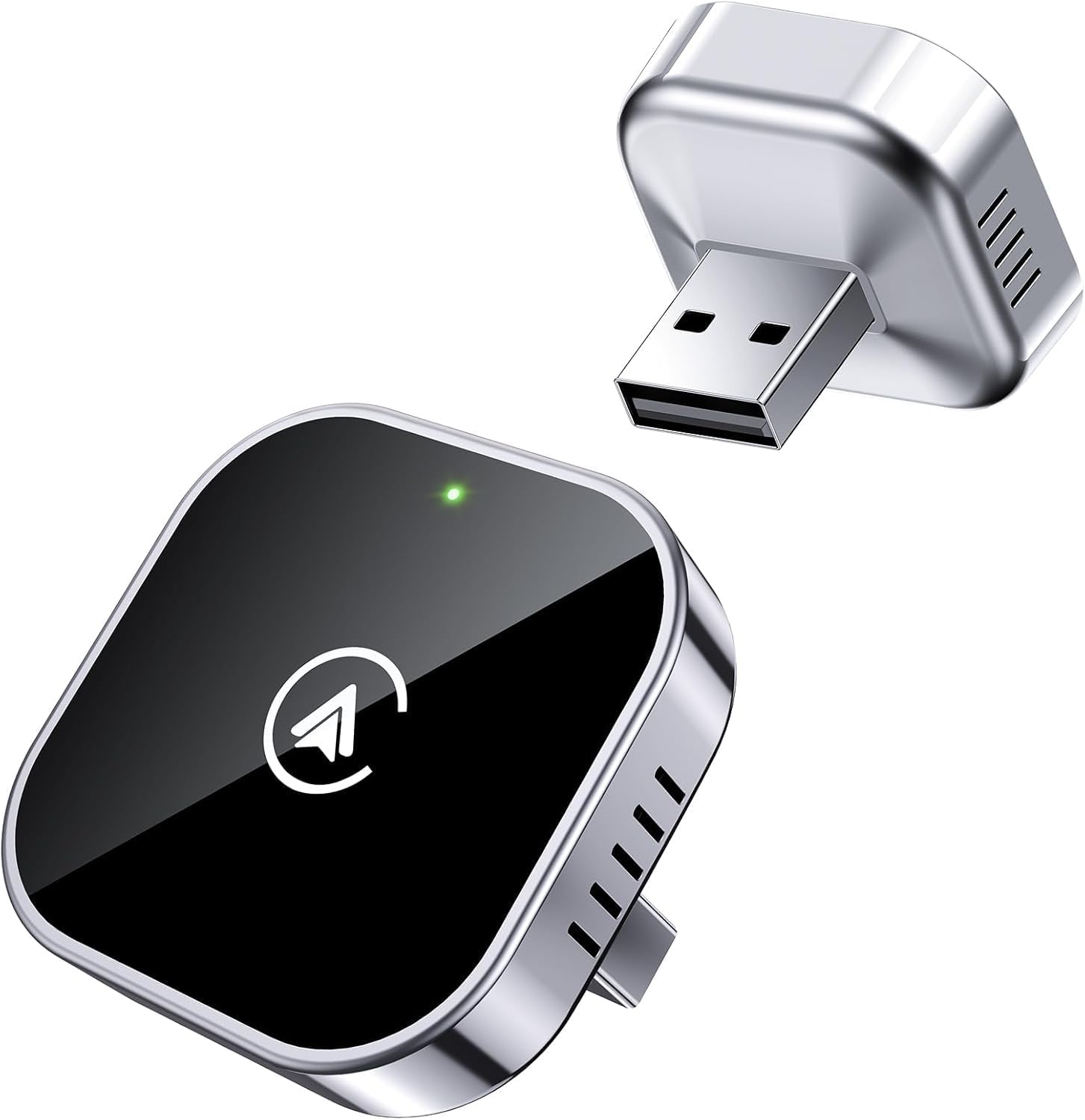
  • Infotainment System: A 12.3-inch touchscreen with BMW’s iDrive system that supports Apple CarPlay and Android Auto.
  • Audio System: A 12-speaker setup that delivers clear and immersive sound.
  • Comfort Features: Things like automatic climate control, power-adjustable front seats, and a panoramic sunroof.

The center media screen is around 12.3 inches, and it also plays nice with Apple CarPlay and Android Auto. If you want, you can get some extras like a better audio system and a head-up display.

As for the back seats, there’s enough room for passengers, but taller folks might find the headroom a bit snug because of the sloping roof. The cargo area, at 18.5 cubic feet behind the rear seats, might be less than some rivals, but it should work fine for daily needs. If you’re looking for that coupe style without sacrificing family space, just make sure to measure your stroller and golf bag before making a decision.


Also Read:
Want to wash your BMW at home? Here’s a simple step-by-step guide for you. We’ll go over how often to wash it and what products to grab.


Performance & Handling

The X4 is like the sportier, more agile sibling of the X3. Even the basic turbo-four engine feels pretty speedy, doing 0 to 60 in the mid-6 seconds for the xDrive30i based on some tests. If you go for the M40i version, you get a really zippy SUV with quick throttle response, sharp body control, and great steering feel. Both models come with BMW’s xDrive all-wheel-drive system, giving you excellent traction and stability no matter the driving conditions. The X4 has a suspension set up for a sporty yet comfy ride, with nice precise steering that really boosts your confidence behind the wheel. It’s a bit firmer than softer rivals, but that’s the trade-off for better agility. If you enjoy feedback from the steering and like cornering without feeling like you’re hauling around a bulky SUV, the X4 has got you covered.

For 2024, the X4 comes in two main trims:

  • X4 M40i: This one features a 3.0-liter turbocharged inline-6 engine with mild-hybrid tech, delivering 382 horsepower. It’s got the performance edge, going from 0 to 60 mph in about 4.4 seconds.
  • X4 xDrive30i: This model has a 2.0-liter turbocharged inline-4 engine that puts out 248 horsepower. It strikes a good balance between fuel efficiency and performance, making it great for your everyday commute and longer trips.

Both are really great options and they go up against other cars with similar engine sizes. Honestly, I think the 2.0-liter is pretty fun for daily driving. I’d probably only want to unleash the full power of the bigger engine on weekends.

Ownership & Running Costs

When it comes to luxury drivetrains and parts from Europe, things can get pricey. CareEdge estimates you’ll spend about $19,113 on maintenance and repairs for the X4 over the first ten years. That means your yearly maintenance bills will likely run higher than those for regular SUVs. On average, you’re looking at around $900 to $1,500 a year for BMW maintenance, depending on the model and how much you stick to dealer services. If you’re planning to keep your X4 past its warranty, it’s something to think about in your total cost of ownership. 

Now about the 2024 BMW X4’s reliability, it’s getting mixed reviews:

  • Consumer Reports: They say the 2024 X4 will likely have about average reliability compared to other new cars, based on info from similar BMWs and the brand’s overall ratings.
  • Kelley Blue Book (KBB): Owners of the second-gen X4 have rated it above average with a score of 4.6 out of 5.

It’s worth mentioning that there’s been a recall for the 2024 BMW X4 about the steering gear not being tightened properly, which could affect how well you control the car. But don’t worry, BMW is fixing this issue by offering free replacements for the steering gear.

Real Repair-Cost Examples

  • Spark-plug service (X4): RepairPal/estimators show typical replacement roughly $230–$310 (parts + labor) for an X4 — modern BMWs use iridium/precision plugs and sometimes require moderate labor to access.
  • Brake pads/rotors: expect $200–$800+ per axle depending on whether rotors are replaced and whether you use OE or aftermarket parts; dealer quotes for both pads and rotors can reach the upper end. JD Power / shop averages for pad jobs give a range from $115–$300 per axle.

Those numbers are realistic shop averages — dealer labor and OEM parts push prices higher.

How The X4 Compares

I went with the usual rivals for the X4: Audi Q5 and Q5 Sportback, Mercedes-Benz GLC Coupe, and Lexus NX if you want a more classic luxury option:

CategoryBMW X4 (2024)Audi Q5 / Q5 Sportback (2024)Mercedes-Benz GLC Coupe (2024)Lexus NX (2024)
Driving characterSporty, sharper chassis; rewarding steering. Balanced, composed, refined; Quattro grip. Comfortable with coupe styling; tuned for luxury-feel more than sharpness. Quiet, smooth; less sporty but very reliable.
Power (base)248 hp (2.0-L turbo) / M40i ~382 hp (I6). Base ~261 hp (2.0-L); SQ5 higher power available. Base ~255–300+ depending on engine; AMG trims much stronger. Base ~239 hp (2.4 / hybrid combos vary).
Interior tech12.3″ display, premium options, driver focus. Strong tech, refined MMI; similar luxury options. High quality, similar option set, MBUX variants. Excellent reliability and feature value, but less driver-centric sport feel.
Practicality (cargo)Smaller rear/roofline reduces usable cargo vs boxier rivals (measure if practicality matters). Q5 (regular) is more practical; Q5 Sportback similar compromise. GLC Coupe similar coupe-SUV tradeoffs.
Running costsHigher-than-average BMW maintenance. CareEdge 10-yr est ~$19k. Audi similar premium costs (slightly lower/higher depending on options). Comparable to BMW depending on spec and dealer pricing. Generally lower maintenance cost and better predicted reliability.
2024 Mercedes GLC Coupe

The Mercedes GLC Coupe looks great and has one of the best interiors in its class. It has slightly less cargo space as the X4 but, the X4 isn’t great in that area either. When it comes to driving dynamics, the GLC Coupe doesn’t quite match up to the X4. But it definitely wins in terms of the interior and overall comfort.


Also Read:
Discover the most reliable BMW X models with engine codes, production years, pros, and cons. Get expert insights to choose the best BMW SUV for you!


If you want sport and a driver’s car, X4 is the most rewarding. If you want the coupe look but more practical room, consider the regular X3 / Q5 instead.

Safety Features

The X4 comes equipped with a comprehensive suite of safety features, including:​

  • Forward Collision Warning with Automatic Emergency Braking: Alerts the driver to potential frontal collisions and applies brakes if necessary.​
  • Blind-Spot Monitoring: Detects vehicles in the driver’s blind spots and provides alerts.​
  • Lane Departure Warning: Notifies the driver if the vehicle unintentionally drifts out of its lane.​
  • Rear Cross-Traffic Alert: Warns of approaching traffic from the sides when reversing.​

2024 BMW X4 Recalls

Here’s what you need to know about the recalls for the 2024 BMW X4. These might be relevant to your model either directly or due to parts that are also used in other BMW cars.

  • Steering gear — Recall 23V-770 (Nov 2023 / reminder Mar 2024).
    Certain 2024 BMW 2-Series, 3-Series, X3 and X4 (xDrive30i and M40i) vehicles may have steering gears that were not tightened to spec; the gear can loosen, which could cause loss of steering control. Remedy: contact an authorized BMW center — dealers will inspect and replace/secure the steering gear as required at no charge.
  • Starter-relay / B48 engine related campaigns (2019–2022 / 2025 Part-573 filings) and small head-airbag frame notices have affected some X4 build years (e.g., 2020–2022 or limited 2025 production runs). These are model-year specific; verify by VIN.

Buying Advice

  1. Decide on trim vs ownership cost: M40i is intoxicating but faster = more wear and more expensive insurance/tires. If you want the look without the full cost, xDrive30i is sensible.
  2. Measure cargo and rear-seat needs. If your life includes frequent long trips, strollers, or large dogs, test the fit with what you actually carry. The roofline trims space.
  3. Ask for maintenance history & service plans. BMWs are best when serviced regularly with quality fluids and software updates — a documented service history is worth money.
  4. Get a PPI that includes suspension and alignment checks. Coupe-SUVs can show accelerated tire wear if alignment isn’t perfect.
  5. Budget for 3–5 years of ownership costs (use CareEdge/RepairPal numbers) — you’ll sleep easier with a replacement-parts contingency.

Why BMW Quietly Pulled The X4

BMW has decided to stop making the combustion-engine X4 since it doesn’t really fit with the brand’s slimmer lineup anymore. The refreshed X2 and the upcoming updates to the X3/X4 family are closing the gaps in pricing and features. This left the coupe-SUV with dropping sales and some overlap within the lineup. Coverage from industry sources and comments from BMW suggest that this is more about a general strategy to clean things up. They want fewer niche models and more focus on their electrification plans rather than any one product failing. BMWBlog and Motor1, however, have shared that the gas-powered X4 models will stop being made in 2025 as BMW shifts their resources to newer models like the rumored iX4 EV successor.

Right now some sources think that since the new X2 gotten bigger that now the two models are pretty similar, here is a quick comparison:

DimensionBMW X4 (2024)BMW X2 (2025, 2nd-gen)Quick note
Length187.6 in (4,751 mm). 179.3 in (4,558 mm). X4 remains the longer vehicle.
Width (w/o mirrors)75.5 in (1,918–1,927 mm). 72.6 in (1,844 mm approx.). X4 is wider.
Height63.8 in (1,621 mm). 62.6 in (1,590 mm). Heights are similar; X4 is a touch taller.
Wheelbase112.8 in (2,864 mm). 106.0 in (2,692 mm). X4 has a longer wheelbase (more rear-seat/cargo room potential).
2025 BMW X2

Bottom line: the new X2 has definitely gotten bigger compared to the last version and made the price difference a bit smaller too, but it’s still smaller than the X4 on paper. We think BMW’s move was less about just swapping one size for another and more about cutting down on models that overlap as they gear up for electrifying their lineup and put their money into fewer platforms that can make more cars. What we know for sure is that whether we’re looking at the next X2 or the seen iX4, the future is electric with no more gas options.

Who Should Buy The 2024 BMW X4?

The 2024 BMW X4 is fun to drive but if you’re thinking about getting one, you might want to keep in mind its average reliability scores. 

To sum it up, go for it if you’re looking for a luxury SUV that feels more like a sporty hatchback instead of a wobbly cruiser. You’ll enjoy great handling, cool looks, and powerful engines. But if you really need extra room in the backseat, more cargo space, or want to keep costs down, you might wanna check out some other options first.


*Disclaimer: This website provides automotive content for informational purposes only and should not be considered professional advice. While we strive for accuracy, we do not guarantee the reliability or suitability of any vehicle or product mentioned—always conduct your own research before making purchasing decisions. Additionally, some links on this site are affiliate links, meaning we may earn a commission if you make a purchase, at no extra cost to you.