
Thinking about picking up a used car? Make sure to get a good pre-purchase inspection because it can really save you cash and headaches. If you skip it, you could end up with someone else’s costly issues. This guide gives you a handy checklist to take to any inspection whether you’re doing it yourself or getting a pro to help. It also shows when you should call in an expert, what each item means, and how to use what you find to come up with a fair offer. Think of it like a doctor’s check-up before surgery—super important, focused, and definitely not something to rush through.
The One Question You Should Ask
So why shell out for a PPI? Well, even the shiniest ride can be hiding things like worn-out control-arm bushings or a head gasket about to go. Not to mention, that odometer could be messed with. Getting a PPI turns those gut feelings into real info: knowing “this car needs three grand in repairs” can give you an edge when you negotiate and could save you a lot more than getting stuck on the side of the road with a broken-down car.
Think about it: do you want to play it safe or take a gamble? If you’re leaning towards safety, keep reading.
Types Of Inspections
| Inspection type | Cost (typical US range) | Best for | Limitations |
|---|---|---|---|
| Dealer inspection (sales pre-check) | Free–$200 | Cars sold by franchised dealers; quick readiness check | Surface-level; may miss mechanical/structural issues |
| Independent pro PPI | $150–$400 | Used-car buyers — full mechanical, electronic & road-test review | Best value; choose specialist for exotic/Tesla/EV/classic |
| Mobile mechanic (YourMechanic-style) | $100–$250 | Convenience at seller’s location; good for early screening | May not have lift or full diagnostic gear |
| DIY inspection | $0–$50 (tools) | Cheap, learn the car — ideal if you know what you’re doing | Risk of missing hidden problems; no third-party report for negotiation |

It’s a good idea to go with a professional PPI for most buying. Try doing it yourself only if you feel sure or if the item’s price is really low. Below, you’ll find a list of handy tools that can make your inspection easier.
The 10-Minute Quick Check
If you’re at a private sale and only have 10 minutes to spare it’s smart to do a quick check before you take the car for a test drive. If it doesn’t pass that quick 10-minute test then you’ve saved yourself some time from a wasted trip.
- Title and keys: Make sure the name on the title matches the seller. Also, watch out for multiple sets of keys—might be a sign of something funky.
- VIN match: Look at the VIN on the dashboard, door jamb, and title. All three spots should have the same number.
- Smell test: If you catch a whiff of strong coolant, burning oil, or lots of exhaust fumes, that’s a red flag.
- Rust or damage: Check out the door sills, wheel arches, and frame rails. Surface rust is usually okay, but stay away from any structural rust.
- Tire condition: Look for even wear on the tires. If they’re uneven or have weird patterns like cupping or feathering, it could mean alignment or suspension issues.
- Start and idle: When you start it cold, listen for any knocks, smoke, or if it takes a long time to crank up.
- Dashboard lights: Make sure there aren’t any lights left on, especially check-engine or airbag warnings.
- Quick test drive: Take it for a short spin, shift through the gears, and see how the brakes feel—no grabbing or pulling, please!
If anything doesn’t look good during this quick check, make sure to set up a full PPI (Pre-Purchase Inspection). If it checks out fine, you’re all set for the test drive!
The Full PPI Checklist:
A. Paperwork & Provenance
- Verify VIN vs title vs registration vs seller ID.
- Title status: clean, salvage, rebuilt, or flood? (Any salvage/rebuilt must be disclosed.)
- Service records: oil-change schedule, major services, timing-belt/chain dates.
- Ask for receipts for major items (clutch, transmission service, timing belt, CV axles, head work).
- Check recall lookup (NHTSA / manufacturer VIN search) and whether recalls were addressed.
B. Exterior & Body
- Paint consistency and overspray patterns (patch paint may hide repairs).
- Panel gaps and alignment (mismatched gaps hint at previous collision repair).
- Rust: rocker panels, door sills, undercarriage, frame rails, suspension pickup points.
- Glass: chips in windshield (especially in driver’s view) and calibration of ADAS cameras (if windshield replaced).
- Tires: brand, age (DOT code), tread depth and evenness; check spare condition.
C. Undercarriage & Suspension
- Fluid leaks: oil, transmission, differential, coolant, brake lines.
- Frame: dents, bends, repair marks, fresh welds—walk away from welded frame repairs unless properly documented.
- Bushings, shocks/struts: excessive play, oil leakage from shocks.
- Brake lines, exhaust hangers, fuel lines condition.
D. Engine Bay
- Cleanliness vs gloss: recent degreasing may hide leaks — ask why.
- Oil level & color; coolant level and color.
- Belts and hoses: cracks, swelling, age.
- Battery: date code and secure mounting. Corrosion on terminals is common and fixable.
- Evidence of overheating: warped overflow, odor, residue around cap.
E. Interior & Electronics
- Odometer consistency with service records and wear patterns.
- HVAC: A/C cold, heater hot, blower fan speeds.
- Infotainment, cameras, sensors, ADAS self-tests.
- Seat mounts, window regulators, sunroof operation (if fitted).
- Smell: heavy air-fresheners may disguise smoke or mold.
F. Transmission & Drivetrain
- Manual: clutch slip test, smooth engagement, gearbox whine, synchro crunch on downshifts.
- Automatic/CVT/DCT: firm shifts, no lag, no shudder; check service history for fluid changes.
- AWD/4×4: engage transfer case and verify front/rear drive engagement; listen for carrier whine.
- Differentials: noise under load, leaks.
G. Exhaust & Emissions
- Smoke color on cold/hot start: blue = oil burn; white = coolant burn; black = rich/EFI issue.
- Catalytic converter: rattles or reduced power hint toward failure or theft damage.
- Tailpipe soot: extreme deposits can flag tuning or injector issues.
H. Test-drive protocol (exact sequence)
- Start cold. Listen for starter/long crank.
- Idle warm-up: note smoke, idle stability, leaks.
- Low-speed drive: listen for clunks, CV joint clicks when turning.
- Acceleration sweep: smooth power delivery, no hesitation.
- Hill/grade: transmission downshift behavior and sustained cooling.
- Highway: cruise at 60–75 mph — check for vibration or wind noise.
- Braking: full-stop tests — pulsing indicates warped rotors; pulling indicates alignment/brake caliper issue.
- Reverse & parking: check for noises and ease of maneuver.
I. Electronic diagnostics
- OBD-II scan: read and clear codes; note pending/active codes.
- For EVs/Hybrids: check high-voltage system logs, battery state-of-health (SOH) if available, charging port status, and regenerative braking behavior.
- For modern cars with OTA and ADAS: ask if latest firmware/AD calibration performed.
EV & Hybrid Specific Checks
- Battery SOH / capacity report and warranty remaining.
- Charging history (fast-charge frequency can accelerate battery wear).
- Inverter and traction-motor fault codes.
- Thermal management system (coolant loops for battery & inverter) — look for leaks or evidence of overheating.
- Range validation: drive if possible to compare claimed range vs real-world.
Classic & Collector Cars
- Rust field-mileage mapping, previous frame-off restorations (photos & receipts).
- Compression & leak-down per cylinder/rotor (rotary engines).
- Originality checklist (matching numbers, VIN tags, factory options).
- Documented storage & use history (covered/garage vs daily driver vs track car).
Red Flags (Walk Away!)
- Title branded salvage, flood, or rebuilt without full disclosure.
- Structural/frame mis-repair or active rust-through.
- Major oil or coolant leak tracing to head or block (head gasket or cracked block).
- Significant dash lights + no diagnostics performed (especially ABS/airbag + engine together).
- Tampered odometer (mismatched wear vs indicated mileage).
- Seller hostile to a professional inspection or to sharing service records.
Post-PPI: Negotiate
- If the PPI shows minor issues (pads, wear items), ask seller to either fix them or reduce price by a realistic quote from a local shop.
- For medium issues (CV axle, patch rust, minor coolant leak), get a written repair estimate and deduct that from your offer.
- For major issues (frame damage, head gasket, transmission fault), walk or insist on a steep discount that reflects full repair or replacement costs.
- Always get estimates from two independent shops if the PPI gives a big bill — shop quotes vary.
Typical Repair Costs
- Spark plugs (parts + labor): $80–$350.
- Brake pads per axle: $120–$600.
- Fuel pump replacement (part + labor): $300–$1,200.
- Alternator replacement: $300–$1,000.
- Wheel bearing: $150–$500.
- Head gasket or major engine repair: $1,500–$6,000+.
- Transmission (rebuild/replace): $2,000–$6,000+.
(Always get local estimates — labor rates and parts differ by region and model.)
DIY PPI: Essential Tools
When you’re checking out a used car, having the right tools helps you find any hidden issues. In that quick 10-minute check we talked about earlier, each tool helps you look at a different part of the car. Bring the right stuff and you can catch problems early, bargain for a better price, and feel good about your purchase.

This is a fast, professional-grade wireless OBD adapter (good if you use ForScan / advanced apps). Plug the OBDLink MX+ into the car’s OBD-II port, pair it with your phone or laptop, and you can read trouble codes, pull live sensor data, and even check manufacturer-specific systems on many Fords, GMs, Toyotas and more.
DIY Guide
- Locate the OBD-II port under the dash and plug the MX+ in.
- Install a compatible app on your phone (Torque, FORScan, Car Scanner, etc.) and pair via Bluetooth.
- Run a quick scan for stored and pending trouble codes, note any that appear, and check VIN/vehicle info.
- Monitor live parameters (RPM, O2, coolant temp, etc.) while you idle and then again on a short road test to see how sensors behave under load.
- Save or export logs and screenshots so you can show them to the seller or a mechanic; if codes are present, ask why they were erased or ignored.

This little multimeter can check battery voltage, confirm alternator charging, test fuses and continuity, or measure sensor signals and capacitors when you’re inspecting a used car.
The True RMS circuitry and 4000-count display mean readings are useful for both household jobs and light automotive troubleshooting, and features like backlight, data-hold and a kickstand make it easy to use on the roadside or in a dim garage. It’s not built like an industrial Fluke, so handle it a bit more gently, but for routine checks and DIY diagnostics it’s a practical, wallet-friendly pick.
DIY Guide
- Before you start, set the meter to the correct function and range — wrong settings can damage the meter.
- Check the car battery at rest: with the car off, measure DC voltage at the battery terminals to see if it’s around 12.4–12.7 V for a healthy battery.
- Start the engine and re-measure battery voltage to confirm the alternator is charging (typically ~13.5–14.8 V).
- Use continuity mode to test fuses, switches and wiring — a quick beep means the circuit is complete.
- For more detailed checks, measure ignition coils, sensors or capacitors as needed, but avoid measuring high current directly unless you use the proper 10 A jack and follow safety precautions.

The JACO ElitePro reads up to 100 PSI with shop-grade accuracy, has a flexible 10″ hose with a 360° swivel chuck so you don’t have to awkwardly bend the valve stem. Use it for routine pre-purchase checks, before a long road trip, or anytime you want to verify the seller’s tyre claims — it’s a simple tool that removes the guesswork.
DIY Guide
- Check tires cold (car parked for a few hours) so readings match manufacturer specs.
- Know the recommended PSI from the driver-side placard or owner’s manual before you start.
- Press the swivel chuck firmly and squarely onto the valve stem—hold it until the display stabilizes.
- Use the bleeder valve to release tiny amounts of air if you’re over the target; re-check to confirm.
- Measure all four tires (and the spare) and compare front vs. rear—big differences can signal alignment or suspension issues.
- If the car has TPMS, compare its reading to the ElitePro to verify sensor accuracy.
- Store the gauge with the included batteries and keep it in a small case so it’s ready for your next inspection.
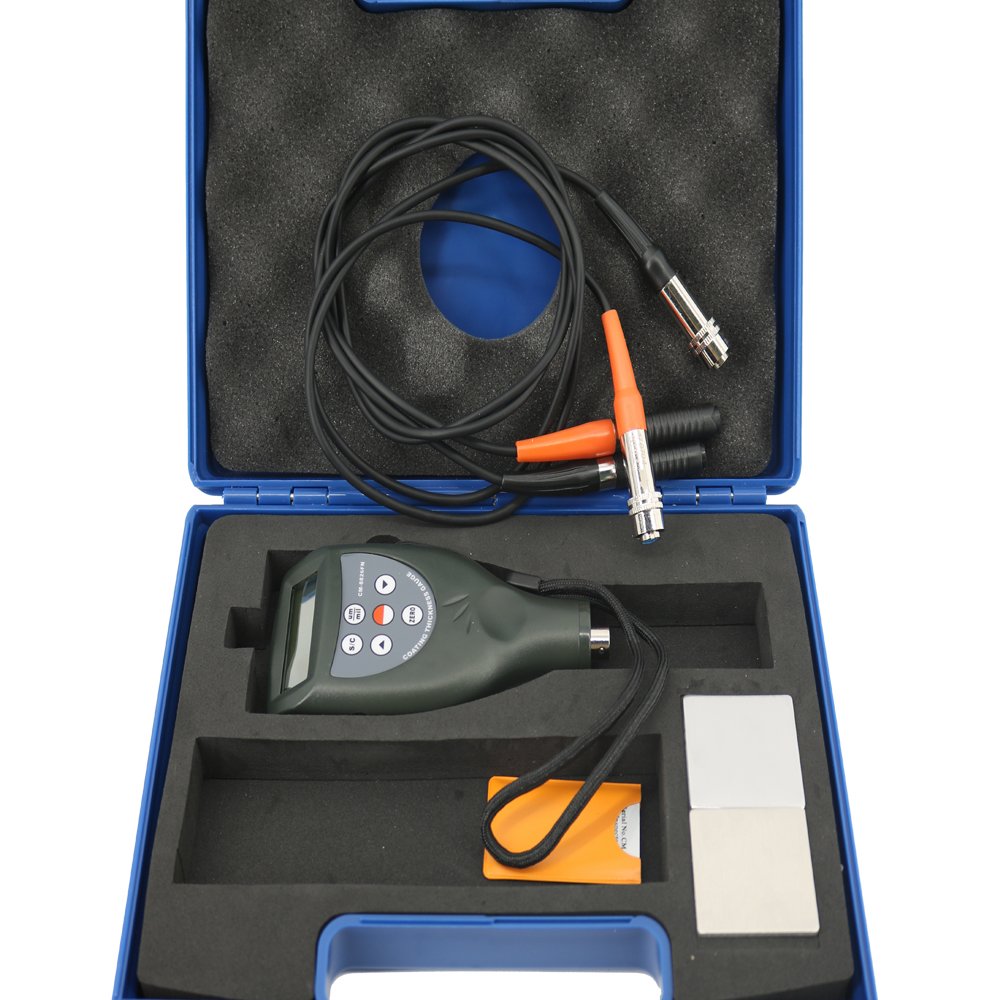
To check whether a used car has been repainted or has uneven coatings, it automatically recognizes the substrate so you don’t have to guess probes, which makes spot-checking fenders, doors and roofs fast.
It’s light enough to use one-handed at the curb, comes with calibration foils and a padded case, and the continuous mode is handy for curved panels. For pre-purchase checks and occasional deeper inspections, it’s a practical tool to carry with you.
DIY Guide
- Find a few reference spots: inside door jambs, under the hood, and behind the wheel arches.
- Turn the meter on, let it settle, and verify with a calibration foil before you start.
- Take at least three readings per panel (center and two edges) and use continuous mode when scanning curved areas.
- Compare readings across matching panels—big differences (e.g., 30–100 µm or more) can indicate respray or filler.
- Use both probe types as needed; the unit’s auto recognition helps, but be consistent with where you place the probe.
- Record your readings on your phone or a notepad so you can show them to the seller or a mechanic.

A, dependable work light that is compact and light enough to hold in one hand or hang with its built‑in hook, and the 90° rotating head makes it easy to aim at tight spots under the hood or inside wheel wells.
It’s not a blinding spotlight — the neutral white output is even and great for close work, so you can spot leaks, rust, interior damage or uneven paint without chasing hotspots. Because it runs off M18 batteries, it fits into the same system if you already own Milwaukee tools, and with a larger battery it can last through a full day of inspections.
DIY Guide
- Bring a charged M18 battery (and a spare if you can).
- Start with the engine bay: hang the light or prop it on the fender and angle the head to illuminate seams, hoses and the firewall.
- Use the rotating head to light up the underside of the car and wheel wells — look for rust, fresh undercoating, or wet spots.
- Scan door jambs, trunk hinges and rocker panels for paint differences or filler.
- Put the light inside the cabin to check dash surfaces, carpet edges and seat mounts for moisture or repairs.
- Shine across panels at a low angle to reveal dents or uneven paint.
- Keep your phone handy to take photos of any issues while they’re well lit.
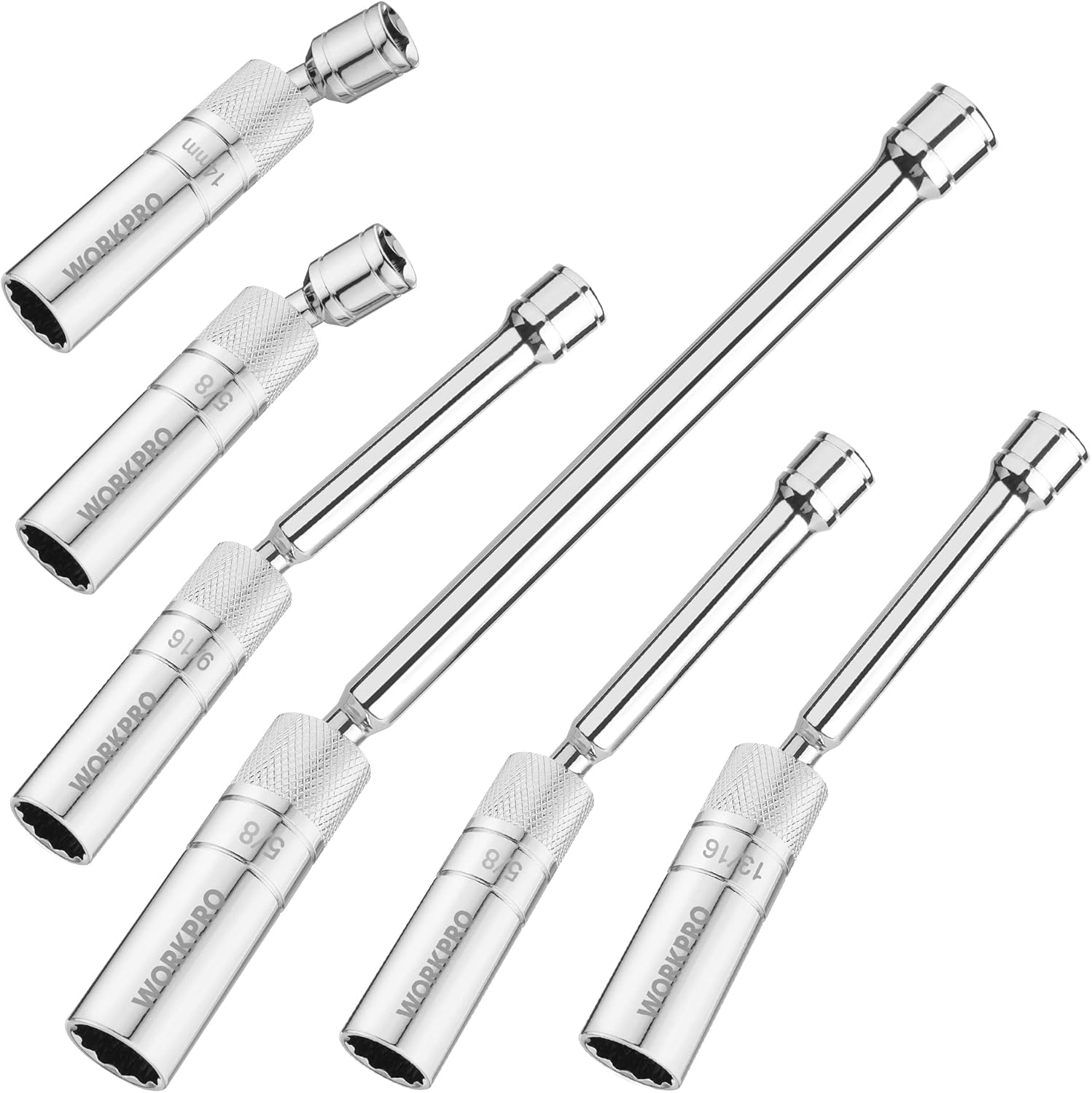
This compact WORKPRO 6‑pc set makes spark plug access a lot less annoying. The mix of 4, 6 and 11‑inch extensions gives you reach into recessed wells while the magnetic core holds the plug as you lift it out or lower a new one in.
The 360° swivel action and thin‑wall design help you work in cramped engine bays without fighting angles, and the chrome‑alloy finish cleans up easily after a messy job.
DIY Guide
- Confirm the correct plug size for the car and bring a rag, anti‑seize and a torque wrench if you have one.
- Disconnect the battery and remove any engine covers blocking access.
- Pick the socket size that matches the plug, attach an extension, and use the magnet to hold the plug while you loosen it.
- Pull the plug straight out on the extension to avoid breaking the porcelain.
- Inspect the plug for oil, carbon or unusual wear and compare readings across cylinders.
- Thread new plugs by hand first, then snug with the socket and finish to factory torque.
- Store the sockets and extensions together so you don’t lose pieces between inspections.
Used Car Inspection List (PPI Checklist)
PPI QUICK FORM
Seller: ___________________   VIN: ___________________   Odometer: ________  Date: _______

Paperwork:
- Title status: _______  |  Owner matches title? Y / N
- Service records: Y / N  |  Major receipts attached? Y / N
- Recall check done: Y / N

Exterior:
- Panels aligned: Y / N
- Paint overspray/panel repairs: Y / N
- Rust at sills/wheelarches/frame: Y / N
- Windshield chips/gps camera/camera calibration: Y / N
- Tires even wear + DOT: Y / N

Undercarriage:
- Frame damage/welds: Y / N
- Fluid leaks: oil / trans / coolant / diff / fuel
- Suspension play/noise: Y / N

Engine bay:
- Oil level & color OK: Y / N
- Coolant level & smell OK: Y / N
- Belts/hoses condition OK: Y / N
- Battery date & terminals OK: Y / N

Interior/Electronics:
- A/C & heat work: Y / N
- All lights / windows / seats / infotainment: Y / N
- Airbag light on? Y / N

Drivetrain:
- Cold start & idle OK: Y / N
- Transmission shifting & clunk free: Y / N
- AWD/4x4 engagement checked: Y / N

Test Drive (notes):
- Acceleration / hesitation: __________________
- Braking / pull / pulsation: __________________
- Highway stability / vibration: _______________
- Strange noises: _____________________________

OBD-II Scan:
- Codes found: _______________________________
- Pending codes: _____________________________

Inspector recommendation:
- Pass / Minor work estimate $______ / Major issues: _______
Inspector name & license: ______________________  Contact: ____________
Final checklist
Here’s a quick rundown of what you should do:
Pay the full price only if you get a clean report, a documented service history, and it matches the market value.
Walk away if you find any frame damage, flood history, salvage title, major engine leaks, or if the seller won’t let you do a pre-purchase inspection.
Bargain hard if the inspection shows minor stuff that needs fixing but isn’t a safety issue like brake pads, tires, or a few small leaks. You can ask for repair credits or try to get a lower price.
FAQs
What is a pre-purchase inspection (PPI)?
A PPI is a professional mechanical, electrical and road-test evaluation of a used car performed before purchase to identify safety issues, hidden damage, and impending repairs.
When should I get a PPI?
Always after a satisfactory test drive and before handing over a deposit or signing — never after purchase.
How much does a PPI cost?
Expect $150–$400 for a thorough independent shop PPI; mobile mechanics are usually $100–$250 and dealer checks are often less detailed.
What does a PPI check (quick list)?
Paperwork/VIN, frame & rust, engine & fluids, transmission, suspension, brakes, tires, electrics/OBD-II codes, undercarriage, and a multi-condition road test.
How long does a professional PPI take?
A full PPI usually takes 60–120 minutes; classics, EVs or detailed diagnostics can take longer.
Can I just do a DIY inspection instead of a pro PPI?
DIY is good for a quick filter, but a pro PPI uncovers structural, electronic, and drivetrain issues you’ll miss — use DIY only for cheap, low-risk buys or to prep for a pro inspection.
What should a PPI include for electric vehicles (EVs)?
Battery state-of-health (SOH) report, charging/port checks, inverter/thermal system inspection, high-voltage diagnostics and a range validation drive.
Which PPI findings should make me walk away?
Frame or structural repairs with poor documentation, flood or salvage brands on the title, odometer tampering, major engine or transmission failure, or seller refusal to allow a PPI.
Can I use the PPI report to negotiate the price?
Yes — use itemized repair estimates from the PPI as leverage for repair credits, a price reduction, or insist the seller performs the fixes before sale.
How do I pick a trustworthy PPI inspector or shop?
Choose ASE-certified techs, shops with good local reviews, a sample report, and experience with the vehicle type (European, classic, EV, exotic, rotary). Ask for references and a written repo
- Best Car Interior Cleaning Kits: Make Your Cabin Look New
- Which XV70 Camry Year Should You Buy? A Tested Guide

- Magnetic Phone Mounts & Mounts for Thick Cases: That Actually Work!

- Best Wireless CarPlay Adapters for Older Cars
- Best Seat Gap Fillers for Leather Seats
- The Most Underrated Cars — Hidden Gems You Should Actually Consider

*Disclaimer: This website provides automotive content for informational purposes only and should not be considered professional advice. While we strive for accuracy, we do not guarantee the reliability or suitability of any vehicle or product mentioned—always conduct your own research before making purchasing decisions. Additionally, some links on this site are affiliate links, meaning we may earn a commission if you make a purchase, at no extra cost to you.
**When you click on links we might get a small commission on purchases that qualify.